
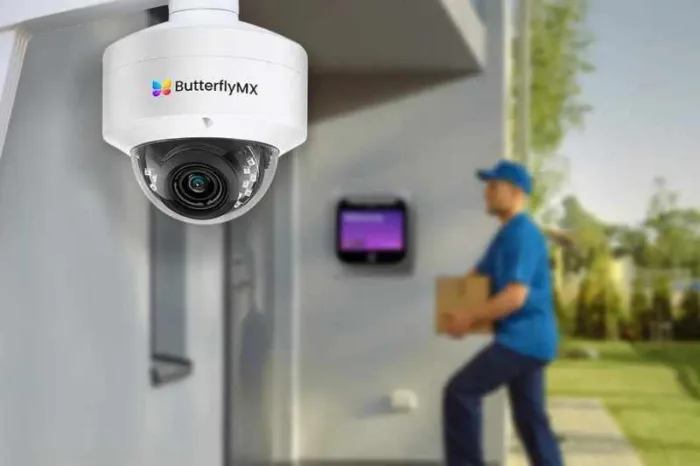





Key takeaways:
- The best security cameras for apartment complexes are planned by zone, with different commercial camera types used for entrances, parking areas, hallways, package spaces, and perimeters.
- A complete multifamily camera system includes more than cameras: it also needs video management, storage, network or PoE infrastructure, permissions, and an incident-review process.
- Common-area cameras, private-space restrictions, audio consent, federal procurement rules, and system compatibility should all be reviewed before choosing equipment.
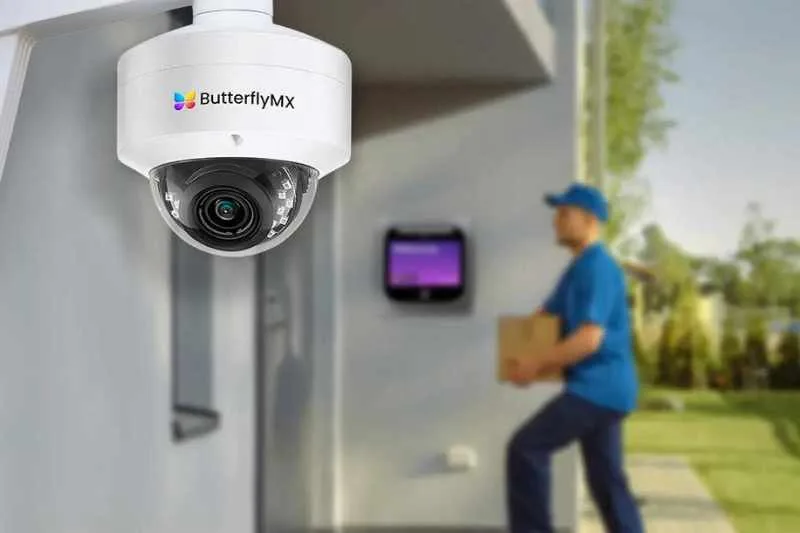
Security cameras for apartment complexes are not a one-camera decision. A property manager has to answer a harder question: What needs to be seen, where, by whom, and what happens after footage is captured?
The best approach is usually a professionally planned commercial security camera system that matches camera types to property zones. Entrances, parking areas, hallways, elevators, package rooms, amenities, and perimeters all create different viewing needs. The system also has to account for storage, network reliability, staff access, privacy rules, and the way your team reviews incidents.
This guide focuses on property-wide multifamily camera systems, not personal renter cameras. You’ll learn how to compare camera types, plan placement, understand major cost drivers, avoid legal and compliance mistakes, and decide when video is more useful alongside access events from entrances, gates, and package areas.
This guide will answer:
- What security camera system is best for an apartment complex?
- Camera types and best-fit zones
- What a complete camera system includes
- Where to install apartment complex cameras
- Privacy and legal boundaries
- NDAA compliance and restricted camera brands
- Cost drivers and total cost of ownership
- Security outcomes and evidence limits
- Camera integration with access control and intercoms
- Property manager buyer checklist
- FAQs
Watch how ButterflyMX works:
What security camera system is best for an apartment complex?
The best security camera system for an apartment complex is a scalable commercial system designed around the property’s zones, sightlines, storage needs, and response process. In practice, that means choosing cameras for specific jobs instead of buying one type of camera for every location.
A useful plan starts with five questions. Which areas need coverage? What level of detail does each area require? Can the property support wired Power over Ethernet, or PoE, connections? How long does footage need to be stored, and who can access it? Finally, should video be reviewed alongside access, visitor, vehicle, or package events?
That last question matters because camera footage often becomes more useful when it is tied to a real property event. A clip near a main entrance, for example, may be easier to review when staff also know that a visitor call, resident credential, gate entry, or package-room access event happened at the same time.
Personal renter devices, such as door cameras or indoor cameras, solve a different problem. They are controlled by residents, may be governed by lease terms and local rules, and should not be used as the model for a managed property-wide system. For a related overview of multifamily security camera systems, start with how coverage and daily operations fit together before comparing equipment.
Camera types and best-fit zones
Camera type should follow the viewing task. A lobby camera, a parking-lot camera, and a gate camera may all belong to the same system, but they should not be selected with the same assumptions. Sightlines, lighting, weather, distance, mounting options, and staff review needs all change the decision.
Dome, turret, bullet, PTZ, and panoramic cameras serve different coverage needs, as outlined in commercial apartment camera guidance. Fixed cameras are often better for continuous views of defined entrances or paths. PTZ cameras can help in broad areas when someone is actively controlling or monitoring the view, but they are not a replacement for fixed coverage where activity must be recorded all the time.
LPR cameras are even more specialized. They are designed for license plate recognition at controlled vehicle approaches, such as gates or parking entrances. They should not be treated as general parking-lot cameras because their usefulness depends on the angle, lighting, vehicle movement, and the property’s policy for collecting and using plate information.
Low-light performance, weather resistance, analytics, and image detail should be specified by zone. Don’t assume a feature label or resolution number guarantees identification at a certain distance. Mounting height, lens choice, obstructions, motion, lighting, and installation quality all affect what the camera can actually show.
What a complete camera system includes
Cameras are only the visible part of a multifamily surveillance system. A complete commercial setup also needs software, storage, network infrastructure, user permissions, and a process for finding and using footage when an incident occurs.
- A video management system, or VMS, organizes camera feeds, user roles, search tools, permissions, and video review.
- An NVR records video from IP cameras. A DVR is associated with systems that use traditional analog camera connections. Either can be part of local storage.
- Cloud-managed storage moves some recording and management functions to a hosted service. It may support remote administration, but bandwidth, subscription terms, retention, and outage planning still matter.
- PoE sends power and network connectivity to compatible IP cameras through Ethernet cabling. For many permanent multifamily installations, it can make power and network planning easier to manage than scattered wireless devices.
- Viewing tools, export procedures, cybersecurity controls, and a clear incident-review process determine whether footage is useful after it is recorded.
Cloud and local storage are different architecture choices, not a simple good-versus-bad comparison. Local hardware can give a property direct control over on-site recording equipment. Cloud services can make remote management easier. A hybrid approach may fit properties that need both local resilience and off-site access. Compare retention needs, bandwidth, maintenance, user permissions, export options, and ownership of stored video before choosing an approach.
Interoperability is another design issue. ONVIF is a vendor-neutral organization that publishes interoperability specifications for IP-based physical security products. ONVIF support can help buyers evaluate whether cameras and video management tools may work together, but it is not a guarantee that every feature will function across every camera, VMS, and integration. Ask vendors to confirm the relevant profiles and test the features your team expects to use.
Where to install apartment complex cameras
Apartment complex cameras should be placed where they support a clear coverage or incident-review need. Camera count should follow entrances, risk zones, sightlines, overlap needs, and layout, not unit count alone.
Start with a site assessment. The installer or security consultant should look at blind spots, lighting, mounting locations, cabling paths, weather exposure, bandwidth, and privacy boundaries before finalizing a plan.
- Main entrances, secondary doors, gates, and visitor-entry points: Cover arrival and access activity without aiming into private units.
- Parking lots, garages, drive lanes, and controlled vehicle approaches: Decide whether the goal is general area coverage, vehicle event review, or specialized LPR at a controlled point.
- Hallways, elevators, stairwells, and circulation routes: Review sightlines carefully, especially where an open unit door or window could create a privacy issue.
- Mailrooms, package rooms, lobbies, amenity spaces, and service areas: Prioritize places where staff may need to verify a delivery, review damage, or reconstruct an incident timeline.
- Perimeters and exterior amenity areas: Account for landscaping, lighting, weather, and the practical limits of a camera view.
Property style changes the plan. A high-rise may concentrate coverage around the lobby, elevators, amenity floors, and package operations. A garden-style community may need more attention to distributed building entrances, exterior walkways, parking, and perimeter approaches. Gated, mixed-use, student housing, and senior living properties each have different visitor patterns, vehicle activity, staffing needs, and resident expectations.
Privacy and legal boundaries
Security cameras may generally be used in apartment common areas, but they should not be installed in units, bathrooms, or similar places where residents have a reasonable expectation of privacy. Common areas and private spaces are treated differently, but that broad distinction does not answer every legal question.
Local and state rules can affect video notice, signage, footage access, retention, employee monitoring, resident policies, and where cameras may point. Tenant privacy guidance also notes that audio recording can raise consent issues separate from video recording. In other words, permission to record video in a common area does not automatically settle whether sound should be captured.
Before installation, have qualified local legal or compliance reviewers assess camera locations, audio settings, notice practices, retention policies, and procedures for footage requests. On the operations side, limit footage access to authorized roles, document review practices where appropriate, and create a consistent process for incident review and exports. The goal is to document shared spaces, not to create unnecessary surveillance of residents’ private lives.
NDAA compliance and restricted camera brands
NDAA and FCC restrictions do not create a blanket ban on every named camera brand at every private apartment property. Their relevance is strongest when a project is federally funded, federally assisted, federally financed, contract-connected, or otherwise subject to specific federal procurement requirements.
The FCC Covered List is the authoritative reference for currently covered communications and surveillance equipment and services. The federal guidance described in the supplied research concerns specified public-safety, government-facility, and critical-infrastructure uses. It includes surveillance equipment from named entities such as Hikvision and Dahua in the applicable Covered List context.
That does not mean a private market-rate apartment community should treat the list as a universal private-use prohibition. It does mean owners and managers should document funding sources, contract clauses, owner policies, and applicable requirements before selecting equipment. Because the list and procurement obligations can change, verify current information at publication and again before contracting.
Cost drivers and total cost of ownership
There is no reliable universal price for an apartment complex camera system because the scope changes from property to property. A small building with existing cabling is a different project from a garden-style community that needs exterior trenching, more network work, and cameras across many separate buildings.
For budgeting, don’t use consumer-camera prices as a stand-in for a commercial multifamily system. Ask vendors to separate one-time infrastructure and installation costs from recurring software, storage, monitoring, maintenance, and support costs.
- Camera quantity, form factor, lenses, mounts, enclosures, weather protection, low-light needs, and specialized devices such as LPR cameras.
- Cabling, PoE switches, network upgrades, power work, trenching, lifts, mounting complexity, and installation labor.
- Local recording hardware or cloud storage, including bandwidth, retention settings, and subscription charges.
- VMS licensing, analytics, user management, remote access, monitoring or remote guarding, and cybersecurity administration.
- Maintenance, replacements, warranties, training, support, and future expansion.
Existing infrastructure can materially change a quote. So can the property layout, the number of priority zones, the desired retention period, and whether the camera plan is being coordinated with access control, intercoms, vehicle access, or package-room projects. A phased deployment may make sense when the property has clear priority areas or needs to schedule work around other upgrades.
When you request proposals, ask each vendor to list assumptions, exclusions, recurring charges, retention capacity, integration scope, and who is responsible for ongoing maintenance. A lower upfront price may be less useful if it leaves out network upgrades, storage needs, licensing, or support.
Security outcomes and evidence limits
Security cameras may contribute to deterrence and can support a broader property security program, but they should not be presented as a guaranteed way to reduce crime at an apartment complex. The available material here supports a more careful claim: cameras can help document events, but placement, image quality, retention, maintenance, and response procedures determine how useful that documentation is.
The practical value often appears after something happens. Staff may need to review a timeline, investigate a dispute, verify a delivery, check a vehicle event, or provide a record from a defined common area. In those moments, a working camera with the right view and the right retention policy is far more useful than a camera that was installed without a clear purpose.
Cameras are also only one layer. Access policies, locks, lighting, staffing, resident communication, and property procedures all shape how a community manages risk. Treat video as part of that larger plan, not as a stand-alone promise.
Camera integration with access control and intercoms
Standalone footage shows what happened in view of a camera. Access events can add context about a controlled point, time, credential, visitor call, vehicle entry, or package-room activity. When those records are designed to be reviewed together, staff spend less time piecing together separate logs and clips.
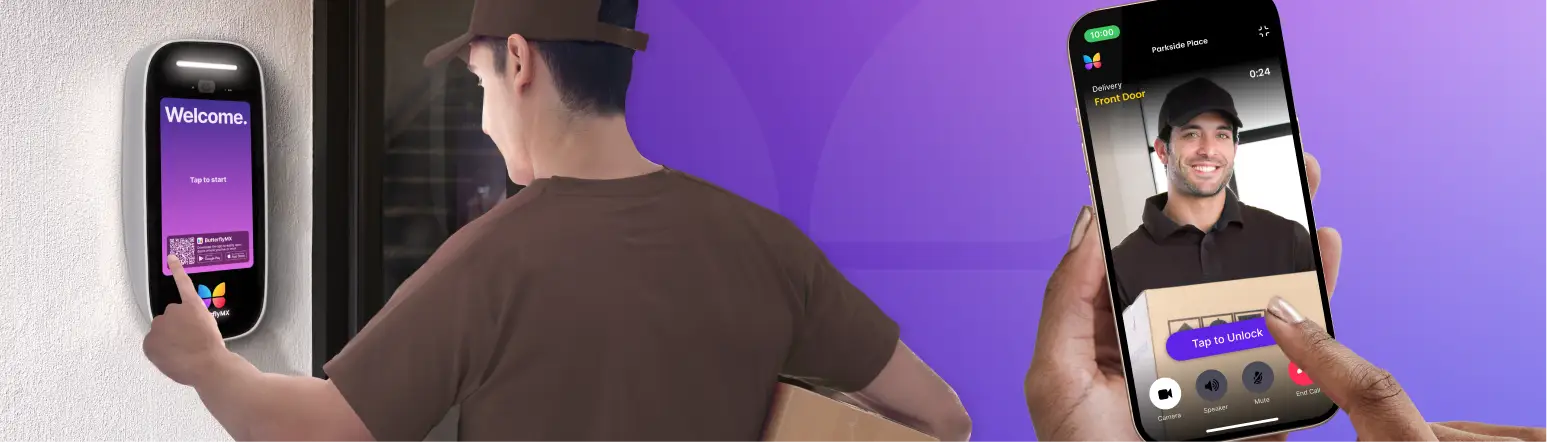
At a visitor entrance, a video intercom supports communication and the entry decision. Nearby surveillance cameras can cover the surrounding approach, lobby, or door area. ButterflyMX video intercoms let residents receive visitor calls and grant access from their smartphones, while property teams can remotely manage residents, visitors, credentials, and access. That makes ButterflyMX relevant for properties that need visitor entry and access management in addition to camera coverage.
The same logic can apply beyond the front door. Vehicle access and LPR may matter at gated or controlled parking entrances. Package-room access and nearby camera coverage can support delivery verification. These examples describe the planning value of connecting video with property events; buyers should confirm exact integrations, timestamp alignment, permissions, exports, compatibility, and data ownership with each vendor before making a purchase.
Property manager buyer checklist
Use this checklist to turn a broad security goal into a vendor-ready scope. The more specific your requirements are, the easier it is to compare proposals fairly.
- Map priority zones, incident types, sightlines, lighting, weather conditions, privacy boundaries, and future expansion needs.
- Define the image and review task for each camera location instead of applying one property-wide specification.
- Request details on cameras, network design, PoE capacity, storage, VMS functions, retention, user roles, remote access, exports, cybersecurity, and support.
- Compare local, cloud, and hybrid storage by bandwidth, maintenance, resilience, retention, and recurring cost.
- Verify ONVIF profiles and feature-level compatibility rather than relying on a generic compatibility claim.
- Review installation plans, warranties, monitoring options, licensing, maintenance, replacement processes, and total cost over time.
- Confirm local privacy policies, audio settings, notice requirements, footage-request procedures, funding obligations, and current Covered List considerations before contracting.
- Identify where camera coverage should be coordinated with visitor entry, resident access, vehicle access, or package workflows.
A strong scope helps vendors design around the property you actually manage. It also helps your team decide whether an integrated ButterflyMX property-access approach belongs in the plan for entrances, visitors, vehicles, or packages.
Frequently asked questions
How many cameras does an apartment complex need?
An apartment complex needs enough cameras to cover priority entrances, risk zones, sightlines, and incident-review needs. Unit count alone is not a reliable formula, so use a site assessment to identify blind spots, lighting issues, overlap, and the level of detail required in each area.
Should apartment security cameras use cloud or local storage?
Apartment security cameras can use cloud, local, or hybrid storage depending on the property’s needs. Compare remote access, bandwidth, subscriptions, hardware control, resilience, retention, maintenance, user permissions, and export options before choosing an architecture.
Are wired cameras better than wireless cameras for multifamily properties?
Wired PoE cameras are often a practical choice for permanent multifamily installations because compatible cameras receive power and network connectivity through Ethernet cabling. Wireless cameras may have limited retrofit uses, but reliability, bandwidth, power, and management needs should be evaluated location by location.
What is the difference between video surveillance and a video intercom?
Video surveillance records or monitors an area, while a video intercom supports visitor communication and entry decisions. Used with access control, these systems can give staff more context around activity at controlled entrances.
The right camera system for an apartment complex is the one designed around the property’s actual zones, infrastructure, privacy obligations, storage needs, and incident-review process. Start with what the property needs to see and why, then evaluate camera hardware, VMS and storage architecture, compatibility, installation scope, and total cost as one connected decision.
If your camera plan also involves visitor entry, resident credentials, vehicle access, or package workflows, ButterflyMX can help you think through the property access side of the project. Discuss your property access and security requirements with ButterflyMX and get a free quote for a property access solution.
Get your free quote!
Fill in the form below, and we'll email you right back.
Want a free quote?
Fill in the form below, and we'll email you right back.
You’ll be redirected shortly...