
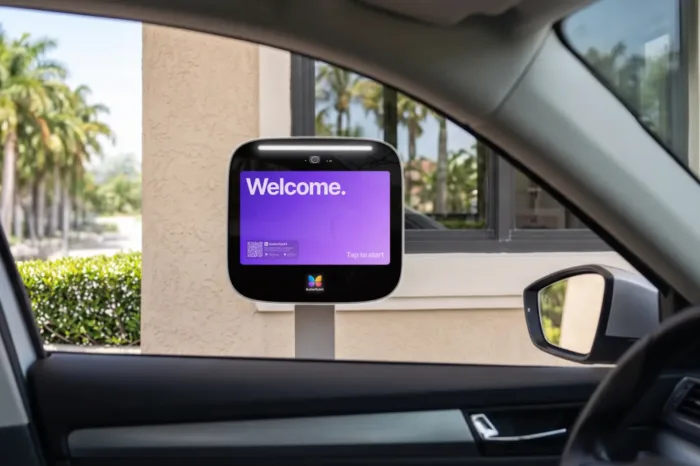





Key takeaways:
- DOOR Intercom is an audio-first entrance intercom with four directory buttons; video requires a separate $499 Camera and remains one-way.
- The current official hardware price is $3,999, before software, installation, and optional equipment such as the Camera or $899 R2 reader.
- Flexible network, calling, and power options suit varied properties, but buyers should test app workflows and ask about recurring costs and capacity limits.
Disclaimer: ButterflyMX provides these blog posts to help our customers and potential customers make the right business decisions. Our blog posts are based on the information available to us at the time of writing.
This DOOR Intercom review covers the smart entrance system formerly sold as Latch Intercom. It is aimed at multifamily and student-housing teams considering directory calling, remote entry, front-desk workflows, and the wider DOOR access ecosystem.
The key questions are simple: What comes with the base unit? Does it include video? What will a full deployment cost? And how does the resident app perform in daily use? This review answers those questions, then covers technical requirements, property fit, video intercom system for apartments alternatives, and ButterflyMX.
This guide will answer:
- What is the DOOR Intercom?
- How does the DOOR Intercom work?
- DOOR Intercom features and ecosystem hardware
- How much does the DOOR Intercom cost?
- Connectivity, power, and installation requirements
- DOOR App ratings and customer feedback
- DOOR Intercom pros and cons
- Is the DOOR Intercom a good fit for your property?
- DOOR Intercom alternatives
- DOOR Intercom vs. ButterflyMX
- Frequently asked questions
- Final verdict on DOOR Intercom
Watch how ButterflyMX works:
What is the DOOR Intercom?
DOOR Intercom is an audio-first directory intercom for multifamily and student-housing entrances. Mounted on a wall or pedestal, it lets visitors call a resident, leasing office, or front desk so someone can grant entry remotely.
The DOOR Intercom product page describes a 7-inch non-touch display with four tactile buttons. Residents and staff can answer through the DOOR App or by phone.
The product was previously called Latch Intercom. Latch adopted the DOOR brand in August 2025, while public filings still identify the legal entity as Latch, Inc. That change explains why older Latch pages, app listings, reviews, and prices still appear in buyer searches.
Who is the DOOR Intercom designed for?
DOOR Intercom is mainly for multifamily and student-housing properties with a managed entrance. It may also fit some gated communities that need directory-based visitor calls.
It works best when a resident, office team, or front desk is available to answer calls and release the door. Listed uses include visitor entry, delivery access, staff calling, and remote unlocking.
How does the DOOR Intercom work?
A visitor uses the tactile buttons to find a directory entry and place an audio call. The call can go to the DOOR App or any U.S. phone number, including a landline, and the recipient decides whether to unlock the entrance.
- The visitor selects a resident, leasing office, or front desk on the display.
- DOOR Intercom places an audio call to the selected app user or phone number.
- The resident or staff member answers and can grant entry remotely.
- If the property adds a DOOR Camera, the person answering can view the visitor through one-way video.
This calling approach can help properties serve residents who do not use smartphones. DOOR Concierge Pro also supports package and delivery workflows tied to the entrance system.
Buyers building a broader entry plan can compare these workflows with ButterflyMX, which supports visitor access, mobile access, and package rooms. The best fit depends on how a property wants to connect resident, visitor, and delivery access.
Does the DOOR Intercom include video?
No. The base DOOR Intercom has no built-in camera. A separate DOOR Camera adds one-way video: residents or staff can see the visitor, but the visitor cannot see them.
The Camera is listed at $499 in the DOOR shop. One-way video can help with visitor screening, but it creates a different experience from a two-way video intercom. Buyers who want a video-first workflow can also compare ButterflyMX video intercoms.
What does the button-only interface mean for visitors?
DOOR uses four physical buttons instead of a touchscreen. The company positions this design as easier for delivery drivers and other visitors who may struggle with touchscreens.
The tradeoff is directory navigation. A four-button interface may be simple at a smaller property, but it could take longer to scroll through a large directory. DOOR does not publicly state directory, resident, or credential capacity limits for the Intercom, so larger communities should request those details and see a live directory demonstration.
DOOR Intercom features and ecosystem hardware
DOOR Intercom combines directory calling, remote unlocks, several connectivity choices, and weather-resistant entrance hardware. Video and wider credential access require separate components, not the base Intercom alone.
Video, audio, and visitor calling
The DOOR Intercom specifications list a 7-inch, 1,000-nit display with a 176-degree viewing angle. The unit also has dual microphones, echo cancellation, noise reduction, automatic volume adjustment, and volume up to 90 dB.
Those details matter at bright or noisy entrances. Still, teams should test the proposed mounting height, sun exposure, street noise, directory size, and cellular coverage at their own site.
DOOR ecosystem hardware
The Intercom handles visitor calling at the entrance. Other DOOR products extend the deployment into video, credential access, and secondary-door workflows.
The R2 Smart Reader supports app, NFC, Apple Watch, keycard, and Doorcode credentials. It is a separate reader, not an included Intercom function. DOOR describes DOOR Link as a QR-based option for access points that do not need visitor calling.
The modular design lets properties select hardware by entrance, but it also makes a full access map essential. Identify each pedestrian door, garage, elevator, amenity, and delivery area before comparing project budgets. ButterflyMX also supports video intercoms, access control, mobile access, vehicle access control, and elevator controls.
Management and property software integrations
DOOR OS provides centralized management for entry points, schedules, intercom calls, and access events. DOOR also lists API integrations with Yardi, RealPage, Entrata, and AppFolio on its building intelligence platform.
These connections may help teams align access operations with property-management processes. Ask what data moves between systems, which functions require additional software, and whether implementation or recurring fees apply.
How much does the DOOR Intercom cost?
The current official DOOR Intercom hardware price is $3,999. A complete system can cost more once a property adds video, broader access control, software, installation, and other components.
As of September 2026, the official DOOR shop lists the Intercom at $3,999, the Camera at $499, the R2 Smart Reader at $899, and an R2 plus Retrofit Kit bundle at $1,499.99. DOOR Link pricing is not publicly listed.
A February 2025 Latch-era review cited a $2,799.30 Intercom price and separate monthly fees for software, property-management integration, and Concierge Pro. Those figures predate the August 2025 DOOR rebrand, so they are historical context rather than a current offer.
DOOR does not publicly list current subscription or installation pricing. Ask for a proposal that separates one-time hardware and labor from per-door, per-unit, platform, support, and optional-service charges.
What should buyers include in a total-cost estimate?
A useful DOOR Intercom budget covers the hardware and services required for the whole property plan, not only the $3,999 entrance device.
- Intercom units for each visitor entrance
- Camera accessories where one-way video is needed
- R2 readers and retrofit equipment for other controlled locations
- DOOR Link devices for suitable QR-based entrances
- Mounting, electrical, network, and installation labor
- Software, property-management integration, and delivery-service charges
- Support, replacement, and contract-term requirements
Ask whether taxes, shipping, cellular service, training, and ongoing support appear as separate line items. The public pricing listed here does not state whether they are included.
Connectivity, power, and installation requirements
DOOR Intercom supports Ethernet, dual-band WiFi, Category 1 cellular, and two power options. Cloud and app features need internet access, so facilities and IT teams should plan for both the primary connection and a backup approach.
These details come from the DOOR technical datasheet. PoE 802.3bt needs more power than basic PoE, so teams should check switch compatibility and available power per port.
The 24VDC two-wire option may help where suitable wiring already exists. Either option still requires a review of network quality, mounting conditions, door-release hardware, local codes, and the route between the entrance and control equipment.
Compliance and specification considerations
The DOOR datasheet lists FCC Part 15B/C and Part 24, IC RSS, UL 62368-1, UL 294, and ADA compliance. Procurement teams should compare these listings with the requirements of the project, jurisdiction, and access-control design.
The surface-mounted unit is IP65-rated and uses Gorilla Glass 3 with anti-reflection and anti-fingerprint treatments. For exposed entries, review the mounting location, weather exposure, temperature conditions, and enclosure needs with the installer.
DOOR App ratings and customer feedback
The DOOR App has strong aggregate ratings, but detailed reviews and independent coverage also describe unlock delays, failed attempts, crashes, and Bluetooth problems. Buyers should weigh both the ratings and the daily workflows users describe.
When captured for this review, the legacy-branded Apple App Store listing showed a 4.7 out of 5 rating. Google Play showed 4.3 out of 5 from 16,569 ratings. Positive themes include remote unlocking and Apple Watch access.
Detailed user reviews and independent coverage of resident experiences also mention slow or failed unlocks, app crashes, and Bluetooth issues. These are user-reported experiences, not controlled performance results, and may not represent every property or configuration.
Before rollout, ask for a live test using the proposed entry hardware, resident phones, building materials, Bluetooth conditions, WiFi coverage, and cellular environment. A small pilot can reveal more about everyday use than an average star score alone.
DOOR Intercom pros and cons
DOOR Intercom offers flexible calling, network, and power choices in durable entrance hardware. The main tradeoffs are optional one-way video, layered costs, recurring app complaints, and unpublished scale limits.
Pros
- Multiple connection options: Ethernet, WiFi, and cellular give teams several deployment paths.
- Landline-compatible calling: The system can call any U.S. phone number, so residents do not need a smartphone to answer visitors.
- Durable, accessible hardware: The Intercom is IP65-rated and listed as ADA compliant.
- Property software integrations: DOOR lists Yardi, RealPage, Entrata, and AppFolio connections through its platform.
- Modular expansion: Properties can add Camera, R2, or Link hardware by entrance and access need.
- Physical directory controls: Tactile buttons provide an alternative to a touchscreen for delivery users and other visitors.
Cons
- Video is not built in: The $499 Camera is required, and its video remains one-way.
- The full price is not public: Software, installation, DOOR Link, and some ongoing costs require a proposal.
- App feedback is mixed: Strong averages coexist with repeated reports of unlock delays, failed attempts, crashes, and Bluetooth trouble.
- Directory scale is unclear: DOOR does not publicly state directory, resident, or credential capacity for the Intercom.
- Broader access needs more hardware: Other doors, elevators, garages, and amenities use the separate R2 reader.
- Long directories may take more scrolling: Properties with many residents should test the visitor experience before purchase.
Is the DOOR Intercom a good fit for your property?
DOOR Intercom may fit properties that value tactile directory calling, landline support, flexible connectivity, and modular DOOR hardware. It deserves closer comparison if built-in two-way video, fully public pricing, predictable app performance, or known directory scale are top priorities.
The product may belong on your shortlist if your property:
- Needs visitors to call residents, staff, a leasing office, or a front desk
- Wants residents to answer through regular phone numbers
- Can benefit from Ethernet, WiFi, or cellular options
- Prefers physical navigation buttons over a touchscreen
- Plans to use DOOR hardware beyond the main entrance
- Can accept one-way video or does not require visitor video
Compare more options if your property needs a built-in camera, two-way video communication, a simple all-in budget, or published capacity figures before beginning a sales process.
Vendor considerations
Long-term access agreements also call for vendor due diligence. A Latch, Inc. SEC filing discusses a prior accounting investigation and restatement, ongoing litigation, and about $34.6 million in unrestricted cash as of December 31, 2025.
These disclosures do not determine product performance or company solvency. They are relevant to buyers evaluating support continuity, contract exposure, financial position, and long-term platform risk.
Questions to ask before requesting a proposal
- Does our property need two-way video, or is one-way video enough?
- How many Intercoms, Cameras, R2 readers, Link devices, and retrofit kits are required?
- What are the current software, cellular, integration, support, and installation charges?
- What contract term, renewal process, and cancellation terms apply?
- What are the directory, resident, device, and credential limits?
- How will the four-button directory work with our number of residents?
- Can existing wiring support 24VDC, or is PoE 802.3bt equipment needed?
- How will Ethernet, WiFi, and cellular perform at each entrance?
- Which functions continue during an internet, power, or cellular interruption?
- Can residents and staff test calls and unlocks on their own devices before rollout?
DOOR Intercom alternatives
Relevant DOOR Intercom alternatives include ButterflyMX, Swiftlane, Aiphone, and 2N. DOOR Link is another option in the same ecosystem, but it serves a narrower QR-entry use case rather than replacing an entrance intercom in every situation.
- ButterflyMX: Consider it when comparing video intercoms with mobile and visitor access, access control, vehicle access, elevator controls, package rooms, security cameras, and smart lock integrations.
- Swiftlane: This option may appeal to buyers prioritizing a video-intercom approach and facial recognition.
- Aiphone: Aiphone offers traditional video and audio intercom options.
- 2N: 2N is relevant for commercial buyers considering modern IP- and SIP-oriented intercom deployments.
- DOOR Link: This QR-based product may fit secondary doors where visitors do not need audio or video calling.
Compare more than the entrance screen. Map the visitor conversation, resident credentials, staff tools, deliveries, elevators, garages, side doors, unit access, and property software before creating a shortlist.
DOOR Intercom vs. ButterflyMX
DOOR Intercom is an audio-first entrance product with optional one-way video and separate R2 hardware for broader access control. ButterflyMX offers video intercoms within a wider property access and security platform.
Neither approach is right for every property. DOOR may appeal to teams that value landline-compatible, button-based calling and modular DOOR hardware. ButterflyMX may be relevant when two-way visitor video and a broader group of access and security products need to work together.
Frequently asked questions
Does the DOOR Intercom include a camera?
No. The base Intercom has no camera; a separate $499 Camera adds one-way video so residents or staff can see visitors, but visitors cannot see them.
How much does the DOOR Intercom cost?
The current official hardware price is $3,999. The Camera costs $499, the R2 reader costs $899, and software and installation require a quote.
Are there recurring DOOR Intercom fees?
Current official recurring charges are not publicly listed. Older monthly figures come from the Latch era and should not be treated as current DOOR pricing.
Does the DOOR Intercom require internet access?
Yes. Internet access is needed for cloud and app functions, and the Intercom supports Ethernet, dual-band WiFi, and Category 1 cellular.
Can the DOOR Intercom call a landline?
Yes. DOOR Intercom can call any U.S. phone number, including a landline.
How is the DOOR Intercom powered?
It supports 24VDC two-wire power or PoE 802.3bt at 50W or more. Typical consumption is 20W, and maximum consumption is 50W.
Is DOOR the same company as Latch?
Yes. Latch adopted the DOOR brand in August 2025, while the legal entity remains Latch, Inc.
What other hardware may a property need?
The Camera adds one-way video, R2 provides credential access at other locations, DOOR Link supports QR entry, and Fanvil i10d provides compatible in-unit PBX call handling.
What are the main DOOR Intercom alternatives?
Common comparison options include ButterflyMX, Swiftlane, Aiphone, and 2N. Compare visitor video, resident workflows, property-wide access scope, infrastructure, and total cost.
Final verdict on DOOR Intercom
DOOR Intercom may suit multifamily and student-housing properties that want tactile directory calling, landline support, flexible connectivity, and a modular path into the wider DOOR ecosystem.
The most important tradeoff is video: the $3,999 base unit is audio-first, while the separate $499 Camera provides one-way rather than two-way video. Request complete recurring and installation pricing, test resident app workflows, and ask for directory and credential limits before signing.
Compare DOOR with other shortlisted products using your full entrance, delivery, elevator, garage, and resident-access plan. If your property wants two-way visitor video within a broader access and security platform, consider ButterflyMX and request a demo.
Get your free quote!
Fill in the form below, and we'll email you right back.
Want a free quote?
Fill in the form below, and we'll email you right back.
You’ll be redirected shortly...