






Key takeaways:
- A small commercial office intercom should match your entrances, visitor volume, answering coverage, door hardware, network readiness, integrations, and budget.
- Video and mobile answering can help lightly staffed offices verify visitors remotely, while audio-only systems may fit controlled, low-traffic entrances.
- Door release can affect egress, power loss, fire-alarm interfaces, UL 294 equipment, and ADA reach ranges, so review each opening before buying.

A small commercial office building usually does not need an enterprise-sized security project to manage the front door. But it does need a system that fits the way visitors, deliveries, tenants, and employees actually arrive.
The best intercom system for a small commercial office building is a right-sized setup that matches the number of entrances, who answers calls, the existing door hardware, the network, the need for video verification, and the budget for installation and support. Lightly staffed offices often benefit from video and mobile answering, while a controlled, low-traffic entrance may only need a simpler audio or fixed-endpoint system.
An business entry intercom connects an entrance station with a desk, in-building, or smartphone answering endpoint. Staff can speak with a visitor, verify why they are there, and, when the system is connected to compatible door hardware, release the door. This guide focuses on visitor entry, not internal staff-to-staff communication, which may require a separate system.
This guide will answer:
- What a small commercial office intercom system does
- How a small office intercom system works
- How small offices can compare intercom types
- How to choose the right system for the building
- What shapes the total cost
- How to assess the site, network, and door hardware
- How to address safety and accessibility
- How to plan integrations, outages, and ongoing ownership
- When mobile video entry fits a small office
- FAQs
Watch how ButterflyMX works:
What a small commercial office intercom system does
A commercial entry intercom is built around a simple moment: someone is at the door, and an authorized person needs enough information to decide whether to let them in. In a small office, that person may be a receptionist, office manager, tenant contact, facilities lead, or designated employee answering from a smartphone.
That makes an intercom different from standalone access control. Access control usually centers on credentials and permissions, such as who can enter with an authorized method. An intercom centers on communication with a visitor. It is also different from a consumer video doorbell, which is designed mainly for residential convenience rather than commercial directories, call routing, tenant access, and shared entry responsibilities.
The right small office intercom system is not the one with the most features. It is the one that can route calls to the right people, work with the actual door and lock, and support the building’s visitor patterns without creating problems during outages, emergencies, or daily administration.
Keep visitor entry separate from internal communication. Some offices still need a way for employees to speak with one another across a larger floor plan or separate work areas. A front-door intercom may not solve that need, even if both products use the word intercom.
How a small office intercom system works
Most office intercoms use some version of a base station and substation arrangement. In modern entry systems, the entrance station at the door handles the visitor side of the call. The answering endpoint may be at a front desk, inside the building, or on a supported smartphone.
A small office intercom commonly works in four steps:
- A visitor uses the entrance station to place a call.
- A receptionist, employee, tenant, or designated mobile user answers and verifies the visitor by audio, video, or both.
- If access is appropriate, an authorized user activates a door-release relay connected to compatible locking hardware.
- Supported systems may record activity or retain event information for later review.
The core pieces are the entrance station, answering endpoint, management software where applicable, relay, power and network connections, and a compatible lock. Door release often uses a relay connected to an electric strike or magnetic lock. That does not make lock compatibility a simple checkbox. Power supply, request-to-exit devices, fire-alarm interfaces, egress behavior, existing access-control equipment, and local code can all affect the final design.
Calls can route to a staffed desk, a tenant destination, a shared answering group, or a supported mobile endpoint, depending on the system. Not every intercom includes video, mobile answering, remote unlocking, or activity records, so list the functions you actually need before vendors start quoting features.
How small offices can compare intercom types
Intercom categories are easier to compare when you treat them as separate decisions. Audio versus video, wired versus wireless connectivity, answering endpoint, and management model can be combined in different ways. A small office might choose a video IP intercom with mobile answering, or it might choose a simpler audio system with a fixed answering station.
Video is worth evaluating when visual verification changes the access decision or helps staff answer from somewhere other than the entrance. Audio can be enough for a controlled, very low-traffic entry where a voice conversation provides the needed context. Either way, decide who answers, what happens when that person misses the call, and whether visitors need a fallback path.
Wired and wireless also need careful wording. Wireless connectivity does not mean the installation is wiring-free. The entrance device may still need power, and door release can still require a relay, lock connection, mounting work, and code-related review. Cloud-managed systems can be convenient for remote access management, but buyers should ask what still works if internet service is interrupted.
For broader category education beyond a small-office deployment, see ButterflyMX’s commercial intercom system guide.
How to choose the right system for the building
Before asking for quotes, turn the building’s needs into a short requirements brief. It gives every vendor the same facts and keeps the conversation focused on fit instead of feature lists.
- List every entrance, tenant or suite destination, answering destination, and person who needs management access.
- Document visitor and delivery volume, reception coverage, mobile-answering needs, call-routing rules, escalation contacts, and whether video would change access decisions.
- Record the existing door, lock, power supply, wiring, conduit, Ethernet, PoE capacity, wireless conditions where relevant, and current access-control equipment.
- Identify required connections to access control, visitor management, smart locks, directories, or other property workflows. Ask vendors to document supported integrations rather than assuming compatibility from product labels.
- Separate entry-intercom needs from any staff-to-staff communication requirement.
- Require each proposal to state door behavior during an outage, local unlock and exit methods, backup-power assumptions, code-review responsibilities, training, and ongoing support ownership.
Two common small-office scenarios
A lightly staffed office with one public entrance may prioritize video, defined mobile answering groups, and a documented fallback procedure for missed calls. An office with a consistently staffed desk and limited visitor traffic may find a simpler fixed-endpoint system adequate. Those are starting points, not rules. The existing door, lock, network, and code review still decide what can be installed safely.
What shapes the total cost
There is no independently verified universal price for a small-office intercom installation. Quotes vary because small offices can be very different from one another: one may have a single prepared entrance, while another may need new wiring, lock work, network changes, and multiple answering destinations.
The main cost drivers are usually:
- Entrance hardware, including the intercom station and any required mounting work.
- Answering endpoints, directories, software, or mobile access features.
- Video requirements, including camera placement, connectivity, and recording policies where applicable.
- Locks, relays, power supplies, request-to-exit devices, and related door hardware.
- Cable routes, conduit, Ethernet, PoE capacity, Wi-Fi conditions, and electrical work.
- Installation labor, permits or reviews where applicable, integrations, training, warranty, support, and recurring software or service charges.
Vendor-published pricing ranges, including examples in Swiftlane’s office intercom buying guide, should be treated as illustrative vendor estimates rather than industry benchmarks. Labor, equipment, subscription pricing, wiring condition, and location can all change the final quote.
Compare like-for-like scopes
Ask each vendor to separate entrance hardware, door hardware, electrical work, network work, installation labor, software or subscription charges, warranty, training, support, and excluded items. Total cost of ownership also includes the staff time to maintain user lists and directories, remove credentials when people leave, test the system, and coordinate future repairs or replacements.
How to assess the site, network, and door hardware
A site survey is where a preferred system meets the actual building. Do it before the final product decision, especially when the project involves electric locking hardware, access control, or an egress door.
For each controlled opening, document the door and frame, existing electric strike or magnetic lock, power supply, request-to-exit devices, relay path, and current access-control equipment. The installer also needs to assess cable routes, conduit, Ethernet availability, PoE capacity, internet service, electrical power, equipment locations, and wireless coverage if wireless connectivity is proposed.
Power over Ethernet can supply power and network connectivity to compatible intercom equipment through Ethernet cabling. It does not automatically solve lock power, relay wiring, fire-alarm interfaces, or life-safety requirements. A qualified installer should confirm the entire opening design before anyone assumes the current lock will work with the new intercom.
Questions to ask during the site survey
- Which cable routes, conduit, switches, and power supplies are included in the proposal?
- How will the existing lock behave during power loss, and what backup power is assumed?
- What local methods allow authorized entry, routine exit, and emergency egress?
- Does the design interact with fire-alarm equipment, and who is responsible for review and testing?
- Who commissions the system, trains users, documents the configuration, and supports it after installation?
These questions are more useful than treating the presence of an electric strike or magnetic lock as proof of compatibility. The same lock category can be part of very different door, power, and code arrangements.
How to address safety and accessibility
Remote door release can affect life safety, so treat safety and accessibility as part of the buying decision, not as details to clean up after installation. Use this section to ask better questions, then confirm the actual requirements with qualified professionals and the local authority having jurisdiction.
For covered electrically locked egress doors, the International Building Code provisions adopted in your jurisdiction may address release under specified power-loss and fire-alarm or sprinkler conditions, along with an egress-side manual-release arrangement. The exact requirements depend on the locally adopted code edition, door classification, and jurisdiction. Review the applicable electrically locked egress-door provisions with the local authority having jurisdiction and qualified professionals.
UL 294 addresses construction, performance, and security levels for electronic access-control system units. Proposed equipment should be reviewed for its current listing status and for its suitability within the overall opening design. UL Solutions provides an overview of access-control testing and certification under UL 294.
Accessibility belongs in the site plan as well. The US Access Board explains that unobstructed operable parts generally fall within a 15-to-48-inch reach range. That guidance is relevant to call buttons and keypads, but mounting height is only one part of accessible design. Consult the US Access Board guidance on operable parts and confirm the conditions at the actual entrance.
Terms such as fail-safe and fail-secure describe how certain locking arrangements respond to power loss. They are not universal answers. The correct behavior depends on the reviewed opening, its egress function, the applicable code, and the full access-control design.
How to plan integrations, outages, and ongoing ownership
An intercom may connect with access control, visitor management, smart locks, directories, and business or property workflows. Do not assume an integration exists because two products use the same broad label. Ask what is supported, what information is exchanged, who maintains the connection, and what happens if either system is unavailable.
Outage planning deserves the same attention. Before purchase, get clear answers to three questions:
- What happens to the door during power loss, internet loss, and fire-alarm activation where applicable?
- Which backup-power, local unlocking, routine-exit, and emergency-egress methods remain available?
- How are calls routed and escalated if the primary responder, mobile service, or network connection is unavailable?
Weak wireless coverage, missed calls, tailgating, stale directories, and missing failover plans are practical risks noted in vendor guidance, not independently measured failure rates. Treat them as planning prompts. Test coverage where wireless connectivity matters, define call-routing rules, review directories regularly, and name the person or team responsible for user changes, credential removal, software updates, support escalation, and vendor coordination.
When mobile video entry fits a small office
Mobile video entry fits best when a small office has little or no front-desk coverage, needs visual visitor verification, or wants authorized staff to answer entry calls away from the entrance. It can be especially useful for a one- or two-entry office with clear answering groups, regular delivery activity, and a need for centralized access management.
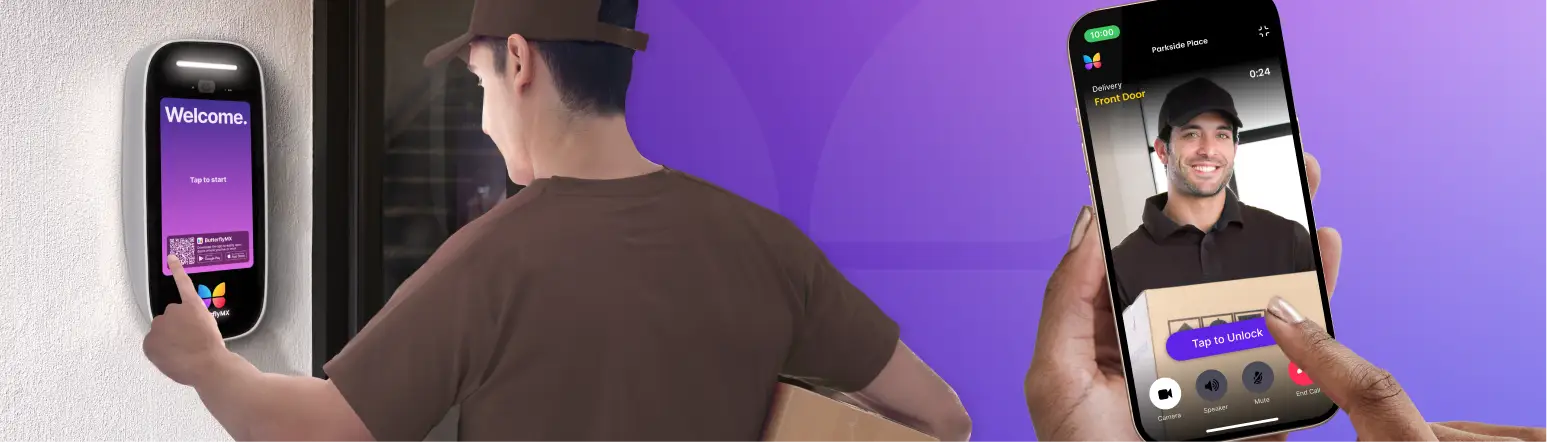
ButterflyMX is one option to evaluate for video verification, smartphone visitor calls, visitor access, and remote access management. Its video intercoms do not rely on traditional POTS telephone lines, and authorized users can receive visitor calls and grant access through supported smartphones. That can be relevant for offices replacing older telephone-entry hardware or trying to support entry calls without a full-time front desk.
Fit still depends on the actual door hardware, network, integrations, outage plan, and site review. Mobile video entry may not solve a purely internal staff-communication need, a deployment with unsupported existing hardware, unsuitable network conditions, or a building that requires a different management model. Choose the final configuration only after the site, integration, and code review confirms it can work for the building.
Frequently asked questions
Can a small office intercom work with an existing electric lock?
It may work if the intercom relay, lock type, power supply, door hardware, access-control equipment, and required egress behavior are compatible. The presence of an electric strike or magnetic lock alone does not establish compatibility, so arrange a site inspection before purchase.
Is professional installation required for a small office intercom?
Professional installation is usually the safer path when the project involves electric locks, wiring, network changes, fire-alarm interaction, or egress doors. Installation and permitting requirements depend on the opening, system design, and jurisdiction.
What happens if power or internet service fails?
It depends on the configuration. Before selecting a system, verify door behavior, emergency egress, backup power, remote-call availability, local unlocking methods, and the staff escalation procedure for an outage.
Can one intercom handle visitor entry and internal staff communication?
Some commercial intercom categories can support internal communication, but a visitor-entry system should not automatically be treated as a replacement for staff-to-staff communication. The right approach depends on the facility layout, daily workflow, and the reason employees need to communicate inside the building.
The right intercom system for a small commercial office building is the one that fits the entry workflow and the building infrastructure while supporting safe, accessible door operation. Define the entrances, responders, visitor volume, door hardware, network conditions, integrations, and outage procedures before comparing quotes.
If video verification, smartphone visitor calls, and remote access management fit your office’s needs, ButterflyMX may be worth evaluating after the site and code review. Get a quote based on your office entrances, staffing model, and access needs.
Get your free quote!
Fill in the form below, and we'll email you right back.
Want a free quote?
Fill in the form below, and we'll email you right back.
You’ll be redirected shortly...