
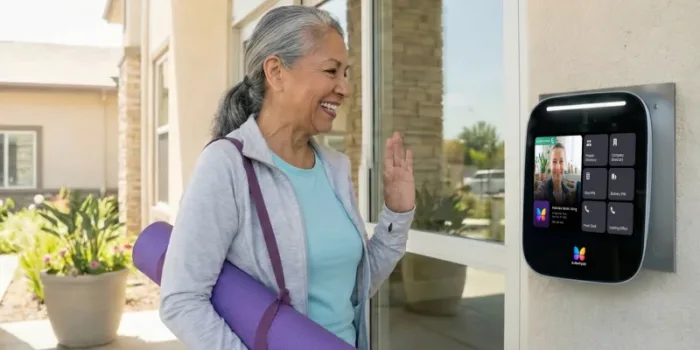





Key takeaways:
- Package room access control is designed to protect parcel delivery and pickup. It is separate from elopement or wander-management access control, even when both are part of the same property security plan.
- Senior living communities need more than one pickup path. A strong program supports self-service, non-app credentials, staff assistance, and care-level-specific rules.
- The best package model depends on package volume, item size, resident abilities, caregiver access, staff workload, audit needs, retrofit conditions, and system compatibility.
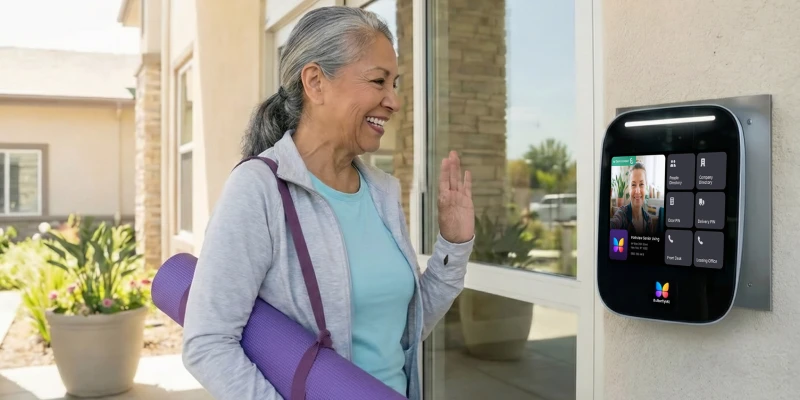
Packages create a small daily test for senior living communities: can residents receive what they need without leaving deliveries exposed, overloading staff, or making pickup harder than it has to be?
Package room access control for senior living communities answers that problem by limiting delivery and pickup to approved people through managed credentials, permissions, notifications, and activity records. In practice, it should do more than lock a door. It should give residents a clear, dignified way to retrieve parcels and give staff a consistent process for exceptions, caregivers, medication deliveries, perishables, and oversized items.
This is different from elopement or wander-management access control. Package access is about parcel custody and authorized pickup. Wander management is about helping communities address unsafe exits when a resident’s needs and care plan call for it. The two may connect within a broader access-control program, but they solve different problems and should be planned that way.
This guide will answer:
- What is package room access control for senior living communities?
- Why package security matters in senior living
- Package rooms vs. parcel lockers vs. traditional mailrooms
- How package room access control works
- Accessibility and ease of use for senior residents
- Access models by care level
- Family, caregiver, medication, and perishable delivery access
- Integration, security, and retrofit planning
- Cost and ROI considerations for senior living operators
- Package room access control buyer checklist
- FAQs
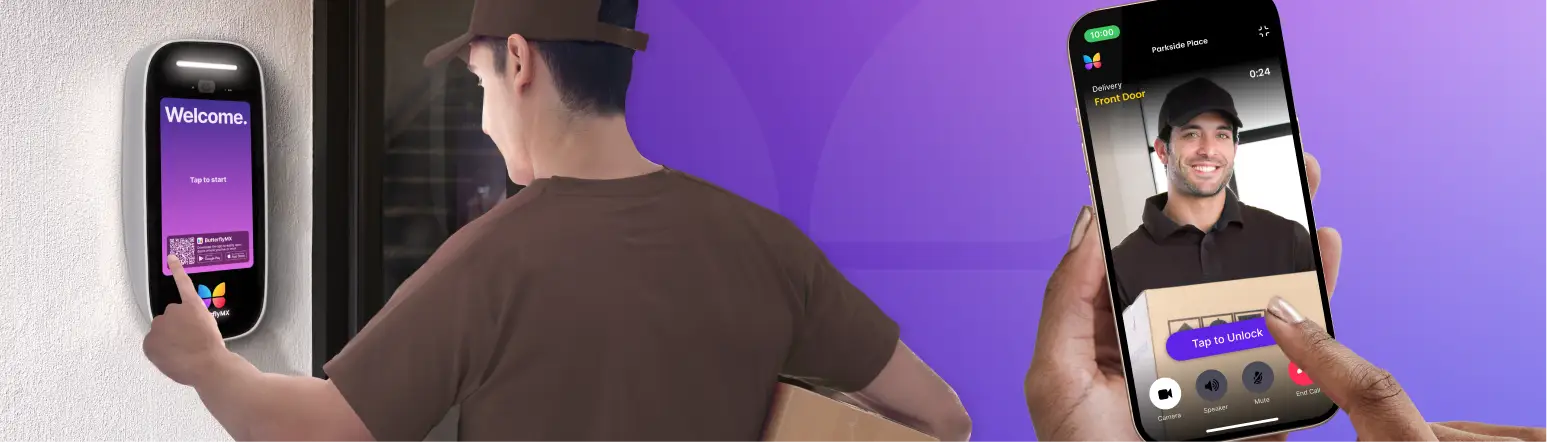
Watch how ButterflyMX works:
What is package room access control for senior living communities?
Package room access control is the system and operating process used to manage who can enter a room where couriers leave parcels and where residents, staff, or approved helpers retrieve them. It can include controlled entry, role-based permissions, delivery notifications, door-event records, cameras, and front-desk procedures.
The purpose is simple: keep packages from becoming unattended shared-property items. A resident should know where a delivery is, staff should know who is allowed to help, and the community should have a record it can review when something goes wrong.
That is not the same as elopement management. Package access focuses on who can enter a parcel area and when. Elopement-focused access control helps communities manage unsafe exits for residents whose care needs warrant that approach. An estimated 60% of people with dementia may wander or attempt to leave a care setting at some point, although individual circumstances vary, according to published literature on wandering behavior. That context explains why senior living access-control conversations often center on resident movement, but it should not pull a package-room plan away from its real job.
A controlled door is only one part of the answer. A complete package process also defines how couriers enter, where parcels go, who receives alerts, who may retrieve items, how staff handle exceptions, and what records are useful during a dispute. Door events can support accountability, but they should not be treated as perfect proof of which person removed which parcel.
Why package security matters in senior living
Package security matters because senior living communities are shared-entry environments. Deliveries often move through lobbies, vestibules, mailrooms, front desks, package rooms, and residential corridors. If the process is loose, packages can sit where too many people can see them, move them, or mistake them for someone else’s item.
The broader package-theft data shows why operators take this seriously. The USPS Office of Inspector General estimated that at least 58 million packages were stolen in the United States during 2024 in its May 2025 Package Theft White Paper. A separate 2025 Package Theft Report from Security.org reported that apartment and condo residents were more than three times as likely to experience package theft as single-family homeowners. That comparison is useful shared-entry context, not a measured theft rate for senior living communities.
Security.org also reported that fewer than one in four package-theft victims report the crime to police. So, operators should not rely only on police reports to understand whether their package process is working. Resident complaints, unclaimed parcels, misdirected deliveries, repeated staff searches, and unclear handoffs can all point to a process that needs more control.
Older-adult fraud risk is related context, but it is not the same evidence. The FBI reported more than $3.4 billion in elder-fraud losses in 2023, and the United States Postal Inspection Service maintains an elder-fraud consumer-protection function. Those facts support careful verification and communication around deliveries. They do not prove that senior living residents have a specific package-theft rate. The stronger editorial point is more practical: a good package process protects property, reduces confusion, and gives residents and staff a clear way to resolve delivery questions.
Package rooms vs. parcel lockers vs. traditional mailrooms
Before choosing technology, decide what kind of package operation the community actually needs. A package room, parcel locker bank, staff-managed mailroom, or hybrid model can all work. The tradeoff is not just security. It is capacity, accessibility, staff time, resident independence, and how the community handles exceptions.
Package rooms are often appealing because the space can handle irregular and oversized items that may not fit fixed locker compartments, a distinction discussed in commercial guidance on assisted-living access control. That flexibility comes with a responsibility to organize the room well. If residents must search through piles of boxes, the room may be controlled but still frustrating.
Parcel lockers provide more separation between items, but they introduce different questions. Can residents reach the compartments? Is the interface easy to read and follow? What happens when lockers are full or a delivery is too large? A staff-managed mailroom offers the most direct help, but it also puts more storage, verification, and handoff work on employees.
Many senior living communities will land on a hybrid approach. Routine parcels may go through one process, oversized items through another, and sensitive or time-sensitive deliveries through staff handoff. For a broader category comparison, see ButterflyMX guidance on smart lockers and package rooms. Teams evaluating a room-based option can also review the ButterflyMX Package Room page for product context after they have defined their own space, staffing, and resident needs.
How package room access control works
A package room works well when every step is clear before the first delivery arrives. The system controls access, but the operating process tells people what to do.
- Define the delivery path so couriers know how to reach the package area and where to place parcels.
- Record or confirm delivery through the community’s chosen process, then notify the resident or responsible staff member.
- Verify pickup through the assigned access method, such as a mobile credential, PIN, fob, keycard, QR-based process, or staff-mediated access.
- Use schedules and role-based permissions so residents, employees, caregivers, and delivery personnel receive only the access they need.
- Document exceptions for lost credentials, failed notifications, oversized deliveries, connectivity problems, misdelivered parcels, and unclaimed items.
An access control credential is the method a person uses to prove they are allowed to enter. In a senior living package room, the best credential mix depends on the people using it. Mobile access may work well for some residents. Others may prefer a fob, keycard, PIN, QR-based process, or help from staff. The community should avoid making one method the only method unless it has tested that choice with the resident population.
Revocation matters as much as entry. When a resident moves, an employee leaves, or a temporary caregiver authorization expires, the community needs a way to remove access without relying on someone to return a physical key. That is why informal shared credentials create problems: they may feel convenient, but they make it harder to know who used access, when they used it, and whether the permission should still exist.
Package-room records are useful, but operators should understand their limits. Door events, pickup records, camera footage, and front-desk notes can help investigate a missing item. Still, an access log usually shows that a person entered a room; it does not automatically prove which parcel that person touched. Good policy closes that gap by setting expectations for labeling, placement, resident pickup, staff assistance, and dispute review.
Accessibility and ease of use for senior residents
Accessibility is the whole pickup experience, not just the reader on the door. A resident has to reach the room, open the door, understand the instructions, find the parcel, lift or move it safely, and leave without needing to guess what to do next.
- Review the accessible route, doorway operation, maneuvering space, lighting, signage, shelving height, control placement, and retrieval reach together.
- Use clear instructions, readable signs, simple prompts, and confirmations that help residents recover if they make a mistake.
- Offer non-app access and staff assistance instead of assuming every resident owns, carries, or wants to use a smartphone for package pickup.
- Plan storage for heavy, oversized, awkward, or fragile parcels so residents are not expected to reach too high, bend too low, or lift unsafely.
- Train residents, families, recurring caregivers, and staff on the actual pickup process, not just the technology.
A package room is not automatically ADA compliant because it has electronic access control. Compliance depends on the route, door operation, clearances, controls, reach ranges, interface design, local requirements, and a project-specific review. Operators should treat accessibility as a design and procurement question, not as a product label.
Cognitive ease matters, too. A process with too many steps can fail even if the room is physically accessible. Short instructions, consistent labeling, clear confirmations, and an obvious way to ask for help make the system more usable for everyone. Biometric access, if considered, should receive a separate review for usability, privacy, traffic flow, and resident comfort rather than being treated as a default upgrade.
Access models by care level
Care level should guide package policy, but it should not erase individual choice. The right model preserves independence where possible and makes assistance predictable where needed.
Independent living
Independent living communities can usually prioritize convenient self-service with optional help. Residents may receive package notifications, use an assigned credential, and ask staff for assistance with heavy, oversized, or hard-to-reach parcels. The policy should still cover exceptions, such as unclaimed items, lost credentials, and family pickup.
Assisted living
Assisted living often needs a blended model. Some residents may retrieve packages independently, while others may rely on reminders, nominated helpers, or staff escalation. The community should define who can authorize an assisted pickup, how staff verify the request, where the handoff happens, and how the resident is told the item was retrieved.
Memory care
Memory-care settings may require supervised or staff-controlled retrieval based on community policy and resident needs. That is an operating decision, not a blanket rule about every resident or every package. The policy should identify who handles urgent, damaged, misdelivered, oversized, and unclaimed parcels while balancing safety, dignity, and autonomy.
Existing ButterflyMX resources on nursing home access control can help frame broader senior living access planning. Package procedures should remain their own workstream, with separate rules for delivery, pickup, assistance, caregiver permission, and investigation.
Family, caregiver, medication, and perishable delivery access
Caregiver and family pickup should be designed on purpose. A good permission rule answers four questions: who can approve the helper, which area the helper may access, when that access expires, and how the use is recorded. A recurring home-health aide, a family member visiting for the weekend, and a delivery driver should not automatically receive the same type of permission.
Temporary access needs boundaries. If a family member is picking up one package, the permission should not become open-ended access to the package room. If a recurring caregiver needs regular access, the community should know who authorized it, how to revoke it, and what record will be available if a question arises later. Scope, expiration, revocation, and audit history are what keep convenience from turning into uncontrolled sharing.
Medication and other sensitive deliveries require an extra policy layer. A smart-package vendor identifies medication delivery as a senior-living use case, as noted in Parcel Pending guidance for senior living, but ordinary package-room technology should not be described as automatically meeting healthcare, privacy, or medication-handling obligations. Depending on community policy, these deliveries may call for identity verification, faster notification, staff handoff, escalation, or separate handling.
Groceries, refrigerated items, and other perishables need time limits and clear responsibility. Decide who receives the alert, how long the item may remain in the room, when staff follow up, and what happens if the delivery is refused, damaged, misdirected, or left unclaimed. These details are easy to overlook until the first problem occurs.
Integration, security, and retrofit planning
Retrofit planning starts with the room, not the product demo. Inventory the proposed space, delivery route, door and hardware condition, accessible path, package staging area, nearby staff coverage, network and power availability, monitoring needs, and emergency considerations. A room that is convenient for couriers may not be convenient for residents, and a room that is easy to secure may not be easy to use.
Next, map the systems that touch the process. That may include controlled-entry hardware, cameras, a video intercom or front-desk communication point, resident directories, credential administration, and event-history records. Confirm whether existing resident credentials can be reused or whether the package room requires separate administration. Also confirm what happens during outages, failed notifications, lost credentials, or staff turnover.
Security choices should match the site. Fail-safe and fail-secure behavior should be determined with qualified access-control and life-safety professionals, not through a generic package-room rule. The same is true for fire, egress, accessibility, privacy, and healthcare-adjacent questions. Operators should document who is responsible for each review instead of assuming the access system itself resolves every requirement.
This is where ButterflyMX may fit naturally into the conversation. ButterflyMX provides package room, access control, video intercom, and remote access management capabilities for managed properties. For a senior living community, the practical question is how those capabilities would be configured for the package area, staff roles, resident credentials, caregiver permissions, and existing property systems. Confirm those details in writing before making integration or assisted-retrieval decisions.
A pilot can reveal issues that a checklist misses. Test real delivery patterns, peak package volume, resident pickup, staff-assisted retrieval, caregiver authorization, oversized parcels, and unclaimed-item handling before a full rollout. Then use resident and staff feedback to adjust signage, notifications, room layout, access schedules, and exception procedures.
Cost and ROI considerations for senior living operators
There is no reliable universal price range for package room access control for senior living communities. Cost depends on the space, door hardware, access reader or entry equipment, room preparation, package-room equipment, power and network work, software, integrations, staff training, support, and ongoing operations.
Retrofit conditions can change the scope quickly. A community with a suitable room, nearby power, reliable network access, and usable door hardware has a different project than one that needs construction, hardware changes, new cabling, accessibility improvements, or system coordination across several buildings. Package volume, credential model, monitoring needs, and portfolio scale also affect total cost.
Build the business case with property-specific measures. Before launch, track staff package-handling time, delivery exceptions, unclaimed parcels, resident support requests, and incident reports. After launch, compare the same measures and include any added training, support, or exception-handling work. Labor savings, amenity value, and resident satisfaction may be part of the case, but they should be measured rather than promised.
The most useful vendor comparison looks beyond equipment cost. Ask what is included, what requires separate work, how permissions are managed, what records are available, how support works, how the system scales across a portfolio, and what ongoing responsibilities remain with the community.
Package room access control buyer checklist
Use the buying process to test the real operating model, not just the product screen. A strong evaluation should cover residents, staff, caregivers, couriers, packages, space, systems, and support.
- Define every user group, including residents, staff, family members, caregivers, couriers, and people who handle exceptions.
- Test self-service and staff-assisted pickup with the physical room, access method, signage, notifications, and support process.
- Validate capacity for routine parcels, oversized items, sensitive deliveries, perishables, peak periods, and unclaimed packages.
- Review permissions, schedules, expiration, revocation, event history, monitoring, camera placement, and incident procedures.
- Assess the room, delivery path, door hardware, power, network, accessible route, staff coverage, and life-safety considerations.
- Confirm integration requirements, rollout support, training, portfolio scalability, ongoing costs, and responsibilities in writing.
Ask vendors to substantiate claims about accessibility, integration, security, and operating impact. A demonstration is useful, but a pilot is better when it reflects the community’s actual residents, package volume, staff model, and caregiver access needs.
Frequently asked questions
Can a family member or caregiver pick up a package for a resident?
Yes, if community policy and the access design support authorized helper pickup. The permission should be scoped to the package area, expire when appropriate, be easy to revoke, and leave a record of use.
How should medication deliveries be handled?
Medication deliveries should follow a community policy that may include identity verification, timely notification, staff handoff, and escalation. A package room is not automatically a healthcare-compliance or medication-handling solution just because access is controlled.
Does every resident need a smartphone to use a package room?
No. Senior living communities should evaluate non-app options such as fobs, keycards, PINs, QR-based processes, front-desk support, and staff-assisted retrieval based on resident needs.
Can package room access use an existing building credential?
It may be possible, but compatibility must be verified with the current vendors and system design. Confirm how permissions, administration, event history, and fallback behavior will work before relying on an existing credential.
A senior living package room should make parcel pickup more secure without making independence harder. That balance depends on the full operating model: the room, access method, staff role, caregiver rules, care-level policy, exception process, and records the community can actually use.
Once those requirements are clear, operators can decide whether a package room, lockers, staff handoff, or a hybrid approach is the right fit. ButterflyMX can be part of that evaluation where package room access, property access control, video intercoms, and remote access management come together. Discuss a package-access plan for your senior living community with a site-specific workflow and implementation review.
Get your free quote!
Fill in the form below, and we'll email you right back.
Want a free quote?
Fill in the form below, and we'll email you right back.
You’ll be redirected shortly...