
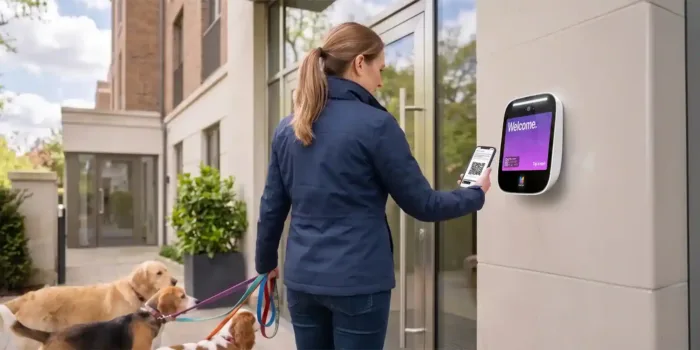





Key takeaways:
- The right condo building entry system depends on the doors, wiring, resident needs, visitor workflows, outage planning, budget, and approval process.
- Older condos may be able to upgrade without rewiring every unit, but only a site survey can confirm the condition of wiring, power, locks, and walls.
- Boards should compare full lifecycle cost, credential administration, accessibility, and continuity plans, not just the price of an entry panel.
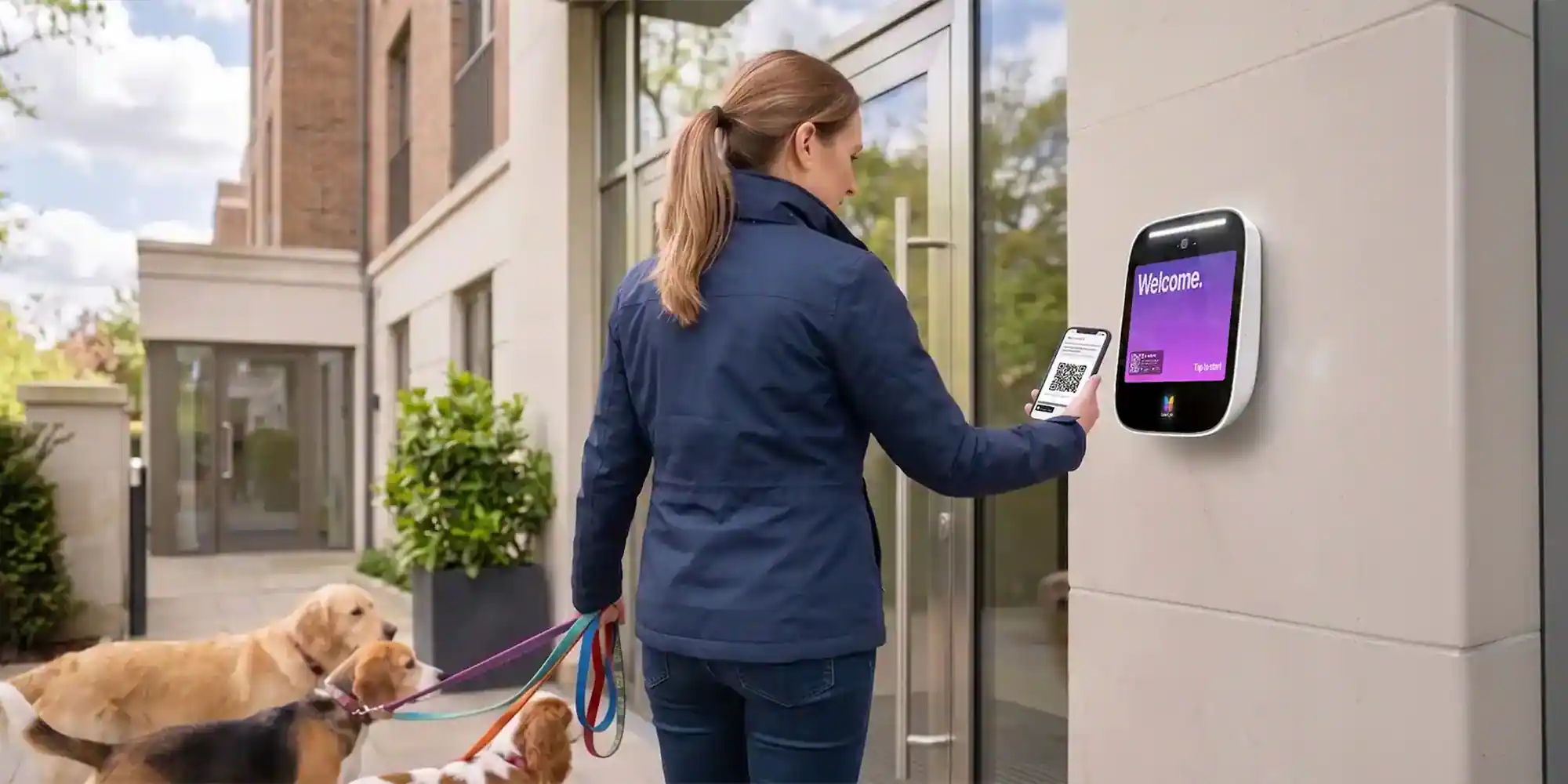
A condo building entry system is more than a lobby callbox. It is the combination of an entry panel, resident directory, answering method, door-release hardware, connectivity, power, and management tools that control how people enter the property.
The best choice is the one that fits your building, not the one with the longest feature list. Before comparing vendors, a condo board should document its doors, wiring, resident access needs, visitor and delivery workflows, outage expectations, budget, and approval requirements. That work produces a shortlist the condo board can defend to owners and use to request comparable proposals.
This guide will answer:
- What a condo building entry system includes
- How main condo entry system types compare
- Map access workflows before selecting technology
- Assess retrofit feasibility and occupied unit disruption
- Plan door hardware, egress and accessible entry
- Manage credentials across sales, rentals and contractor access
- Compare lifecycle cost and association funding
- Build an approval ready board process
- Plan copper retirement, outages and phased rollout
- When a cloud video intercom may fit
- FAQs
Watch how ButterflyMX works:
What a condo building entry system includes
A condo building entry system lets authorized people enter while giving visitors a way to contact a resident, staff member, or front desk. Its core parts are the entry panel and directory, an answering endpoint, door-release hardware, connectivity, power, and software or local controls for managing users.
Intercom communication and access control are related but different. An intercom lets a visitor call someone for entry. Access control authenticates a resident, employee, contractor, or other approved user with a fob, card, PIN, or mobile credential. Many properties need both: a multi-tenant directory for visitors and credentials for everyday resident entry.
Define the project boundary early. The scope may include a lobby door, vestibule, gate, garage, package room, amenity space, elevator access, cameras, or compatible smart locks. Each additional opening can change wiring, controller, credential, and governance needs.
How main condo entry system types compare
These are system architectures, not brand rankings. A condo can pair a visitor intercom with credential-based access control, so the board does not necessarily have to select one function over the other.
Swipe to compare →
A multi-tenant directory calls individual units. A front-desk-only arrangement routes calls to staff instead. That difference matters in a self-managed building with no staffed lobby. Cloud-managed and locally managed systems also create different obligations for subscriptions, support, administration, and continuity. Neither approach is automatically less expensive over its full life.
For broader category background, boards can also review this guide to apartment and multifamily intercom systems. Eliminate options that cannot meet your door, wiring, resident-access, outage, governance, or budget requirements before requesting detailed proposals.
Map access workflows before selecting technology
Technology decisions are clearer once the board maps what actually happens at each entrance. Treat resident entry, visitor calling, deliveries, contractors, move-ins, emergency access, and staff access as separate workflows. A system that works well for a resident returning from work may be a poor fit for a package courier at a locked vestibule.
Questions to settle before the site survey
- For visitors, who receives the call, is video needed, who can release the door, and what option serves residents who do not use a smartphone?
- For deliveries, should access stop at an exterior door, reach a package room, or require resident authorization? Avoid shared permanent codes where individual or time-limited access is practical.
- For contractors, how will the association issue, time-limit, and revoke access?
- For owner-managed rentals and unit sales, who tells the administrator when a credential should be added or removed?
- Which controlled areas need to be included now: gates, garages, elevators, amenities, package rooms, and side entrances?
Ask vendors to explain administrator roles, available audit information, credential revocation, and handling for owner-managed rentals. Some platforms, including ButterflyMX according to its product content, describe remote administration, Visitor Passes, delivery access, package-room workflows, and elevator controls. Those capabilities and configurations should be confirmed for the property before a purchase decision.
A board that documents these journeys can give every bidder the same operating requirements. It also avoids a common mistake: buying a lobby intercom and discovering later that the garage, package room, or contractor workflow needs a separate solution.
Assess retrofit feasibility and occupied unit disruption
Can an older condo upgrade without rewiring every unit? Sometimes. Reused wiring, lower-cabling designs, or smartphone answering can reduce the need for complete in-unit rewiring. But that outcome cannot be promised before a site survey.
The survey should inspect cable condition and routes, available power, network or cellular conditions, lock voltage and compatibility, door count, and every controlled area. A 2025 practitioner account of older-building intercom replacements identified obsolete wiring, thick walls, preservation constraints, misplaced power, permits, and possible asbestos or lead work as common complications. Those observations are useful planning insight, not a national prediction for every older building. Read the older-building retrofit discussion for the full context.
Plan for the work inside occupied homes
Replacing in-unit stations can require appointments, access to homes, removal of old handsets, temporary wall covers, and later wall repair. A board may decide to phase some handset removal with planned unit work, but that is a project choice rather than a universal retrofit practice. Prewar, postwar, and newer buildings can each present different conditions, so an installer or solutions engineer should assess the actual site.
Wireless and cellular options still need suitable signal, power, and continuing service. A design that avoids new cable runs is not automatically a design that avoids all construction, maintenance, or outage risk.
Plan door hardware, egress and accessible entry
Electrified doors need a door-by-door review. Before approving hardware, require the installer to identify the lock type, release method, request-to-exit arrangement, fire-alarm interface, power-loss behavior, and locally adopted code provisions that apply to each opening.
- Confirm whether the opening uses an electric strike, maglock, or another locking arrangement. Fail-safe and fail-secure describe system behavior under a defined condition; they do not eliminate the need to review the actual opening.
- Document what releases the door from the egress side, including request-to-exit devices and any fire-system interface.
- Confirm power-loss and backup-power design, rather than assuming the selected intercom determines it.
- Have the installer and relevant design professionals confirm requirements with the authority having jurisdiction before finalizing hardware or panel placement.
As a scoped example, the inspected 2021 International Building Code provision for sensor-released electrically locked egress doors addresses power-loss unlocking, fire-system release, a manual power-cutting device, egress-side emergency lighting, and UL 294-listed locks. The published 2021 IBC text was reproduced for Illinois and has been renumbered in the 2024 IBC, so it is not a universal rule for every condo door.
Accessibility also requires project-specific review. 24 CFR 100.205 applies certain entrance and common-area design and construction requirements to covered multifamily dwellings first occupied after March 13, 1991, subject to its scope and exceptions. It does not supply a universal intercom mounting-height rule. Local code, the building condition, and qualified professional review control the final design.
Manage credentials across sales, rentals and contractor access
Condo access changes follow ownership events, not just apartment lease turnover. Create a written process for unit sales, owner-managed rentals, lost devices, guests, contractors, staff changes, and temporary projects. It should say who can request a credential, who approves it, how quickly it is issued, and when it is removed.
Where practical, individually assigned credentials or time-limited access are easier to revoke than a shared permanent code. Vendor sources describe encrypted 13.56 MHz and mobile credentials as harder to copy than unencrypted legacy 125 kHz proximity credentials, but no credential is risk-free. Reader settings, enrollment practices, prompt revocation, and whether older formats remain accepted all affect the result.
If a building runs old and new fobs during a transition, set a deadline, verify enrollment, and explicitly disable legacy-format acceptance once migration is complete. Biometrics should be treated as an optional category requiring jurisdiction-specific privacy and governance review, not as a default upgrade.
Compare lifecycle cost and association funding
A proposal price is not the same as total cost of ownership. Separate hardware, installation, lock and electrical work, network work, permits, in-unit devices, training, support, maintenance, connectivity, subscriptions, and future credential replacement. Then compare each proposal over the same planning period.
Published intercom figures should be handled carefully. One vendor source describes a range of $1,000 to $7,000 per entry door installed, while ButterflyMX content describes $1,000 to $7,000 for hardware excluding installation and maintenance. These are illustrative vendor estimates with different definitions, not independent condo-market benchmarks. A transparent planning calculation is more useful: divide the chosen planning-period cost plus recurring fees by the number of units and months in that period to estimate the per-unit monthly impact.
Potential funding paths can include reserves, operating funds, financing, or a special assessment. Eligibility and approval depend on governing documents, local law, reserve planning, and association circumstances. The 2025 national community association review estimated that $31.1 billion in assessments went to reserve funds for common-property repair and replacement, but that figure covers community associations broadly and does not establish that an entry-system project is a reserve expense.
Build an approval ready board process
Condo governance is part of the technical decision. The system may affect common elements, association budgets, resident privacy, unit access, and long-term obligations. Before selecting a vendor, use a process that makes the authority and tradeoffs visible.
- Determine whether the doors, equipment, and wiring are common elements, then review applicable statutes, declarations, bylaws, rules, contracts, and reserve documents with qualified advisers.
- Confirm whether the board can authorize the project and funding or whether an owner vote or another approval process is required. Do not assume a generic voting threshold.
- Use the workflow map and site survey to issue requirements for accessibility, backup power, offline operation, data administration, expansion, removal work, support, and owner disruption.
- Request comparable proposals that state exclusions, recurring fees, warranties, service responsibilities, implementation sequence, training, and acceptance testing.
- Communicate the rationale, funding plan, schedule, unit-access needs, credential enrollment process, accommodation path, temporary access method, and administrator contacts to owners.
That level of process is especially useful for volunteer-led associations. The 2025 community association review estimated that 30% to 40% of associations are self-managed and that 2.555 million people serve on boards and committees. Those figures cover all community-association types, not condos alone, but they underscore why a clear decision record matters.
Plan copper retirement, outages and phased rollout
A legacy phone-line callbox deserves attention before it becomes an emergency replacement. Identify the carrier, service type, account owner, current notices, and viable migration paths. FCC guidance updated March 30, 2026 states that incumbent carriers must provide at least 90 days of notice to residential retail customers before copper retirement and 180 days to non-residential customers. Actual timing varies by carrier and area, so boards should review the FCC copper-retirement guidance and current carrier communications rather than relying on a general date.
Require every bidder to provide a written failure-mode matrix. It should address power loss, internet loss, cellular loss, cloud-service interruption, resident credentials, visitor calling, remote administration, door release, fire-system behavior, and backup-power duration. Do not assume that a cloud-managed system has a particular offline feature or that a replacement connection will operate for a fixed number of hours.
Plan a phased rollout that covers installation, overlap with the old system where feasible, credential enrollment, resident training, testing, legacy deactivation, treatment of old handsets, and final acceptance. The agreement should also identify support ownership, escalation paths, software and hardware dependencies, and expansion to future entrances.
When a cloud video intercom may fit
A cloud video intercom may be a strong candidate when a condo wants smartphone video answering, remote administration, coordinated visitor or delivery workflows, and less dependence on in-unit intercom hardware. It is a fit question, not a default answer. The board still needs a non-smartphone option, reliable connectivity and power, compatible door hardware, an acceptable recurring-fee model, privacy controls, and a documented outage plan.
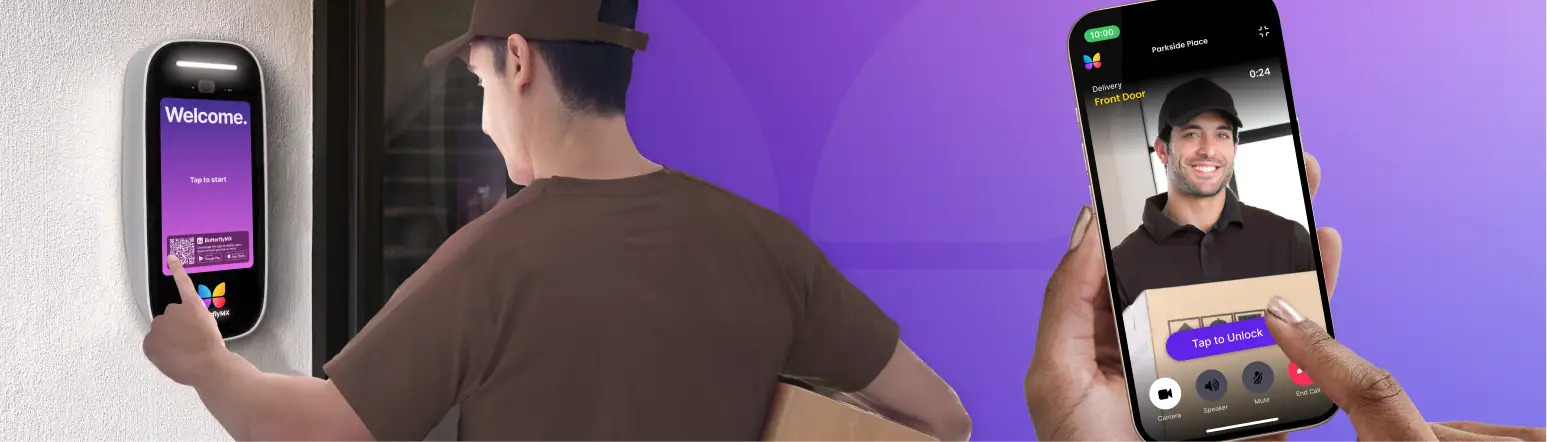
ButterflyMX is one cloud video intercom option for boards evaluating that model. Its video intercoms do not rely on traditional POTS telephone lines, and residents can receive visitor calls and grant access through their smartphones. Property teams can remotely manage residents, visitors, credentials, and access, including access needs beyond the main entrance. Review the video intercom benefits for condos and HOAs alongside the site survey and proposal requirements developed here.
Compare ButterflyMX using the same criteria applied to every vendor: door compatibility, resident alternatives, current feature availability, credential lifecycle, data administration, lifecycle cost, accessibility review, support, and continuity behavior. Boards ready to evaluate a fit can discuss their condo entry requirements with an access expert.
Frequently asked questions
Do residents need a smartphone to use a modern condo intercom?
No. Smartphone-first systems are one option, while telephone calling, in-unit stations, fobs, cards, and other alternatives may serve residents who cannot or do not want to use an app. The board should make the alternative path a written requirement because available options vary by product and configuration.
What happens to entry access during an internet or power outage?
It depends on the system and the door design. Ask for a written matrix covering resident credentials, visitor calling, door release, remote administration, fire-system behavior, and backup power for each failure mode.
Can one platform control the garage, gate, elevator and package room?
Some platforms can support multiple controlled areas and related integrations, but the board should verify every opening, controller, credential rule, elevator function, and delivery workflow separately. Compatibility depends on the hardware, configuration, site conditions, and current product offerings.
How can a condo stop former owners or contractors from using old access credentials?
Use individually assigned credentials, prompt revocation procedures, time-limited contractor access where supported, periodic audits, and a migration deadline that disables legacy credential acceptance. Effective control depends on administration and configuration as well as credential technology.
Should a condo keep or remove old in-unit handsets?
The answer depends on cable condition, resident needs, the replacement architecture, disruption, wall repair, and whether removal can be phased with other planned unit work. A site survey and installer review are necessary because not every handset or cable can remain in service.
A sound condo entry upgrade begins with the property, not the product. Map how residents, visitors, deliveries, contractors, and owners move through the building; inspect the doors and infrastructure; and compare proposals on their full lifecycle cost and continuity plan.
If a cloud video intercom fits those requirements, ButterflyMX can be part of a disciplined comparison. Request a ButterflyMX demo for your property after the board has defined the workflows, site conditions, and approval path it needs a vendor to meet.
Get your free quote!
Fill in the form below, and we'll email you right back.
Want a free quote?
Fill in the form below, and we'll email you right back.
Redirecting you in 5 seconds.