





Key takeaways:
- Gate Key is a cloud-based visitor management platform built for gated communities and other guarded properties.
- It stands out for guard workflows, resident guest management, and support for several credential types through compatible third-party hardware.
- Before you buy, weigh its low monthly entry price and gatehouse focus against limited public review volume, unclear Gate Key Plus differences, and voice-first visitor communication.
Disclaimer: ButterflyMX provides these blog posts to help our customers and potential customers make the right business decisions. Our blog posts are based on the information available to us at the time of writing.
If you’re comparing visitor management software for a gated community or guarded property, Gate Key is likely on your list for one reason: it was built around gatehouse operations.
This Gate Key review looks at what the platform does, who it fits best, how residents and guards use it, what it costs, and where the tradeoffs show up.
You’ll also see how Gate Key handles credentials, mobile access, setup, and visitor communication so you can decide whether it belongs on your shortlist.
This guide will answer:
- What is Gate Key?
- How does Gate Key work?
- Gate Key features
- Gate Key models and product family
- Does Gate Key have a mobile app?
- Does Gate Key support video, calling, and remote communication?
- Gate Key integrations and hardware compatibility
- How much does Gate Key cost?
- Installation and setup requirements
- Gate Key pros and cons
- What do customers say about Gate Key?
- Gate Key alternatives
- Gate Key vs. ButterflyMX
- Frequently asked questions
What is Gate Key?
Gate Key is a cloud-based visitor management and access administration platform for gated communities, guarded residential properties, apartments, offices, and guard companies.
It’s built around three main user groups: residents, guards, and administrators. Residents manage guests, guards handle arrivals, and administrators oversee records, alerts, reports, and supported credentials.
Gate Key, Inc. says it has offered cloud-based visitor management software since 1994. That long history helps explain why Gate Key often comes up for properties that still rely on staffed entrances.
Who is Gate Key designed for?
Gate Key is designed for properties where visitor access runs through a guard, gatehouse, kiosk, or controlled entrance.
Common buyer types include:
- Gated community HOAs
- Property management companies
- Guard and patrol companies
- Apartment communities
- Office buildings
- Guarded residential communities
Its best-fit use cases include guest check-in, resident guest list management, printed or emailed passes, guard-to-resident communication, and credential administration for fobs, cards, transponders, decals, barcodes, and supported phone credentials.
Watch how ButterflyMX works:
How does Gate Key work?
Gate Key works by giving residents, guards, and administrators cloud-based tools to manage guest entry and supported access credentials.
A typical workflow starts when a resident adds a guest through the web portal or mobile app. When the guest arrives, a guard searches for the guest or resident record, admits the visitor, and can issue a printed or emailed pass. The resident can then receive an arrival notification by push message, text, or email.
Administrators use Gate Key to manage community records, export reports, send mass email or text messages, and oversee guard activity. Properties can also connect Gate Key to supported third-party access-control hardware for credential administration.
Guard, resident, and admin workflows
Gate Key separates daily tasks by user role, which makes it easier to picture how the system would work at your property.
- Guards: Search resident and guest records, admit visitors, print passes, capture ID or vehicle images, call residents, and log incidents.
- Residents: Add, edit, and remove guests, manage personal information, receive guest arrival alerts, and view guest activity history.
- Administrators: Manage resident, guard, and guest records; send community messages; export reports; and track assets such as parking spaces, boat docks, and lockers.
For a gated community, that structure can reduce friction at the entrance because guests are easier to find and residents have more control over their own guest lists.
Cloud access and device requirements
Gate Key runs through a browser or app on an internet-connected computer, tablet, or smartphone.
That means the core platform doesn’t require a local server at the property. It also means reliable internet at the guard station matters because the system is cloud-based.
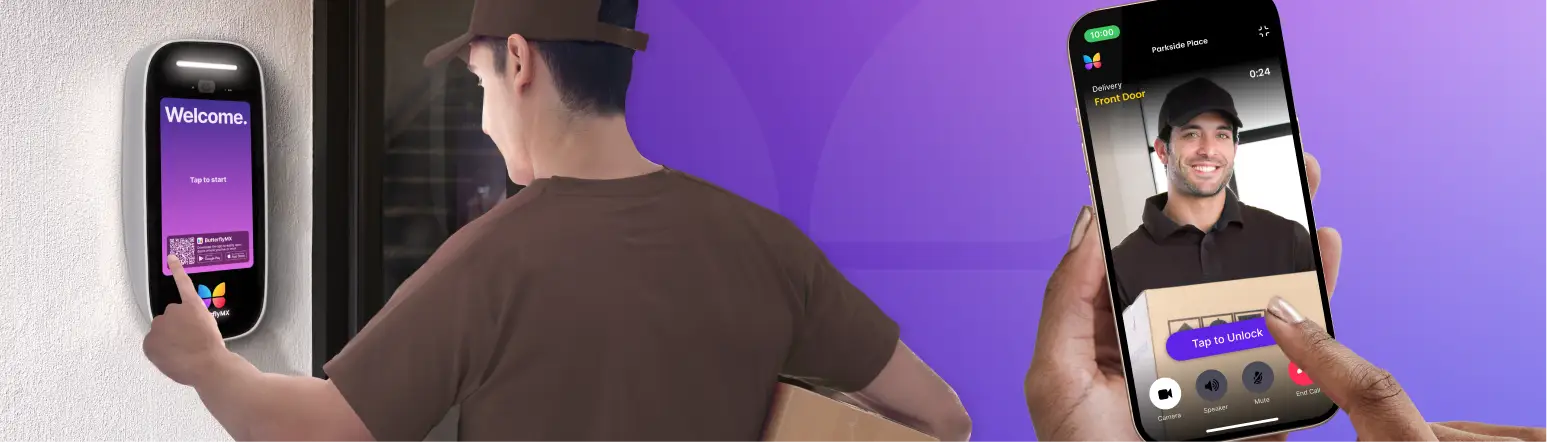
Gate Key positions its in-app guard-to-resident calling as a way to remove the need for dedicated phone lines at the gate. For some buyers, that’s enough. Others may also want a video-based entrance experience. ButterflyMX, for example, supports video intercoms that let residents see and speak with visitors through the mobile app before granting access remotely.
Gate Key features
Gate Key features center on visitor processing, resident communication, guard workflows, and credential administration for guarded properties.
In practice, that means Gate Key does more than store a guest list. It combines pass issuance, notifications, image capture, reporting, and supported hardware integrations in one system.
Visitor and guest management
Gate Key’s core value is its guest pass workflow for guarded entrances.
Residents can pre-register guests online, and guards can search for and admit those guests from a kiosk, terminal, or tablet. Gate Key supports printed or emailed entry passes, along with custom pass types and directions.
Residents can also view guest activity history, while administrators can run and export visitor and guard activity reports. That matters because visitor management isn’t only about letting someone in. It’s also about keeping a clear record of who entered and how the visit was handled.
Properties evaluating both guest entry and vehicle access may also compare ButterflyMX. ButterflyMX supports visitor access workflows and vehicle access control for gates and garages as part of a broader property access platform.
Credentials and access methods
Gate Key supports several access methods, including guard-issued passes, RFID fobs, access cards, windshield transponders, decals, barcodes, and Bluetooth phone credentials through PDK integration.
If residents, staff, and vehicles all enter in different ways, that flexibility may be useful. But buyers should review their existing hardware carefully because credential workflows depend on supported third-party controllers and readers.
Security, communications, and reporting
Gate Key includes several tools that support guard operations and property oversight.
- Driver’s license and vehicle image capture
- Watch list support
- Resident identity checks using a secret word
- Guard incident reporting
- Community-wide email and text blasts
- PDF and Excel report exports
- Asset tracking for items such as parking spaces, docks, and lockers
These features help connect visitor entry to daily operations. A guard can admit a guest, record useful context, contact the resident, and leave an activity trail that administrators can review later.
Gate Key models and product family
Gate Key’s product family includes Gate Key and Gate Key Plus, but public materials don’t give a full feature-by-feature breakdown.
Gate Key is the core cloud-based visitor management platform. Gate Key Plus is described as the newer and more advanced version, but the exact differences aren’t laid out in much detail.
Gate Key vs. Gate Key Plus
This matters because version names can affect both budgeting and expectations. Before choosing a plan, ask for a clear written feature list for the version you’re being quoted.
Does Gate Key have a mobile app?
Yes, Gate Key offers native iOS and Android resident apps for guest management and notifications.
Residents can use the app to manage guests and receive arrival alerts. Guards can also run the system from a tablet, such as an iPad, which may help with gatehouse or field use.
Gate Key is also browser-accessible from connected devices. For buyers, the bigger question is how each user group will use it day to day: residents through the mobile app, guards through a terminal or tablet, and administrators through management tools.
Does Gate Key support video, calling, and remote communication?
Gate Key supports in-app voice calling between guards and residents, but its public product materials don’t describe a video intercom workflow.
The platform also supports image capture for visitor records, including driver’s license and vehicle or license plate images. That gives guards a way to document a visit, but it’s different from a resident seeing a live video call from the entrance.
This difference matters if you’re deciding how visitors should be identified. A guard-led property may be comfortable with voice calling tied to gatehouse workflows. A property that wants residents to see and speak with visitors remotely may also compare platforms such as ButterflyMX, which offers video intercoms and lets residents receive visitor calls through the ButterflyMX mobile app.
Gate Key integrations and hardware compatibility
Gate Key integrates with multiple third-party access-control hardware brands to support credential administration.
Listed hardware ecosystem names include Allegion, HID, Nedap, Essex, Farpoint, Veridt, Invixium, Identive, Iris ID, XPR, and MorpakTrak. Gate Key also lists PDK integration for Bluetooth phone credentials and Galaxy Systems as a partner integration.
These integrations can help properties manage fobs, access cards, RFID credentials, transponders, decals, and other credential types through the Gate Key interface. The tradeoff is that the best setup depends on compatible hardware.
Some buyers may compare this approach with ButterflyMX if they want mobile-first access and wallet-based credentials within a broader access platform. ButterflyMX supports mobile access through its app, wallet-based credentials on compatible mobile devices, and access control for doors and other controlled entry points.
How much does Gate Key cost?
Gate Key pricing starts at $195 per month on the company’s public pricing page, with month-to-month billing and no long-term contract listed.
Software directory listings show a lower $145 per month starting price. Because the company’s own pricing page and third-party listings differ, buyers should treat $195 per month as the official public starting point and ask for a current quote based on their property and setup.
Gate Key says the core service doesn’t require a major hardware or software purchase. Still, total cost can change if your property needs optional pass printers, supplies, RFID hardware, access-control readers, credentials, or PDK Bluetooth reader hardware.
What may affect total cost?
Your total Gate Key cost depends in part on how much hardware your property needs beyond the software subscription.
- Optional pass printers and printing supplies
- Third-party RFID readers, controllers, or credentials
- Access cards, fobs, decals, or transponders
- PDK Bluetooth reader hardware for phone credentials
- Any changes needed to make existing access hardware compatible
For budgeting, it helps to separate the software subscription from the hardware and credential costs tied to your actual access plan.
Installation and setup requirements
Gate Key is a web-based system that can run on existing internet-connected devices, with optional hardware added for printing or credential workflows.
Gate Key says service can go live in about a day or two. The baseline requirement is an internet-connected computer, tablet, or smartphone for the guard station and for users who need access to the system.
Optional hardware may include a pass printer, third-party RFID or access-control readers, physical credentials, and PDK Bluetooth readers. Because Gate Key is cloud-based, reliable internet at the gatehouse is one of the most important setup needs.
It’s also worth thinking through how the system will fit daily operations. A property with a busy gatehouse may focus on guard screens and pass printing, while a community replacing vehicle credentials may need more planning around controller compatibility.
Gate Key pros and cons
Gate Key’s pros and cons come down to its fit for guarded properties, its credential flexibility, and a few practical buying tradeoffs.
What do customers say about Gate Key?
Public customer feedback for Gate Key appears limited, but the detailed feedback available is positive.
The main themes are ease of use, reliability, and affordability. One property manager described a smooth rollout across three communities and praised the system’s uptime and low number of bugs.
The main tradeoff mentioned is that Gate Key may not include some newer or extra features found in competing products. Because the public review sample is small, customer feedback makes the most sense as one input alongside a demo, quote, and hardware review.
Gate Key alternatives
Gate Key alternatives are worth exploring if your property wants a different visitor workflow, a broader access platform, or more video-oriented entry tools.
- Visitly: A visitor management platform that may appeal to buyers comparing tools for gated or guarded properties.
- Sign In App: A broader visitor management option for buyers looking beyond gated-community-specific gatehouse operations.
- Qminder: A visitor and queue management platform that may come up for properties comparing visitor-focused software at a different price level.
- ButterflyMX: A property access and security platform for multifamily, commercial, gated communities, student housing, and other properties. It may fit buyers who want video intercoms, access control, mobile access, visitor access, vehicle access control, and other access products in one broader platform.
Gate Key vs. ButterflyMX
Gate Key and ButterflyMX both relate to property access, but they start from different buyer needs.
Gate Key is a focused visitor management and access administration platform built around guard, resident, and administrator workflows for gated and guarded properties. ButterflyMX is a broader property access and security platform that includes video intercoms, access control, mobile access, visitor access, vehicle access control, elevator controls, security cameras, package rooms, smart lock integrations, and wallet-based credentials.
Gate Key may be the better fit for properties that already rely on guard-led entry and want focused visitor management software. ButterflyMX may be worth a closer look if your property wants video-based visitor entry, mobile access, vehicle access control, and other access workflows managed in one broader platform.
Frequently asked questions
What is Gate Key?
Gate Key is a cloud-based visitor management and access administration platform for gated communities, guarded residential properties, apartments, offices, and guard companies.
It supports resident guest management, guard visitor processing, administrator tools, notifications, reporting, and credential administration through supported hardware integrations.
How does Gate Key work?
Gate Key works by letting residents pre-register guests, guards search for and admit visitors, and administrators manage records, alerts, reports, and supported credentials.
Users access the system through connected devices such as computers, tablets, smartphones, browsers, and mobile apps.
How much does Gate Key cost?
Gate Key’s company pricing page lists plans starting at $195 per month with month-to-month billing and no long-term contract.
Some third-party software directory listings show a $145 per month starting price, so buyers should ask for a current quote and separate software costs from optional hardware costs.
Does Gate Key have a mobile app?
Yes, Gate Key offers native iOS and Android resident apps for guest management and notifications.
Residents can manage guests and receive arrival alerts, while guards can also use the system from a tablet such as an iPad.
Does Gate Key require internet?
Yes, Gate Key is a cloud-based platform that depends on internet-connected devices for access.
At minimum, a guard station needs a connected computer, tablet, or smartphone to use the system for gate operations.
Does Gate Key require a landline?
No, Gate Key positions its in-app guard-to-resident calling as a way to remove the need for dedicated gate phone lines.
This may matter for properties that want guards to call residents from within the system instead of maintaining separate phone lines at the gate.
Does Gate Key support video calling or video intercom?
Gate Key’s public product materials describe in-app voice calling and image capture, not a video intercom workflow.
Properties that want residents to see and speak with visitors at the entrance may want to compare video intercom platforms as part of their evaluation.
What credentials does Gate Key support?
Gate Key supports printed or emailed passes, RFID fobs, access cards, transponders, decals, barcodes, and Bluetooth phone credentials through PDK integration.
Credential administration depends on compatible third-party access-control hardware, so buyers should review existing controllers and readers before purchase.
What hardware does Gate Key need?
Gate Key’s baseline need is an internet-connected device for the guard station, such as a computer, tablet, or smartphone.
Optional hardware may include pass printers, printing supplies, third-party RFID or access-control readers, physical credentials, and PDK Bluetooth readers.
What are the main alternatives to Gate Key?
Main Gate Key alternatives include Visitly, Sign In App, Qminder, and ButterflyMX.
These options may come up for buyers comparing visitor management, video-oriented access workflows, or broader property access platforms.
Is Gate Key right for your property?
Gate Key may be a strong fit if your property has a staffed gate, guard-led visitor entry, resident guest lists, and a need to manage several types of credentials.
The biggest question is whether its voice-centered workflow, supported hardware ecosystem, pricing structure, and version options match your long-term access plan.
That’s why comparing alternatives matters. If you want a broader property access and security platform, ButterflyMX is worth considering for video intercoms, access control, mobile access, visitor access, vehicle access control, elevator controls, security cameras, package rooms, smart lock integrations, and wallet-based credentials.
To see how ButterflyMX could support your property’s access needs, request pricing from the ButterflyMX team.
Get your free quote!
Fill in the form below, and we'll email you right back.
Want a free quote?
Fill in the form below, and we'll email you right back.
You’ll be redirected shortly...