





Key takeaways:
- Geokey became part of OneQuext on April 27, 2026, so buyers should ask how branding, support, and product plans will evolve.
- Geokey offers flexible lock and PMS integrations, but its app averages 1.5/5 from 618 App Store ratings and 1.7/5 from 171 Google Play reviews.
- Geokey publishes no hardware, subscription, or installation prices, making an itemized quote and on-site connectivity test essential.
Disclaimer: ButterflyMX provides these blog posts to help our customers and potential customers make the right business decisions. Our blog posts are based on the information available to us at the time of writing.
Geokey is a mobile and cloud access control platform for multifamily, student housing, senior living, affordable housing, condos, and selected commercial properties. It turns smartphones into credentials and works with third-party locks, property management systems, gates, garages, elevators, and smart-building devices.
This Geokey review covers how the platform works, its features, pricing approach, app reliability, connectivity needs, and alternatives. It also explains what the 2026 OneQuext merger means for current and prospective customers.
This guide will answer:
- Geokey review at a glance
- How does Geokey work?
- Geokey features and integrations
- Is Geokey reliable?
- How much does Geokey cost?
- Who should consider Geokey?
- Geokey pros and cons
- Geokey alternatives
- Geokey vs. ButterflyMX
- Frequently asked questions
- Should Geokey be on your shortlist?
Watch how ButterflyMX works:
Geokey review at a glance
Geokey is a cloud-based access platform that uses smartphones and compatible third-party hardware to manage entry at doors, gates, garages, elevators, and amenities. On April 27, 2026, Geokey joined Quext and Homebase to form OneQuext. The merger announcement said existing customers would continue to receive service and support, while local coverage of the merger described the companies as combining their smart-community products.
Is Geokey still a standalone product?
No. Geokey is no longer an independent company, although the Geokey app and support continued after the OneQuext merger announcement. Older product and partner pages may still describe Geokey as a standalone company, so buyers should assess the product in the context of OneQuext.
During a sales discussion, ask who owns implementation and support, whether contracts use the Geokey or OneQuext name, and how existing integrations fit the combined product plan. The merger does not mean the product will change or disappear, but it creates fair questions for a long-term access control purchase.
How does Geokey work?
Geokey gives residents and authorized users digital credentials, which they use near a compatible access point. Property staff can manage permissions, schedules, revocations, and access records through cloud tools.
The platform can cover more than a lobby door. Geokey’s multifamily materials describe access for buildings, apartments, amenities, elevators, garages, and visitors. The exact workflow depends on the lock, reader, gate controller, or other hardware installed at each location.
Geokey access methods
Geokey supports geofence-based mobile access, Bluetooth tap, NFC, wallet passes, and QR-code intercom calling. Compatible Igloo hardware can also provide PIN access. A Geokey partner page from Genie describes the geofence approach and its use with garage access.
The Geokey App Store listing and version history describe NFC, wallet support, widgets, QR intercom functions, and an increase in the registered-device limit from three to five devices per account. That limit can matter for households that need credentials on several phones or tablets.
ButterflyMX also supports mobile and wallet-based credentials. Buyers comparing the platforms should consider which credential types residents prefer and which options remain available when a phone has poor connectivity.
Compatible locks and installation requirements
Geokey is hardware-agnostic, not hardware-free. A property still needs compatible locks, readers, controllers, or other entry hardware, along with resident smartphones. Documented partners include Yale, dormakaba, Igloo, ProdataKey, Keri Systems, and TTLock.
Keri Systems’ Geokey integration page and the Geokey knowledge base describe supported hardware and integrations. Each brand can have different power, wiring, network, monitoring, and fallback needs, so buyers should not assume every Geokey deployment works the same way.
Professional installation is likely to be part of a property deployment, but the scope depends on the selected hardware and existing doors. A retrofit using compatible equipment can be very different from a project that needs new locks, readers, power, or gate controls.
Internet, Wi-Fi, Bluetooth, and offline access
Geokey positions its core geofence approach as not requiring Wi-Fi at the door. That does not make connectivity irrelevant: the resident’s phone still relies on Bluetooth for nearby communication and may need phone data for app or cloud functions. Some integrated locks also use Wi-Fi.
Igloo algoPIN is a hardware-specific resilience option described in the Geokey knowledge base. Buyers should ask what residents do if their phone is offline, Bluetooth fails, the app does not load, or a third-party lock loses its connection.
Geokey features and integrations
Geokey combines mobile credentials with cloud administration, access scheduling, temporary visitor permissions, event records, remote management, and several property technology integrations. Its main operational value may be the link between access permissions and property management data.
Property management system integrations
Geokey integrates with Entrata, Yardi Voyager, and RealPage. These connections can issue and revoke credentials based on resident move-in and move-out dates, reducing the need for staff to manage every credential by hand.
- The Entrata integration connects tenant records with credential provisioning and revocation.
- The Yardi Voyager integration supports resident-data synchronization and access lifecycle automation.
- Geokey documentation lists RealPage support, which was added in 2025.
This automation can be especially useful for student housing and other high-turnover properties. Buyers should still ask which data fields sync, how exceptions are handled, and what staff must do when a resident record is incomplete or delayed.
Visitor, garage, and smart-building capabilities
Property teams can grant, schedule, and revoke temporary guest access through Geokey. The platform also extends to garage entry through Genie and Aladdin Connect. Geokey’s Resideo integration covers compatible thermostats, leak detectors, and water shutoff devices.
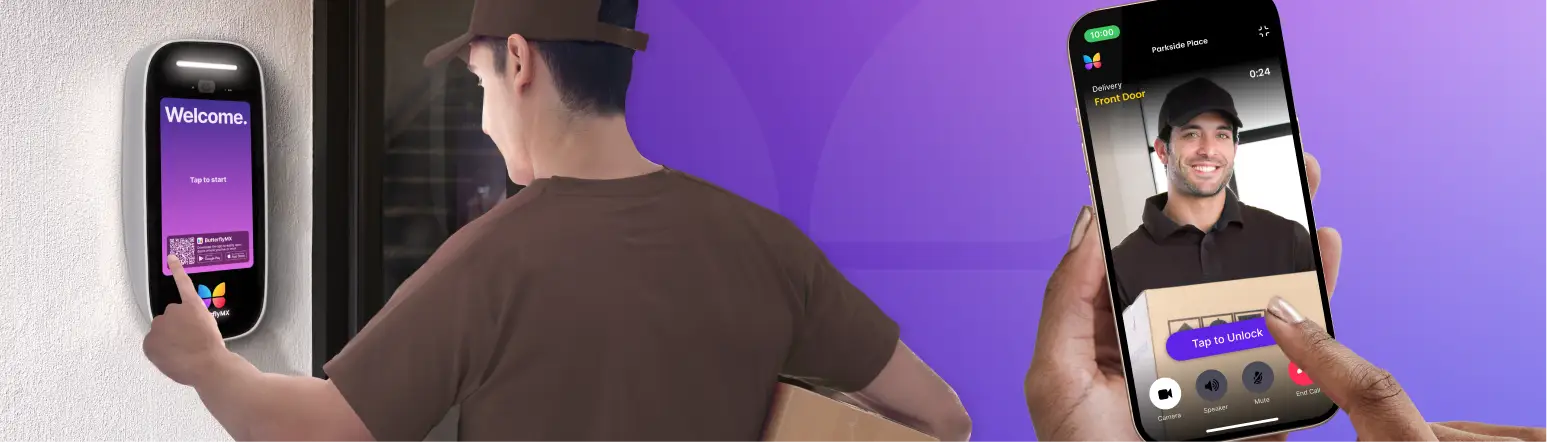
Geokey supports QR-code intercom calling for accounts using compatible third-party intercom hardware, but its documented product coverage does not describe a dedicated video intercom. ButterflyMX supports visitor calls through video intercoms, allowing residents to see and speak with visitors before granting remote access. Properties should compare whether temporary credentials alone meet their needs or whether visitor screening is also a priority.
Is Geokey reliable?
Independent app sentiment is poor overall, so reliability deserves close attention during a Geokey evaluation. The Apple App Store lists a 1.5/5 average from 618 ratings, while Google Play lists 1.7/5 from 171 reviews and more than 10,000 downloads.
Reviews across the Apple App Store and Google Play repeatedly mention failed unlock attempts, lockouts, slow entry, weak-signal locations, and app reinstallation. Some users also describe positive experiences with individual support agents or straightforward smaller deployments.
These ratings and comments are not a measured failure rate, and they do not mean every property will have the same experience. They do point to a meaningful resident-experience risk that operators should test instead of relying only on a sales demonstration.
What should properties test before deployment?
A Geokey pilot should recreate real resident conditions across the full property. Testing only at a well-connected leasing office or model unit can miss the locations where residents most need dependable access.
- Test iOS and Android phones at every controlled entrance.
- Check underground parking, garages, elevators, gates, stairwells, and other known signal dead zones.
- Test Bluetooth and cellular performance during busy periods and after normal business hours.
- Measure common entry workflows while residents carry bags or push a stroller.
- Test visitor credentials, move-in provisioning, move-out revocation, and staff overrides.
- Document the fallback process for a dead phone, lost phone, app error, or offline lock.
- Confirm whether the selected hardware supports PINs, physical credentials, or another backup method.
The pilot should include support escalation, too. Property teams need to know who residents contact, what staff can resolve locally, and how entry is restored when a mobile credential fails.
How much does Geokey cost?
Geokey does not publish hardware, subscription, or installation prices. Its website directs prospective buyers to a private Cost Explorer and sales process instead of listing standard product prices.
The quote is likely to depend on the number and type of access points, selected third-party hardware, existing door conditions, installation work, integrations, and optional smart-building devices. Because the hardware-agnostic model allows several equipment brands, buyers should request an itemized quote rather than compare only one total.
Geokey content cites legacy costs of $1 to $4 for a copied key and $4 to $25 for a fob. Those figures appear in company content about physical credentials; they are not Geokey prices, guaranteed savings, or a substitute for a full cost comparison.
Ask for separate figures covering hardware, software, installation, recurring charges, replacement equipment, support, integrations, and future expansion. The quote should also identify which company supports each third-party lock or controller.
Who should consider Geokey?
Geokey may fit operators that prioritize mobile credentials, PMS-driven automation, and the ability to choose among several lock brands. It is most relevant to multifamily, student housing, senior living, affordable housing, condo, and selected commercial properties that are willing to test resident workflows carefully.
Student housing and other high-turnover properties may find Entrata, Yardi, or RealPage automation especially useful. Multifamily operators may value coverage across unit doors, common entrances, garages, gates, elevators, and amenities. Properties using compatible Resideo equipment can also consider thermostat and leak-management functions.
When may Geokey be a weaker fit?
Geokey deserves extra scrutiny when a property has weak cellular or Bluetooth coverage, needs one offline credential method across every entrance, or wants predictable budgeting before speaking with sales. Low app ratings also make a resident pilot important when mobile access will be the main entry method.
Geokey materials focus on access and smart-building integrations rather than a dedicated package-room workflow. Properties that want package handling within a broader access platform may compare ButterflyMX, which supports package rooms along with mobile access, visitor access, video intercoms, and other property entry products.
Geokey pros and cons
Geokey offers useful hardware and integration flexibility, but that flexibility also adds deployment variables that buyers need to assess.
Geokey alternatives
Relevant Geokey alternatives include Gatewise, Brivo, Kisi, SmartRent, and Swiftlane. These products belong on a comparison list for different reasons, so buyers should assess them against the same property requirements rather than treat them as interchangeable.
- Gatewise: A cloud access option relevant to multifamily and student housing evaluations.
- Brivo: A cloud access platform to consider for multi-site access requirements.
- Kisi: An app-based access option for buyers comparing cloud administration approaches.
- SmartRent: Relevant to operators considering access alongside broader smart-apartment functions.
- Swiftlane: Relevant to buyers who want to compare access control and intercom functions.
Third-party competitor tracking also places Geokey among a wider group of mobile and cloud access companies. For a useful comparison, give every vendor the same door schedule, resident count, integration needs, connectivity conditions, and fallback scenarios.
Geokey vs. ButterflyMX
Geokey emphasizes mobile access across a range of partner hardware, while ButterflyMX combines several property access and security product categories in one platform. The better fit depends on the entrances, visitor workflows, credentials, and operational tools your property needs to manage.
Geokey may appeal to buyers who value lock-brand choice and specific PMS automation. ButterflyMX may appeal to properties that want to connect mobile access with video intercoms, visitor workflows, vehicle access, elevator controls, package rooms, security cameras, and smart lock integrations in a broader platform. Neither approach is right for every property.
Frequently asked questions
Is Geokey still an independent company?
No. Geokey merged with Quext and Homebase to form OneQuext on April 27, 2026, while continued service and support were promised for existing Geokey users.
How much does Geokey cost?
Geokey does not publish hardware, subscription, or installation prices. Buyers must contact sales or use the company Cost Explorer to obtain a property-specific quote.
Is the Geokey app reliable?
Independent app sentiment is poor overall. Geokey averages 1.5/5 on the App Store and 1.7/5 on Google Play, with recurring reports of failed unlocks and weak-signal problems.
Does Geokey require Wi-Fi?
The core geofence and Bluetooth approach is positioned as not requiring Wi-Fi at the door. However, phone data and Bluetooth remain relevant, and some third-party lock configurations use Wi-Fi.
Which lock brands work with Geokey?
Documented Geokey integrations include Yale, dormakaba, Igloo, ProdataKey, Keri Systems, and TTLock. Buyers should ask which features and fallback credentials are available with the exact hardware proposed for their property.
Which property management systems integrate with Geokey?
Geokey integrates with Entrata, Yardi Voyager, and RealPage. These integrations can connect credential provisioning and revocation to resident move-in and move-out dates.
Can Geokey work when a lock is offline?
Compatible Igloo hardware can support offline algoPIN access. This fallback is specific to supported Igloo configurations and should not be assumed for every Geokey installation.
How many devices can a Geokey account register?
The Geokey app registration limit increased from three to five devices per account in an October 2024 update.
Should Geokey be on your shortlist?
Geokey may belong on the shortlist for properties that value mobile credentials, PMS automation, and the ability to choose among several lock brands. Entrata, Yardi, and RealPage integrations can help turnover-heavy operations, while support for doors, gates, garages, elevators, and amenities gives the platform broad access coverage.
The main tradeoff is the resident experience. Low app ratings, reported failures in weak-signal areas, hardware-dependent fallback methods, quote-based pricing, and the evolving OneQuext structure all deserve careful attention.
Before committing, request an itemized quote, test every entrance with real resident devices, document offline procedures, and ask how support duties are divided between Geokey, OneQuext, and hardware partners. Compare those results with alternatives that match your full access plan.
ButterflyMX is another option for properties comparing mobile access with video intercoms, visitor access, vehicle access, elevator controls, package rooms, security cameras, and smart lock integrations. Request a ButterflyMX demo to compare the platform with your property requirements.
Get your free quote!
Fill in the form below, and we'll email you right back.
Want a free quote?
Fill in the form below, and we'll email you right back.
You’ll be redirected shortly...