





Key takeaways:
- IZCloud Virtual Guard combines automatic license plate recognition, an AI intercom, PINs, phone and text approvals, and cloud management to automate resident and visitor entry without requiring residents to use an app.
- Inex does not publish HOA pricing; third-party hospitality pricing provides limited context but should not be treated as the cost of an HOA deployment.
- Deployment requires professional wired infrastructure and reliable site internet: the camera uses an Inex-specific PoE++ injector, supports a 5–40-foot capture range, and allows shielded CAT6 runs up to 328 feet.
Disclaimer: ButterflyMX provides these blog posts to help our customers and potential customers make the right business decisions. Our blog posts are based on the information available to us at the time of writing.
IZCloud Virtual Guard is Inex Technologies’ cloud-based system for vehicle and visitor access at gated communities. HOA boards, property managers, developers, and security committees may consider it when they want to replace fobs, shared gate codes, or routine guard involvement with plate-based access and automated visitor handling.
This Inex Technologies review explains how IZCloud works, what residents and visitors experience, the hardware and network infrastructure it requires, and what pricing information is public. It also covers the system’s tradeoffs, alternatives, and how IZCloud compares with ButterflyMX
This guide will answer:
- What is Inex Technologies’ IZCloud Virtual Guard?
- How does IZCloud Virtual Guard work?
- IZCloud hardware and specifications
- How much does Inex Technologies cost?
- Installation, connectivity, and outages
- Inex Technologies review: pros and cons
- Is IZCloud right for your community?
- Inex Technologies alternatives
- Inex Technologies vs. ButterflyMX
- Frequently asked questions
- Choosing a gated-community access platform
Watch how ButterflyMX works:
What is Inex Technologies’ IZCloud Virtual Guard?
IZCloud Virtual Guard is a cloud-based gated-community access platform that combines automatic license plate recognition (ALPR), an AI intercom, PIN codes, phone and text approvals, and centralized management. It is designed to automate entry for residents, guests, vendors, deliveries, and certain special vehicles.
Inex Technologies is an ALPR and vehicle-imaging company founded in 1993 and based in Wayne, New Jersey. It applies that vehicle-recognition background to tolling, parking, and access-control products, including IZCloud for HOAs and gated communities.
The IZCloud gated-community system is positioned as an alternative to fobs, gate remotes, shared keypad codes, legacy callboxes, and fully staffed guard booths. A registered plate can serve as a resident credential, while the AI intercom and temporary PINs help manage people who are not enrolled residents.
Inex says its ALPR technology achieves more than 99% accuracy, including more than 99.5% in measured U.S. applications, and processes more than five million plate reads each day. Those are company-wide figures across Inex deployments, not a performance guarantee for a specific HOA entrance.
Who is IZCloud designed for?
IZCloud is aimed at HOA boards, property managers, gated-community developers, and security teams that want vehicle-first access. It can suit gated residential communities, master-planned developments, condominium associations, and private club or golf communities.
Its clearest fit is a property where most residents arrive by vehicle and management wants the plate itself to act as the credential. Communities that also need to control pedestrian gates or amenity doors can consider the separate Smart Lock Connect add-on.
How does IZCloud Virtual Guard work?
IZCloud reads an arriving vehicle’s plate, checks it against an authorized access list, and applies the appropriate entry rules. Visitors can use a registered guest plate, a temporary PIN, or an AI intercom that contacts the resident for approval.
The IZCloud HOA platform records access events with plate images, timestamps, entrance details, and grant-or-denial actions. Property staff can search prior events, monitor multiple gates, open a gate remotely, and receive selected denial or suspicious-event alerts.
Resident and guest access
For registered residents, the normal process is simple: the camera reads an approved plate and signals the existing gate operator to open. That plate-based workflow does not require a fob, remote, shared code, or resident app.
Residents use a dedicated phone or text process to register a guest plate, create a PIN, approve an arrival, or request a remote gate opening. Guest and vendor credentials can be limited by date, time, and location, which helps prevent a temporary code from remaining active longer than needed.
This phone-and-text approach may appeal to communities that do not want residents to install another app. Residents who expect app-based control may prefer a different experience. ButterflyMX supports mobile access and wallet-based credentials, so buyers should compare which workflow residents are most likely to adopt.
AI intercom, deliveries, and emergency vehicles
At the entry, visitors can speak to the IZCloud AI intercom. The system identifies the requested resident, checks access rules, and starts a phone or text approval process without requiring a guard to manage every routine arrival.
The documented workflow also supports delivery and rideshare approvals. The IZCloud HOA user guide describes recognition of designated vehicle types or markings, including emergency vehicles, without requiring every individual plate to be registered in advance.
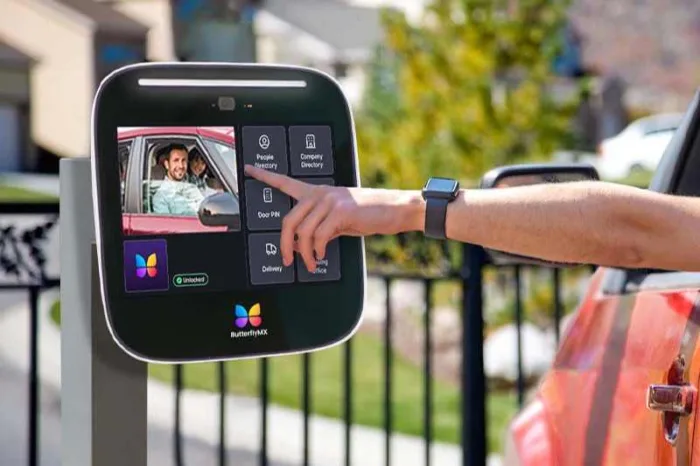
ButterflyMX takes a video-intercom-centered approach to visitor access. Residents can receive calls in the mobile app, see and speak with visitors, and grant access remotely. Neither workflow is automatically better; the right choice depends on whether a community prefers AI voice automation with phone or text approval or app-based video communication.
Pedestrian and amenity access
IZCloud Smart Lock Connect extends the platform beyond vehicle lanes. According to the Inex HOA gate-access guide, it can cover pedestrian gates, clubhouses, pools, gyms, laundry rooms, and rental units through PIN or mobile credentials.
Smart Lock Connect is an add-on, not the same component as the ALPR vehicle-access workflow. Buyers should identify which access points are included in the initial proposal and which require added hardware or licensing.
Platform scope is another useful comparison point. ButterflyMX can combine vehicle access control with access control, video intercoms, elevator controls, package rooms, security cameras, and smart lock integrations. Communities should decide whether they mainly need a gate-centered ALPR deployment or a broader property-access plan.
IZCloud hardware and specifications
IZCloud is a multi-component deployment, not a single gate device. A typical plan can include cloud software, an ALPR camera and proprietary injector for each lane, a call box at entry lanes, network equipment, and optional panels or modules for other access points.
The manufacturer’s installation guide says the IZA500GR-DRW-P24 camera must use an Inex IZ1POE PoE++ injector rather than a generic injector. It also lists a 5–40-foot capture range, with roughly 15 feet recommended, and shielded CAT6 camera runs of up to 328 feet, or 100 meters.
These details affect site planning. A long entrance may require network equipment closer to the lane, while an unusual camera angle or vehicle stopping point may require a different mounting plan.
What do the component limits mean for larger communities?
The IZACP-4D supports four doors or gates per panel. A community with more than four applicable pedestrian gates, amenity entrances, or other controlled points may need more panel capacity, which should be reflected in the design and quote.
Lane count matters, too. Each planned ALPR lane can require its own camera and Inex injector. Ask vendors to list hardware by lane and access point instead of providing only a single project total.
How much does Inex Technologies cost?
Inex does not publish a price for its HOA gated-community system, so buyers need a project-specific quote. Its public materials do not provide a confirmed HOA price for hardware, software, installation, accessories, or subscriptions.
A ResNexus hospitality integration page lists gate-access hardware from $2,300 plus $1 per unit per month, with a $90 monthly minimum. It also lists a camera-only visitor-management option from $1,600 plus $3 per room per month, with a $49 monthly minimum. These third-party hospitality figures are not confirmed prices for an HOA deployment.
Published buyer guidance cites general access-control benchmarks of about $1,000 to $5,000 or more per door, depending on system type and project scope. That range is market context only and should not be used to estimate an IZCloud proposal.
Quote-only pricing and professional wired installation mean total ownership cost depends heavily on the property. A one-lane retrofit is a different project from a multi-gate community with pedestrian access, new network runs, and several panels.
What should an Inex quote request include?
Ask each bidder to separate one-time and recurring costs. An itemized scope should address:
- The number of entry and exit lanes
- Camera, IZ1POE injector, and call-box quantities
- Router, switch, and network-enclosure needs
- Shielded CAT6 runs and any trenching or conduit work
- Power supplies and electrical work
- Relay connections to existing gate operators
- IZACP-4D panel quantities
- Smart Lock Connect coverage
- Cloud subscriptions, support, and maintenance
- Replacement-hardware terms and ongoing service responsibilities
Also ask how the proposal changes when the community adds a lane, pedestrian gate, or amenity door. That makes it easier to compare the initial scope with likely expansion costs.
Installation, connectivity, and outage considerations
IZCloud requires professional wired installation with an on-site router, a GigE PoE+ network switch, shielded CAT6 cabling, component-specific power, and relay or direct wiring to the existing gate operator. The documented HOA architecture uses wired Ethernet and PoE; it does not describe a cellular option.
IZCloud does not replace the physical gate, barrier, or operator. It makes the access decision and connects to existing gate equipment, so the condition and compatibility of that equipment remain part of the project.
Internet reliability is a major planning issue. Inex documentation says the cloud platform cannot receive new data or updates without site internet, and it does not describe an offline path for those functions. That does not establish that every gate action stops during an outage, but communities should ask the installer to document the behavior of registered plates, new guests, PINs, event logs, intercom calls, and remote opening when connectivity is interrupted.
Retrofit and site-planning questions
Before requesting a final proposal, map every vehicle lane, pedestrian gate, and amenity door. Record the distance to network equipment, available power, camera mounting options, broadband signal, existing conduit, and gate-controller model.
Ask who monitors network health and responds if a camera, injector, switch, call box, or gate relay fails. The answer can affect support contracts and long-term operating responsibility even when two proposals have similar equipment lists.
Inex Technologies review: pros and cons
IZCloud is strongest as an LPR-first system for communities that want automated vehicle access and less routine guard involvement. Its main tradeoffs are quote-only HOA pricing, wired installation, internet dependence, proprietary camera-power hardware, and a phone-or-text workflow instead of a native resident app.
Inex brings more than three decades of ALPR company history. Independent public feedback specific to the HOA version of IZCloud is sparse, so buyers may have less third-party experience to review than they would for some consumer-facing platforms.
Boards can respond by requesting references from communities with a similar number of lanes, residents, and visitor arrivals. Ask about system age, recognition performance under local conditions, support response, outage behavior, false reads, resident adoption, and actual recurring costs.
Is IZCloud right for your community?
IZCloud may fit a community that prioritizes automated plate entry, AI-assisted visitor processing, centralized gate records, and less dependence on a staffed booth. The property should also have reliable broadband and be willing to fund a professionally designed wired deployment.
IZCloud is more likely to belong on your shortlist if:
- Most resident access occurs through vehicle gates.
- You want license plates to replace fobs, remotes, or shared codes.
- You want to automate routine visitor verification.
- Phone and text are acceptable resident self-service methods.
- Your entrances can support Ethernet, CAT6, power, and the required Inex injectors.
- You need searchable, image-backed gate records.
- You may add pedestrian or amenity access through Smart Lock Connect.
Give the documented constraints extra attention if the gate has unreliable internet, long cable distances, difficult trenching, or residents who strongly prefer an app. The same applies if the procurement team wants to reuse generic PoE components or needs public pricing before speaking with vendors.
A pilot or live demonstration should use realistic conditions. Test resident plates, visitors, vendors, deliveries, emergency-vehicle procedures, nighttime arrivals, temporary PINs, and a simulated connectivity interruption. Ask for written answers about any workflow that cannot be demonstrated.
Inex Technologies alternatives
Alternatives to Inex Technologies include ButterflyMX, LiftMaster/myQ, CellGate, Ubiquiti UniFi Access, and Proptia. The most useful shortlist depends on whether the property values an LPR-first workflow, mobile access, cellular connectivity, self-hosted management, or broader property-wide access.
A December 2025 Beach Community Development District agenda package shows Inex being evaluated alongside ButterflyMX, Proptia, and another virtual-guard option. This is one procurement snapshot, not a market-share measure, but it shows why buyers often compare several workflows before choosing a platform.
- ButterflyMX: Consider it when mobile and wallet-based credentials, video intercoms, visitor access, vehicle access control, and broader property access are priorities.
- LiftMaster/myQ: Current gated-community comparisons describe its CAPX products as managed cloud and video-intercom options.
- CellGate: Its Watchman products are relevant for buyers considering a cellular-first entrance option where wired site internet is a concern.
- Ubiquiti UniFi Access: This self-hosted option may interest technology-focused communities considering license-plate unlock and local system management.
- Proptia: The Proptia platform is a modular HOA security and visitor-management alternative that also appeared in the Beach CDD evaluation.
Ask every vendor to demonstrate the same scenarios and price the same scope: resident entry, visitor approval, recurring vendors, after-hours access, internet interruption, pedestrian gates, amenity doors, staff administration, and future expansion.
Inex Technologies vs. ButterflyMX
Inex Technologies and ButterflyMX both address gated-community access, but they emphasize different workflows. Inex centers on LPR vehicle entry, AI voice interaction, phone and text resident actions, and optional Smart Lock Connect access. ButterflyMX combines vehicle access with mobile access, video intercoms, access control, visitor access, and other property-access and security products.
Neither product is the universal choice. Inex may align with a community focused on plate-based resident entry and AI-assisted gate automation. ButterflyMX may be worth evaluating when mobile access, video visitor communication, and property-wide access products are central requirements.
Use the same site map and workflow checklist for both vendors. That keeps the comparison focused on the entrances, credentials, visitor processes, management tools, and platform scope your property actually needs.
Frequently asked questions
What is IZCloud Virtual Guard?
IZCloud Virtual Guard is an Inex Technologies cloud platform that combines automatic license plate recognition, an AI intercom, PINs, phone and text resident actions, and centralized gate management.
How much does Inex Technologies cost?
Inex does not publish pricing for its HOA gated-community system, so buyers need a project-specific quote. Third-party hospitality pricing starts at $2,300 for certain gate-access hardware plus $1 per unit monthly with a $90 minimum, but that is not confirmed HOA pricing.
Does IZCloud require internet access?
Yes. IZCloud requires site internet for cloud-based operation and to receive new data or updates. The available documentation does not describe an offline path for those functions, so buyers should ask what each gate workflow does during an outage.
Does IZCloud have a resident mobile app?
No native resident app is part of the documented IZCloud workflow. Residents use phone calls or texts to register guests, create PINs, approve visitors, or request a gate opening.
What hardware does IZCloud require?
A typical deployment requires an IZA500GR ALPR camera and Inex IZ1POE injector for each lane, an IZCallBox at entry lanes, an on-site router, a network switch, shielded CAT6, power, and a connection to the existing gate operator. The four-door IZACP-4D panel is optional for applicable pedestrian or gate access points.
Can IZCloud control pedestrian gates and amenity doors?
Yes. IZCloud can extend to pedestrian gates, pools, gyms, clubhouses, laundry rooms, and rental units through the Smart Lock Connect add-on.
How does IZCloud handle visitors without a guard?
IZCloud can use an AI intercom to identify the requested resident and start phone or text approval. Visitors may also enter with a registered guest plate or a temporary PIN limited by date, time, or location.
Does IZCloud replace the physical gate operator?
No. IZCloud connects to the existing gate operator through relay or direct wiring; it does not supply or replace the physical gate or barrier itself.
What are the main alternatives to Inex Technologies?
Alternatives include ButterflyMX, LiftMaster/myQ, CellGate, Ubiquiti UniFi Access, and Proptia. Compare them by resident credentials, visitor workflow, connectivity, vehicle access, property-wide coverage, and management approach.
Choosing a gated-community access platform
IZCloud Virtual Guard may fit communities that want plate-based resident access, AI-assisted visitor handling, and searchable gate records. The key tradeoffs are quote-only pricing, dependable internet, wired installation, proprietary camera-power hardware, and a phone-or-text resident experience instead of a native app.
Before selecting a vendor, compare proposals using the same lane count, access points, visitor scenarios, outage questions, installation scope, and expansion plan. A documented demonstration under realistic conditions can reveal more than a feature list alone.
Communities that also want mobile access, video intercoms, visitor access, vehicle access control, and broader property access in one platform should include ButterflyMX in the comparison. Schedule a ButterflyMX demo to explore the access workflows that fit your property.
Get your free quote!
Fill in the form below, and we'll email you right back.
Want a free quote?
Fill in the form below, and we'll email you right back.
You’ll be redirected shortly...