





Key takeaways:
- Keypad entry is usually a stronger fit for lower-traffic church doors used by staff, volunteers, offices, storage areas, and secondary entrances than for an unattended public entrance.
- Shared PINs are easy to use but harder to manage responsibly; individual PINs, cards, fobs, or mobile credentials can provide better accountability when the system supports them.
- A keypad is only one part of the opening. The full door, lock, power source, egress path, accessibility, and administration plan all need to work together.
A keypad sounds like a simple fix for a church door: give the right people a PIN, keep the door locked, and stop passing around keys. Sometimes, that is exactly the kind of access and security system a church needs. Other times, a keypad by itself creates new problems, especially at a busy main entrance or a door used by many volunteers.
Keypad entry for church doors lets authorized people unlock an entrance with a PIN. It tends to work best on controlled, lower-traffic doors with known users, such as staff entrances, offices, storage rooms, and some secondary doors. The decision gets more complicated when a door needs visitor screening, stronger individual accountability, code-compliant egress, accessible operation, outdoor durability, or centralized management.
The right question is not whether keypads are good or bad. It is which church doors are good keypad candidates, which need another credential or visitor-entry method, and what the church must manage after the hardware is installed.
This guide will answer:
- What keypad entry for church doors means
- Which church doors are strong keypad candidates
- How keypad security depends on PIN governance
- How to choose a standalone lock or commercial reader
- How egress and accessibility shape installation
- What affects installation reliability and total cost
- How keypad compares with other access approaches
- How to manage volunteer and event PINs
- How to build a layered church access plan
- FAQs
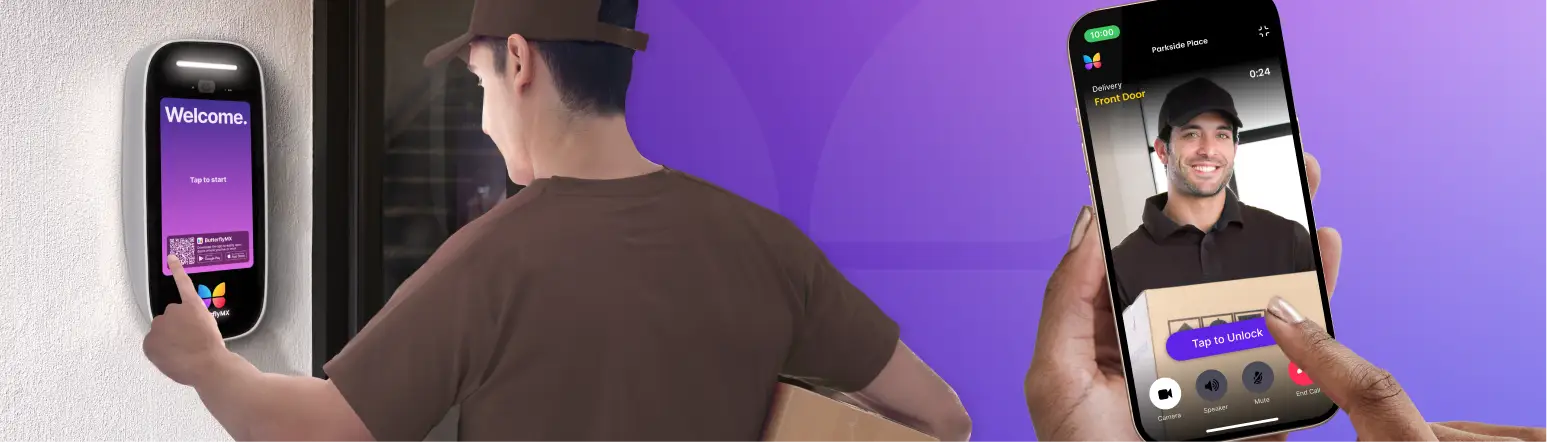
Watch how ButterflyMX works:
What keypad entry for church doors means
A keypad entry system lets an authorized user unlock a church door by entering a PIN. In practice, that can mean two different things. A self-contained keypad lock combines the keypad and locking function at one opening. A keypad reader, by contrast, is commonly connected to separate commercial locking hardware, an access controller, and sometimes management software.
That distinction matters before a church compares products. A battery-powered PIN code lock on one office door may solve a narrow access problem. A commercial keypad reader may be part of a wider church door access control system that manages several openings, credentials, schedules, and users. In both cases, the keypad checks the code and triggers the selected lock, but user management, audit logs, remote changes, and scheduling depend on the system design.
For a deeper category overview, churches can review how keypad access control works. For church planning, the more important question comes next: which doors should use PIN entry in the first place?
Which church doors are strong keypad candidates
Keypad entry is most useful when the people using the door are known, the traffic is manageable, and the church can keep codes up to date. It is usually a weaker stand-alone choice for an unattended public entrance where the church needs to identify, communicate with, or approve unknown visitors.
Strong keypad candidates
- Staff entrances used by employees and regular volunteers with a clear reason to enter.
- Church offices where access can be assigned, reviewed, and removed promptly.
- Storage, maintenance, and utility rooms with a limited group of authorized users.
- Lower-traffic secondary doors that do not need visitor screening and can be configured for appropriate egress.
Conditional keypad candidates
- Side and back entrances, where traffic, schedules, visibility, door hardware, and accountability should be reviewed together.
- Event-space doors, where temporary access may be helpful if someone owns the process for issuing and removing codes.
- Exterior doors exposed to weather, if the selected keypad or reader is rated and installed for that environment.
Weak keypad-only candidates
- A busy or unattended main entrance that needs visitor identification, communication, or approval.
- Doors where a reusable public PIN would spread too widely to manage responsibly.
- Any opening whose lock configuration cannot preserve required egress or pass review by the local authority having jurisdiction.
This framework is not a rule that every side door needs a keypad or every main entrance needs an intercom. A religious-institution access-control guide takes a similar approach by matching access methods to property operations and user needs rather than treating one credential as universal.
Churches should also avoid focusing only on the front door. A NIBRS-based analysis covering 2000 through 2016 reported 1,652 serious violent incidents at places of worship in reporting jurisdictions. In that study, 71% of interior incidents involved entry through a side door, back door, or window, and 28% occurred after hours. Those findings are historical and should not be used as current trend data, but they do support a practical point: every exterior and interior opening deserves a measured review. The NIBRS-based church violence analysis explains the methodology and limits of the findings.
Before choosing a credential, list each door’s purpose, typical traffic, public-access need, credential owner, volunteer turnover, emergency use, existing hardware, and person responsible for approving changes. That inventory turns a broad security conversation into a door-by-door plan.
Need help evaluating which access method fits each church door? Talk with an access-control specialist after documenting those requirements.
How keypad security depends on PIN governance
A keypad can be secure enough for a church door when the door use, hardware, code practices, and accountability needs line up. The PIN is only one part of the decision. The physical door, locking arrangement, code policy, and removal process all affect whether keypad entry works in the real world.
The biggest governance question is whether the church uses shared or individual PINs. A shared PIN is convenient, especially for a small group that needs quick access. But it can be copied, given to someone else, or kept by a volunteer after that person no longer needs access. When many people use the same code, it is harder to know who actually entered the building.
Where the selected system supports them, individual PINs give each person a separate code. Cards, RFID fobs, and mobile credentials can serve a similar purpose when they are assigned to a user. These options can improve accountability, but the details vary. Do not assume every keypad offers audit logs, user-level reporting, schedules, remote changes, or enough user capacity for a growing church.
Set the policy before issuing codes. Decide who approves access, who creates or changes credentials, when access should be removed, and what happens if a code may have been exposed. A longer PIN or a more convenient credential cannot make up for weak door hardware, poor code discipline, or a process no one owns. For related context on keyless entry in worship spaces, see this discussion of keyless locks for places of worship.
How to choose a standalone lock or commercial reader
The choice between a standalone keypad lock and a commercial keypad reader is really a choice about how much the church needs the door to do. A standalone keypad lock puts the credential input and locking function at one opening. A commercial keypad reader usually sends credential information to a controller, which decides whether the connected lock should release.
A standalone lock can be a practical fit for one controlled opening with a limited number of users. A commercial reader may make more sense when the church has multiple doors, changing schedules, higher user counts, audit needs, or a desire to manage credentials from one place. Neither model is automatically better. The right choice depends on the opening and the administrative burden the church is willing to carry.
Residential smart-lock articles can help a reader understand consumer-style keypad deadbolts, but they do not prove that a product is suitable for a public-assembly property, a high-traffic church door, multi-user administration, or local code requirements. The distinctions in this church keyless-lock overview are a starting point, not a substitute for site-specific review.
The lock itself also matters. Electric strikes and magnetic locks are different arrangements, and each can affect power, release, egress, installation, and emergency behavior. Ask the installer to evaluate the complete opening: door, frame, reader, controller, lock, power source, emergency plan, and applicable requirements. Treat the keypad as one component, not the whole access-control decision.
How egress and accessibility shape installation
Controlling entry must not block code-compliant egress from the occupied side of a church door. A keypad on the outside of a door does not, by itself, answer the life-safety question. The lock type, release method, occupancy, fire alarm interface where applicable, adopted code edition, local amendments, and authority having jurisdiction all affect whether the opening is acceptable.
It is also important to separate ordinary controlled entry from access-controlled egress. Many doors restrict entry while still allowing people inside to exit freely. Access-controlled egress is a narrower category associated with certain configurations, including sensor-released electromagnetic-lock arrangements. This explanation of access-controlled egress doors is useful for the concept, but its 2018 discussion should not be treated as a universal compliance determination.
Common code references may include adopted editions of the International Building Code and NFPA 101, along with local amendments. A church should not try to resolve those requirements from a product brochure alone. The actual opening and the local authority having jurisdiction matter.
Installers may use terms such as fail-safe, fail-secure, request-to-exit device, and push-to-exit control. In basic terms, a fail-safe electric lock releases when power is removed, while a fail-secure lock stays secured on the entry side during power loss. A request-to-exit device signals that someone is leaving, and a push-to-exit control is a manual release method used in some configurations. Those definitions are only the starting point. The church still needs to know how the selected door behaves during power loss, fire alarm activation, emergency release, and normal daily use.
Accessibility questions to resolve
- Under U.S. Access Board guidance, operable door hardware is generally placed 34 to 48 inches above the finished floor within the guidance scope.
- Operation should allow one-handed use without tight grasping, pinching, or twisting of the wrist.
- The guidance addresses a maximum five-pound operating force for operable parts of door hardware within its scope.
Read the U.S. Access Board guide to doors, doorways, and gates for the underlying accessibility guidance. These points do not prove that any specific keypad, reader, lock, or ButterflyMX installation is compliant. Accessibility depends on the complete installed opening, including placement, clearances, hardware, and operation.
What affects installation reliability and total cost
Church keypad access-control cost depends on the full project, not just the device mounted beside the door. Major cost drivers include hardware grade, door and frame preparation, locking hardware, wiring or battery power, controller requirements, software, integrations, labor, retrofit constraints, and the number of openings.
Two church doors can look similar and still have very different scopes. One may already have usable electrified hardware and cable pathways. Another may need door or frame work, power, new locking hardware, and a controller. That is why a numeric price range can be misleading without a current, site-specific proposal.
Battery-powered and wired designs also create different responsibilities. A battery-powered lock may reduce new wiring at some openings, but someone must monitor and replace batteries. A wired keypad or reader may fit other needs, but its scope depends on available power, pathways, controllers, and the full locking arrangement. Offline behavior, power-loss behavior, and emergency release are product- and configuration-specific.
Exterior openings add another layer. For an outdoor keypad, verify the manufacturer’s environmental rating, operating conditions, mounting location, enclosure needs, warranty conditions, and installation instructions. Weather suitability should be confirmed for the exact device and location, not assumed from the word keypad.
Before approving an installation, document how the selected configuration handles battery depletion, power loss, network loss, fire alarm activation where relevant, and other emergency conditions. Those answers affect reliability, maintenance, and the church’s ability to manage access after installation.
How keypad compares with other access approaches
A church does not have to choose one credential for the whole property. The main entrance, staff entrance, office, storage room, and event space may each call for a different approach. Use the table below as a decision aid, not a ranking.
The important point is that credential type, locking hardware, visitor process, and management model are separate decisions. A keypad may be right for a staff door, while a public entrance may need visitor-assisted entry. A card, fob, or mobile credential may be better when the church wants access tied to a specific person. Cloud management may help when schedules change often or several doors need coordinated access.
For churches that need to coordinate schedules across doors, the ButterflyMX resource on a church access-control system with scheduled office hours provides related planning context. ButterflyMX may be worth evaluating when a church needs cloud-managed administration, mobile access, visitor access, or a mixed-credential approach alongside keypads. Product compatibility and site-specific hardware requirements should be confirmed before selection.
Explore a door-by-door access plan for your church once the team has identified its public-entry, staff-access, visitor, and administration requirements.
How to manage volunteer and event PINs
Volunteer PIN management is not a one-time programming task. It is an access-governance process that should account for changing ministries, office staff, contractors, events, and volunteer roles.
- Create an access inventory that records each role, event, door, permitted schedule, credential owner, approving administrator, and event assignment.
- Use individual PINs where the selected system supports them. Reserve shared codes for narrow situations, with a documented owner and a decision about when the code expires or gets reviewed.
- Issue temporary or event-specific codes only when the chosen system supports them. Define when the code starts, when it ends, and who is responsible for removal.
- Review or revoke access when a volunteer leaves, changes roles, finishes an event assignment, or when a code may have been exposed.
- Document who can create, change, review, and deactivate credentials. Test the process before high-attendance events, not while people are waiting at the door.
No universal PIN rotation interval fits every church. A risk-based policy is more useful: act immediately after exposure, a departure, a role change, or a temporary event, then review credentials on a schedule that fits church operations and the sensitivity of the doors.
Also, be honest about the limits of the selected hardware. Do not assume every standalone keypad supports schedules, expiration dates, remote changes, or user-level reporting. If manual code management becomes hard to keep up with, that may be a sign to consider a managed access-control system rather than adding more shared codes.
How to build a layered church access plan
A layered church access plan starts by assigning each opening a purpose, user group, visitor requirement, credential method, locking arrangement, schedule, egress requirement, and responsible administrator. That process keeps a PIN from being treated as the whole security plan.
For example, a secondary staff entrance may use PIN access when a known group needs scheduled entry. A public entrance may need individually issued credentials, mobile access, or visitor-assisted entry, depending on how the church welcomes visitors and protects the building. That is an illustrative planning pattern, not a prescribed design. The right configuration depends on the property and the opening.
Centralized management can help when a church has multiple doors, changing volunteer groups, several credential types, or frequent schedule changes. It should support door-specific choices rather than force every entrance into the same model. Door access also belongs within broader procedures for people, visitor handling, emergency planning, and physical security.
Use this sequence to move forward: assess each door, confirm egress and accessibility constraints, choose credentials by user and visitor need, validate the complete hardware configuration, define governance, and request a qualified site-specific proposal. That order gives the church a better basis for deciding where keypad entry belongs and where another access method is the better fit.
Frequently asked questions
What happens to a keypad-controlled door during a power or internet outage?
It depends on the exact hardware and configuration. Battery-powered locks and wired systems can behave differently, so verify offline operation, stored credentials, emergency release, recovery behavior, and applicable code requirements before installation.
Can an exterior church keypad be exposed to rain, heat, or cold?
Only if the selected device and installation are suitable for that environment. Check the manufacturer environmental rating, operating range, mounting location, enclosure needs, installation instructions, and warranty conditions for the specific keypad or reader.
Can a residential smart lock be used on a church office door?
Possibly, but only after reviewing traffic, durability, door construction, administration, egress, accessibility, and local requirements. Residential convenience does not establish suitability for a public-assembly property or a specific church opening.
When should a church use visitor-assisted entry instead of a public PIN?
Visitor-assisted entry is worth considering when a main entrance needs identification, communication, or approval for unknown visitors. The decision is specific to the door and church operations; it does not mean keypads can never be used near a main entrance.
Keypad entry can be a practical part of a church access plan, especially for controlled staff, office, storage, and secondary doors. The deciding factor is not whether keypads are generally secure. It is whether the specific door, credential policy, locking hardware, egress requirements, accessibility, and management workload all fit the use case.
Churches that need centralized administration, mobile credentials, visitor access, or a mixed-credential strategy can consider ButterflyMX as part of a door-by-door evaluation. Request a free quote for your church access-control project after validating the property requirements with a qualified access-control professional.
Get your free quote!
Fill in the form below, and we'll email you right back.
Want a free quote?
Fill in the form below, and we'll email you right back.
You’ll be redirected shortly...