





Key takeaways:
- Luxer One uses a required 15-compartment Main Unit with add-ons for dense package volume, oversized items, compact spaces, and refrigerated deliveries.
- Luxer One has no public list price: the widely cited $6,000–$20,000 installed estimate dates to 2015, while a 2026 cross-vendor benchmark cites $800–$2,500 per door plus $500–$1,500 per bank each year.
- Customer feedback is mixed by channel, with a 4.6 out of 5 Trustpilot score, a 3.2 out of 5 Android app rating, and BBB complaints involving billing, package assignment, service, and loss disputes.
 Disclaimer: ButterflyMX provides these blog posts to help our customers and potential customers make the right business decisions. Our blog posts are based on the information available to us at the time of writing.
Luxer One Smart Package Lockers help apartments, offices, universities, hotels, and other properties accept and distribute deliveries without having staff handle every package. Buyers usually weigh its modular locker hardware, resident app, installation demands, and approach to package security before choosing a system.
This Luxer One review covers the models, pricing context, technical requirements, outage options, customer feedback, package liability, fees, and alternatives. The key question is not just whether the lockers fit the space, but whether the property can support the workflow, infrastructure, and resident policies that come with them.
This guide will answer:
- What is Luxer One?
- Luxer One models and capacities
- How much does Luxer One cost?
- Luxer One features and management tools
- Installation, connectivity, and outage planning
- Security, package liability, and resident fees
- What customers say about Luxer One
- Luxer One pros and cons
- Luxer One alternatives
- Luxer One vs. ButterflyMX
- Frequently asked questions
- Is Luxer One a good fit?
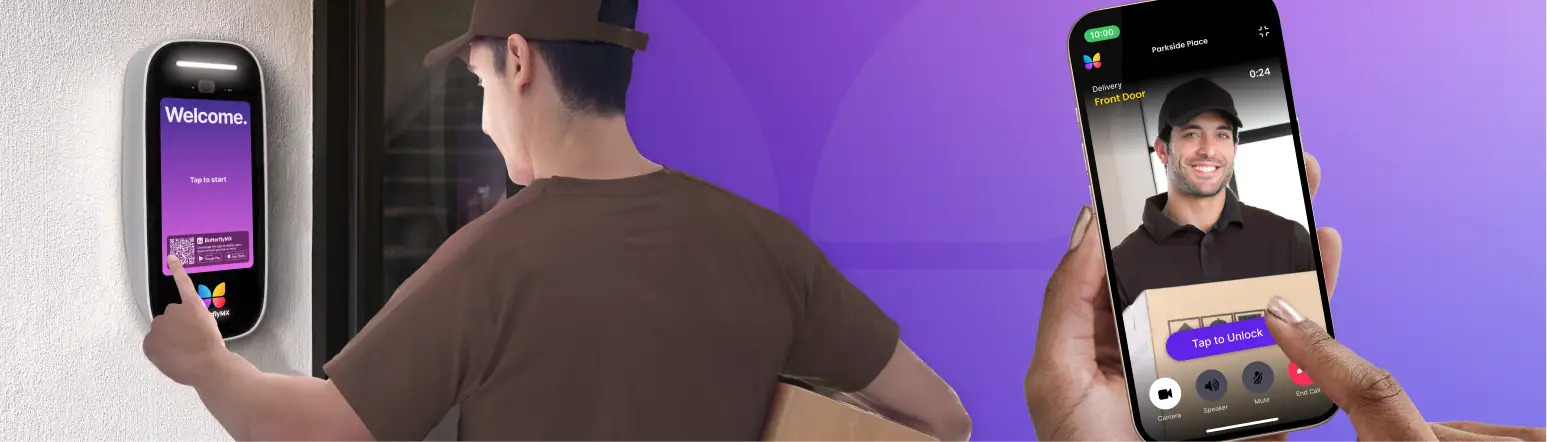
Watch how ButterflyMX works:
Luxer One review: What is the product?
Luxer One is an ASSA ABLOY-owned package-management company. Its main product is a modular indoor or outdoor locker system that accepts deliveries from multiple carriers and gives recipients self-service pickup access.
A carrier uses a shared kiosk to deposit a package, and the resident receives pickup credentials by app, text, or email. The resident can enter a code at the touchscreen or use supported app-based access. Luxer One describes its lockers as carrier-agnostic, which can reduce the number of packages staff must store and hand out.
Luxer One launched its current brand in 2013, and ASSA ABLOY acquired the company in December 2018. In June 2026, Luxer One reported more than 12,000 properties and 560 million resident transactions, and introduced Luxer Access as a separate platform for broader building, resident, visitor, and amenity access.
Who is Luxer One designed for?
Multifamily communities are a core market, but Luxer One also serves offices, retail stores, universities, hotels, senior living communities, and mail centers. Its multifamily package-management offering combines lockers or package rooms with resident notifications, reporting, roster management, and optional package services.
Luxer One is best suited to properties with enough delivery volume to justify permanent package infrastructure. The right setup depends on package volume and size, available space, outdoor exposure, and whether the property needs refrigerated storage.
Luxer One models and capacities
Every standard Luxer One installation starts with a 15-compartment Main Unit. Buyers can add high-density, extra-tall, oversized, compact, or refrigerated modules to match their package mix and space.
The Main Unit contains the touchscreen, electronics, battery backup, and surge protection for the locker bank. The details below come from the Luxer One specification book, so buyers should compare them with the equipment in a current quote.
Swipe to compare →
Luxer Fridge connects refrigerated compartments to the same package workflow. Luxer One also lists 14-, 17-, and 24-door add-ons, which give buyers more ways to balance small, medium, and large compartments.
How to choose a Luxer One configuration
Start with delivery records, not unit count alone. Review daily and seasonal volume, the share of small parcels, oversized deliveries, and how long packages stay in the system.
- Many small packages: The 44-door add-on provides the highest listed compartment density.
- Large items: The Oversized Module can improve acceptance, but fixed dimensions will not fit every irregular box or furniture delivery.
- Dry cleaning or tall goods: The 4-Door Add-On has extra-tall compartments with hooks.
- Low vertical clearance: The Sightline Series is shorter than standard towers.
- Perishable deliveries: Luxer Fridge adds refrigerated storage and a higher power draw.
Plan for overflow, too. A bank sized for average demand may fill during holidays or when residents delay pickup.
How much does Luxer One cost?
Luxer One does not publish a standard list price, so buyers need a property-specific quote. The public figures below offer context, but neither is a current Luxer One price.
Swipe to compare →
The two larger benchmarks are not interchangeable. The older number is an installation-level estimate, while the newer one uses per-door hardware and annual per-bank service costs across vendors. Configuration, site work, software, and timing can all change the total.
What to request in a Luxer One quote
Request an itemized proposal. It should separate the required Main Unit and add-ons from installation and ongoing costs.
- Indoor or outdoor hardware, freight, installation, and commissioning
- Electrical, network, conduit, concrete-pad, drainage, and roof-package work
- Oversized, refrigerated, or custom-branded modules
- Software, support, and annual service charges
- Optional Level-Up plans and any property-set storage or late-pickup fees
Ask for the resident fee policy in writing. Optional plan charges and property-set late or storage fees are different costs, but both can affect resident satisfaction.
Luxer One features and management tools
Luxer One combines locker hardware with mobile pickup, package-area surveillance, cloud management, and roster integrations. Its value is the workflow connecting carrier deposits, resident notifications, pickup records, and property oversight.
Hardware and pickup access
Luxer One says its lockers use American-made 12-gauge steel and internal tamper-resistant hinges. Residents can receive a pickup code by app, text, or email, enter it at the kiosk, or use supported tap-to-open access in the app.
One shared kiosk can accept packages from major carriers and independent couriers. That can simplify delivery operations, although carrier training and accurate recipient selection still matter.
Mobile app experience
The Luxer One resident app supports pickup codes, notifications, tap-to-open access, delivery holds, and account or payment management. It can also use Bluetooth as a local fallback during an internet interruption.
App feedback differs sharply by platform. In November 2026, the Google Play listing showed 3.2 out of 5 from 4,583 ratings, while the Apple App Store rating was 4.7 out of 5 from about 32,000 ratings. Properties with a mixed device base should test both workflows during evaluation.
Video, reporting, and integrations
Luxer One provides 24/7 cloud video surveillance of the locker area, with footage retained for 10 days. Video can help with incident review, but it does not guarantee package recovery or reimbursement.
Property tools include a centralized dashboard, resident-roster management, usage and dwell-time reporting, multi-location oversight, and support-ticket tracking. Named connections include Yardi, Entrata, RealPage, ConciergePlus, Greystar systems, and Secure FTP.
The core locker materials describe surveillance, not a native two-way video intercom. Properties that also need live visitor communication can compare this package-monitoring workflow with ButterflyMX, which supports video intercoms and security cameras.
Installation, connectivity, and outage planning
Luxer One requires professional installation, continuous power, and normal internet service. Indoor deployments need 120VAC power and CAT6 Ethernet, while outdoor installations add concrete, conduit, electrical, drainage, and weather-exposure requirements.
Swipe to compare →
The official specifications call for CAT6/RJ45 with at least 1.5Mbps upload and DHCP preferred. Normal kiosk communication, code issuance, and remote door commands rely on that connection.
What happens during a power or internet outage?
Luxer One has several fallback options, but each serves a different purpose. If internet fails while power remains on, a nearby resident may be able to use Bluetooth mode in the app, while staff can use documented override procedures.
If power also fails, Luxer One says its APC battery backup provides about two hours of power and surge protection. During a longer outage, staff may need to use a physical key or master override and communicate an alternate pickup process.
Bluetooth does not restore full cloud operation. Residents must be near the locker, have the app, and use a supported account and device. Properties should document who holds the physical key, who can use an override, and how residents will receive updates.
Space and site requirements
The standard indoor Main Unit is 76 inches high, 37.5 inches wide, 23 inches deep, and 500 pounds. Plans should also allow 60 inches of clear space in front and a 30-by-80-inch ADA-compliant entry area.
An outdoor deployment is a site project, not a simple equipment delivery. It may require a level concrete pad, 20A circuit, conduit, suitable drainage, outdoor-rated networking or cellular service, and a roof package for an uncovered location.
Security, package liability, and resident fees
Steel construction, access records, individual locker doors, and package-area video can improve control and accountability. They do not eliminate package loss, assignment mistakes, or financial disputes.
Package loss and liability
Luxer One limits its liability for lost or stolen packages and generally does not reimburse residents. In published BBB complaints and company responses, residents were directed to pursue the carrier, merchant, insurer, or law enforcement.
Property teams should decide who handles incident review, video requests, carrier claims, and resident communication. Video may help reconstruct an event, but it should not be presented as a reimbursement guarantee.
Recipient matching and delivery errors
Carrier workflow can create another risk. Complaint responses describe carriers selecting recipients from partial-name matches at the kiosk. A wrong selection can assign a package to another resident account, especially when several residents have similar names.
Ask how resident records are synchronized, how carriers see unit details, and what staff can do when a package is assigned to the wrong account.
Package lockers vs. shared package rooms
Individual locker compartments isolate each deposited item behind its own door. A shared package room holds multiple deliveries in one controlled space, so security depends more on room-entry rules, user behavior, camera placement, and prompt pickup.
A resident discussion of one Luxer One package room describes theft concerns despite access codes and cameras. One building does not represent every installation, but it shows why buyers should assess lockers and rooms separately.
ButterflyMX also supports package-room access workflows. Regardless of vendor, buyers should examine who can enter, how access is revoked, whether entries are recorded, and how packages are separated after delivery.
Resident plans and property-set fees
Luxer One lists optional Level-Up plans at $5, $10, and $15 per month. Depending on the tier, benefits may include household accounts, returns, and other resident features while creating a property revenue opportunity.
Storage and late-pickup charges can vary by property. Before launch, disclose any grace period, daily charge, subscription renewal, and return-to-sender rule.
What customers say about Luxer One
Luxer One feedback varies by platform. Trustpilot shows strong overall sentiment, the iOS app is rated more favorably than the Android app, and BBB complaints center on specific disputes rather than broad satisfaction.
Swipe to compare →
The difference matters. Trustpilot reviews reflect the wider pickup experience, app stores focus on mobile software, and BBB records help buyers understand dispute patterns and company policy responses.
Luxer One pros and cons
Luxer One is strongest when a property needs modular, carrier-agnostic package hardware and can support the required infrastructure and operating policies.
Pros
- Modular configurations: Properties can combine a required Main Unit with high-density, extra-tall, oversized, compact, or refrigerated modules.
- Durable design: Twelve-gauge steel and internal tamper-resistant hinges suit shared-property environments.
- Broad carrier workflow: One kiosk can accept packages from major carriers and independent couriers.
- Named property-system connections: Luxer One lists Yardi, Entrata, RealPage, ConciergePlus, Greystar, and Secure FTP.
- Layered outage options: Battery backup, Bluetooth access, and staff override provide more than one continuity option.
- Large reported footprint: ASSA ABLOY ownership and more than 12,000 company-reported properties suggest substantial operating scale.
Cons
- No public list pricing: Buyers need an itemized quote to separate hardware, installation, service, options, and site work.
- Normal operation depends on connectivity: Internet interruptions can disrupt cloud communication and require fallback steps.
- Limited financial recourse: Luxer One limits liability and directs loss claims to other parties rather than reimbursing residents.
- Uneven app sentiment: The Android score trails the iOS score by a wide margin.
- Fixed compartment sizes: Even an Oversized Module cannot fit every large or irregular item.
- Different format risks: Shared package rooms provide less per-item isolation than individual locker compartments.
Luxer One alternatives
Compare Luxer One with other package-management products using the same delivery volume, site, fee, integration, and security requirements. Common alternatives include:
- Parcel Pending by Quadient: A direct smart-locker comparison option for multifamily properties.
- Package Concierge by Quadient: An established compartment-based locker product in Quadient’s package-management portfolio.
- Smiota smart lockers: A multi-use option for packages, assets, day-use storage, and other workflows.
- Amazon Hub Apartment Locker: A commonly named apartment package-pickup alternative.
A package-locker alternatives overview identifies several of these products in the multifamily market. Ask each vendor about installation scope, carrier workflow, recipient matching, overflow, oversized items, app support, integrations, outage procedures, loss policy, recurring service, and resident charges.
Luxer One vs. ButterflyMX
Luxer One and ButterflyMX overlap around package access, but they start from different product centers. Luxer One focuses on modular package lockers and package-management services. ButterflyMX is a property access and security platform that supports package rooms alongside video intercoms, access control, mobile access, visitor access, vehicle access control, elevator controls, security cameras, smart lock integrations, and wallet-based credentials.
Swipe to compare →
Neither approach is right for every property. Luxer One may fit buyers whose priority is dedicated compartment-based locker hardware. ButterflyMX may merit consideration when package-room access is one part of a larger plan for entrances, visitors, vehicles, elevators, cameras, and other controlled access points.
Frequently asked questions
How much does Luxer One cost?
Luxer One does not publish a standard list price. A $6,000–$20,000 installed estimate dates to 2015, while a separate 2026 cross-vendor benchmark cites $800–$2,500 per door plus $500–$1,500 annually per bank; neither is a current Luxer One quote.
Does Luxer One require internet access?
Yes. Luxer One needs internet for normal kiosk communication, code issuance, and door commands; its stated wired requirement is CAT6/RJ45 with at least 1.5Mbps upload and DHCP preferred, while cellular is available for outdoor installations.
What happens if Luxer One loses power or internet service?
An APC battery backup provides about two hours of power, and Bluetooth mode can let a nearby resident use the app without internet. Staff also have physical-key or master-override options for supported situations.
Who is responsible if a package is stolen?
Luxer One limits its liability and generally does not reimburse residents for lost or stolen packages. Its published complaint responses direct residents to the carrier, merchant, insurer, or law enforcement.
What Luxer One locker models are available?
Luxer One offers a required 15-compartment Main Unit, 14-, 17-, 24-, 44-, and four-door add-ons, an Oversized Module, the lower-profile Sightline Series, and one- or three-door Luxer Fridge configurations.
Does Luxer One have a mobile app?
Yes. The Luxer One app supports notifications, pickup codes, tap-to-open access, delivery holds, Bluetooth fallback, and account or payment management; iOS and Android ratings differ notably.
Which property systems integrate with Luxer One?
Named options include Yardi, Entrata, RealPage, ConciergePlus, Greystar property systems, and Secure FTP for resident-roster synchronization.
Is Luxer One suitable for outdoor use?
Yes, Luxer One offers outdoor configurations with a listed operating range of -4°F to 113°F. Outdoor installations need a suitable concrete pad, 120VAC/20A power, conduit, and outdoor-rated CAT6 or available cellular connectivity.
What are the main Luxer One alternatives?
Common comparison options include Parcel Pending, Package Concierge, Smiota smart lockers, and Amazon Hub Apartment Locker. ButterflyMX is also relevant when a property is considering package-room access as part of a broader property access and security platform.
Is Luxer One a good fit?
Luxer One may fit properties that want dedicated, carrier-agnostic package lockers with flexible compartment options, resident notifications, surveillance, and management tools. It is most compelling when delivery volume supports permanent infrastructure and the site can meet its power, network, space, and installation requirements.
The biggest tradeoffs are pricing uncertainty, normal dependence on internet service, fixed compartment sizes, resident-fee policy, and limited reimbursement after package loss. Buyers should also decide whether individual compartments or a shared package room better matches their security and overflow needs.
Compare current proposals using the same hardware configuration, site work, recurring service, app workflow, outage process, and liability questions. If package access should be part of a wider plan for entrances, visitors, vehicles, elevators, and property security, add ButterflyMX to the shortlist and request a demo.
Get your free quote!
Fill in the form below, and we'll email you right back.
Want a free quote?
Fill in the form below, and we'll email you right back.
Redirecting you in 5 seconds.