





Key takeaways:
- An RFID door system is a complete chain of credentials, readers, controller communications, door hardware, and management software, not just a reader at the door.
- Frequency does not determine credential security. Evaluate the credential family, key ownership, configuration, and reader-to-controller connection.
- Installed cost varies by opening because hardware, labor, existing conditions, credentials, software, and recurring services can differ widely.
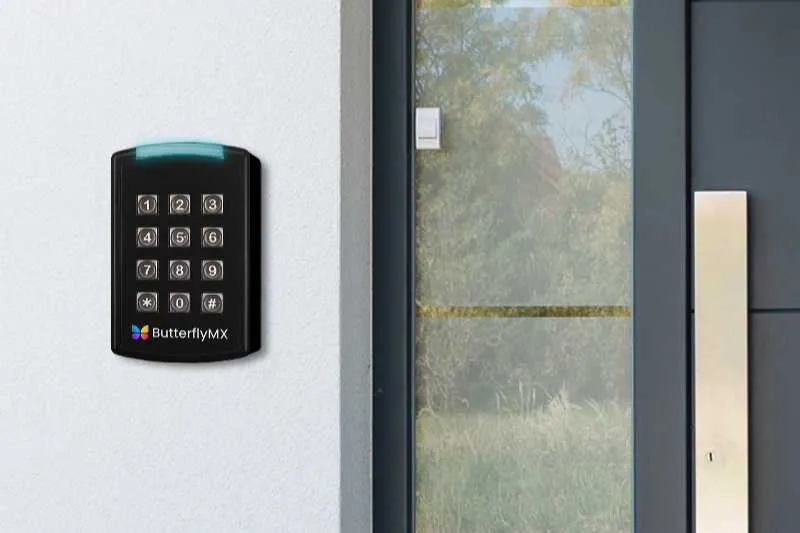
An RFID door access control system uses a card, fob, phone, or vehicle tag to present an identifier to a reader. The system then checks whether that credential has permission to enter, records the event, and signals the door hardware to unlock when access is approved.
That simple tap or wave can hide a complicated set of choices. Property teams must consider credential security, reader wiring, lock behavior during outages, resident workflows, visitor entry, vehicle gates, and the real scope behind a per-door quote. This guide explains how to evaluate those choices without treating every RFID access credential or access system as the same.
This guide will answer:
- What is an RFID door access control system
- How an RFID door access control system works
- How RFID frequencies and credential families differ
- How to evaluate cloning risk and reader link security
- How door hardware, outages, and egress affect operation
- How managed properties handle credentials and access workflows
- How much an RFID door system costs
- How to plan installation and a phased migration
- Where ButterflyMX fits in a multi-credential access plan
- FAQs
Watch how ButterflyMX works:
What is an RFID door access control system
An RFID door access control system is a network of hardware and software that verifies an access credential and controls an opening. The credential might be a card, fob, phone, or vehicle tag. The reader captures its data, a controller evaluates permissions and schedules, and approved access triggers an electrified lock while creating an event record.
The reader is only one part of the system. A typical opening includes the credential, reader, reader-to-controller link, access controller, power supply, lock hardware, request-to-exit device, door-position sensor, and management software. Some products combine components, but the jobs remain distinct. In a networked system, the controller and software can support schedules, audit trails, and credential changes. A standalone RFID lock may offer a simpler setup, but it may not provide the same centralized management or remote revocation.
The components that make an opening work
- A credential identifies a resident, employee, visitor, vehicle, or other approved user.
- An RFID reader receives data from the credential.
- A controller applies the access rules and sends the unlock command.
- An electric strike, maglock, or electrified lever changes the door state. These hardware types are not interchangeable.
- A request-to-exit device and door-position sensor help manage safe exit and report whether the door is open or closed.
- Management software supports credential administration, schedules, logs, and reporting in systems designed for centralized operation.
How an RFID door access control system works
Presenting a valid fob does not automatically unlock a door. The access decision depends on the credential status, the opening, assigned permissions, and often the time of day.
- The user presents a card, fob, phone, or tag to a compatible reader. Passive credentials are energized by the reader field; other credentials may require an active interaction.
- The reader obtains the credential data.
- The reader sends that data through its connection to the controller. This reader-to-controller link is a separate security layer from the credential itself.
- The controller checks the credential against rules such as status, permitted doors, and schedules.
- If access is approved, the controller commands the locking hardware to release and records the event. Door sensors and request-to-exit devices can provide additional operating information.
This sequence is why a property should assess the full path, not merely ask which reader is mounted beside the door. A strong credential can still be part of a weak deployment if key management or reader communications are poorly handled.
How RFID frequencies and credential families differ
RFID is an umbrella term. Frequency helps determine compatibility and typical use, but it does not create a universal security rating. In building access, low-frequency 125 kHz credentials are often associated with legacy proximity systems, 13.56 MHz high-frequency technology supports smart cards and NFC, and UHF is commonly used for longer-range vehicle applications. Kisi explains the RFID and NFC categories in more detail.
Swipe to compare →
NFC is a subset of 13.56 MHz RFID, not a competing category that is automatically better or worse than RFID. A property may use physical fobs, smart cards, NFC phones, and UHF vehicle tags together because each serves a different opening or workflow.
Credential family matters more than frequency alone. For example, Radboud University documented weaknesses in the Crypto-1 design used by MIFARE Classic. That research should not be stretched into a claim about every 13.56 MHz credential. NXP documents AES-128 and mutual authentication capabilities for MIFARE DESFire EV3, though a secure deployment still depends on how keys are issued, protected, and managed.
How to evaluate cloning risk and reader link security
Ask four questions when assessing RFID security: What frequency is in use? What is the credential family? Who owns and controls the site-specific encryption keys? How does the reader communicate with the controller? Each question covers a different risk.
Use a four-layer security check
- Band: Identify whether the system uses low-frequency, high-frequency, NFC, or UHF technology. This establishes compatibility and typical use, not security by itself.
- Credential family: Name the exact format. Many legacy 125 kHz formats transmit fixed identifiers, which generally makes them more exposed to copying than modern encrypted credential families.
- Key governance: Document whether keys are site-specific, who can provision them, where they are stored, and what happens if the property changes vendors.
- Reader link: Confirm how credential data travels from reader to controller and whether the installed configuration protects that connection.
Wiegand is commonly a one-way, unencrypted reader protocol. OSDP, formally standardized as IEC 60839-11-5, can support encrypted communications when Secure Channel is enabled. Encryption is not automatic merely because a product is OSDP-capable. At handover, ask the installer to document the protocol and installed mode for every relevant opening. The Security Industry Association announced OSDP version 2.2.2 in October 2024, reflecting the continuing importance of that standard. Read the SIA announcement about OSDP 2.2.2.
No credential should be described as impossible to clone. The practical risk depends on the technology, the keys, the reader configuration, physical access to equipment, and property procedures. Stronger credentials and a protected reader link can reduce exposure, but they do not replace prompt deactivation of lost credentials or careful administration.
How door hardware, outages, and egress affect operation
Internet loss, power loss, and emergency release are different events. A property should know the expected behavior for each controlled opening before installation, not after a disruption.
Fail-safe and fail-secure describe hardware behavior, not a simple good-versus-bad choice. The appropriate approach depends on the door, security goal, egress design, and locally adopted requirements. An electric strike, maglock, or electrified lever can be part of different compliant designs depending on the opening.
Code requirements vary by jurisdiction and door type. The inspected IBC 2021 Illinois adoption includes a sensor-release path that coordinates release conditions, exit controls, alarm or sprinkler activation, emergency lighting, and listed hardware. It does not mean every electrically controlled door must unlock in every power-loss scenario. The 2024 IBC also changed section numbering. Review the locally adopted code path with a qualified installer and the AHJ. The inspected sensor-release provisions illustrate why egress cannot be treated as a reader setting.
Create and test an opening-by-opening outage plan for entrances, amenities, garages, gates, elevators, and other controlled areas. Record the expected state, backup-power source, release method, and person responsible for testing each opening.
How managed properties handle credentials and access workflows
RFID is only one part of property access. A resident fob can open a designated door, but it does not by itself create a visitor process, authorize a delivery person, or manage a vehicle lane.
Build a credential lifecycle
- Assign a credential at move-in or onboarding and apply the correct doors and schedules.
- Record issuance, replacement, and exceptions so the property can understand who has active access.
- Deactivate a lost credential promptly and issue a replacement under the property policy.
- Remove or change access at move-out, role changes, or contract completion.
A centrally managed system can support permission changes, event records, and remote revocation when those functions are included in the selected configuration. The process should also accommodate residents who do not own, cannot use, or simply prefer not to use a smartphone. Physical credentials and mobile access are often complementary rather than mutually exclusive.
Do not assume a system can identify every copied fob. Whether duplicate use is detectable depends on credential technology, product capabilities, event data, configuration, and property practices. Prevention through credential selection, key governance, reader-link protection, and prompt deactivation is more dependable than a promise of automatic detection.
For properties that need connected workflows beyond a resident fob, evaluate ButterflyMX cloud-based access control alongside the same criteria used for any platform: opening compatibility, credential support, outage behavior, integrations, installation scope, and recurring costs. Confirm current product specifications and credential details for the intended deployment.
How much an RFID door system costs
There is no reliable universal cost per door because an opening is a scope of work, not a single product. For 2026 planning context, Swiftlane lists a standard installed door at about $1,500 to $5,000. ButterflyMX cites vendor and integrator estimates of roughly $500 to $5,000 or more per door. These are vendor-sourced planning ranges, not independent industry averages, and their scopes may differ. Swiftlane explains its 2026 RFID access cost range.
Compare quotes by opening
- Reader, controller, power supply, backup power, and lock hardware
- Cabling, conduit, network work, labor, and existing-condition repairs
- Credentials, enrollment, replacement stock, and credential administration
- Software, support, connectivity, maintenance, and other recurring services
- Permits, integrations, testing, training, warranty, and closeout documentation
Ask each bidder to state what is reused, what is replaced, which openings are included, how many credentials are included, and which recurring fees begin after installation. Existing wiring, door condition, fire-release interfaces, and lock hardware can materially change the total. For a deeper multifamily budgeting framework, see this guide to access control cost per unit and per door.
How to plan installation and a phased migration
Begin with an inventory, not a product shortlist. Document every controlled opening, its existing credentials and readers, controller, wiring, lock hardware, power, network connection, door sensors, request-to-exit equipment, and emergency interfaces. Then require an opening-by-opening compatibility assessment.
For each vendor, ask for written answers about credential family, site-specific key ownership, credential provisioning, OSDP availability, Secure Channel status, offline decisions, backup power, and expected behavior during power loss. Do not assume old readers, wiring, controllers, or locks are reusable simply because a current fob works at the door.
A legacy 125 kHz property may be able to use a phased transition. A possible approach is a compatibility audit, multi-technology readers where appropriate, a limited dual-credential period, clear resident communication, and a defined date to retire legacy credentials. The right plan depends on the installed equipment and the chosen credential platform, so it should be tested before a property-wide rollout.
Aliro 1.0, announced by the Connectivity Standards Alliance in February 2026, is a standards-development milestone for NFC, Bluetooth LE, and UWB access interoperability. It is not proof that a particular reader, phone, wallet, or access-control product currently supports the standard. The Aliro 1.0 announcement is useful context, but buyers should verify certified products and actual reader support before including it in a migration plan.
Where ButterflyMX fits in a multi-credential access plan
ButterflyMX may be worth evaluating when a managed property wants centrally managed access alongside broader resident and property workflows. The useful question is not whether RFID alone is enough. It is whether the property needs an access plan that accounts for residents, staff, visitors, deliveries, vehicles, elevators, and different opening types.
Start with a fit checklist: list the openings to be controlled; determine which users need physical and mobile credentials; document visitor and delivery needs; evaluate existing-system compatibility; define outage and egress behavior; and compare the installed and recurring costs. Then confirm current ButterflyMX capabilities, credential support, installation requirements, and integrations for the property before selecting a design.
Frequently asked questions
Can a property upgrade from 125 kHz fobs without replacing every reader?
Possibly, but only after an opening-by-opening compatibility audit. A phased migration may use compatible or multi-technology readers, a dual-credential period, and a planned cutoff date, but existing readers, wiring, controllers, and credentials are not automatically reusable.
Can an access control system detect a duplicated RFID key fob?
It depends on the credential technology, system functions, configuration, event data, and operating practices. Properties should focus first on stronger credential choices, sound key management, protected reader communications, and prompt deactivation of lost credentials.
Should an apartment property use fobs, phones, or both?
Many properties should evaluate both options. The right mix depends on resident accessibility, opening compatibility, credential issuance, lost-device procedures, support needs, and visitor workflows. A physical credential remains important for residents who do not have or prefer not to use a compatible smartphone.
Is RFID or NFC better for an apartment entrance?
NFC is a subset of 13.56 MHz RFID, so this is not a simple either-or choice. The better fit depends on the credential family, reader support, key management, configuration, and user needs, not on frequency alone.
Do RFID windshield tags work for garage and community gates?
UHF windshield tags are a common vehicle-access option, but performance is site-specific. Tag placement, reader position, antenna design, lane geometry, traffic flow, and environmental conditions all affect usable read performance.
Who should control credential encryption keys when a property changes vendors?
The property should require a written explanation of key ownership, whether keys are site-specific, who can provision credentials, what is provided at handover, and how a future migration would work. The right arrangement depends on the credential platform and contract.
The best RFID door access control system is not defined by a reader frequency or a single fob. It is defined by how well the credential family, key governance, reader communications, controller, door hardware, outage plan, and daily property workflows fit together.
Build your evaluation around each opening and each user group, then compare systems on documented security, compatibility, operating behavior, and complete cost. If your property needs a connected plan for residents, visitors, deliveries, vehicles, or elevators, talk with ButterflyMX about your property access plan.

Get your free quote!
Fill in the form below, and we'll email you right back.
Want a free quote?
Fill in the form below, and we'll email you right back.
Redirecting you in 5 seconds.