





Key takeaways:
- An exterior apartment door may be an exposed unit door in a breezeway property or a shared entrance used by many residents, and each requires a different access strategy.
- Apartment-friendly installation does not prove exterior suitability. Verify the exact lock model, exposed components, temperature limits, warranty terms, and ANSI/BHMA certification.
- For multifamily properties, the decision should also account for turnover, staff access, visitor entry, credential revocation, audit needs, and integration with the broader property access system.
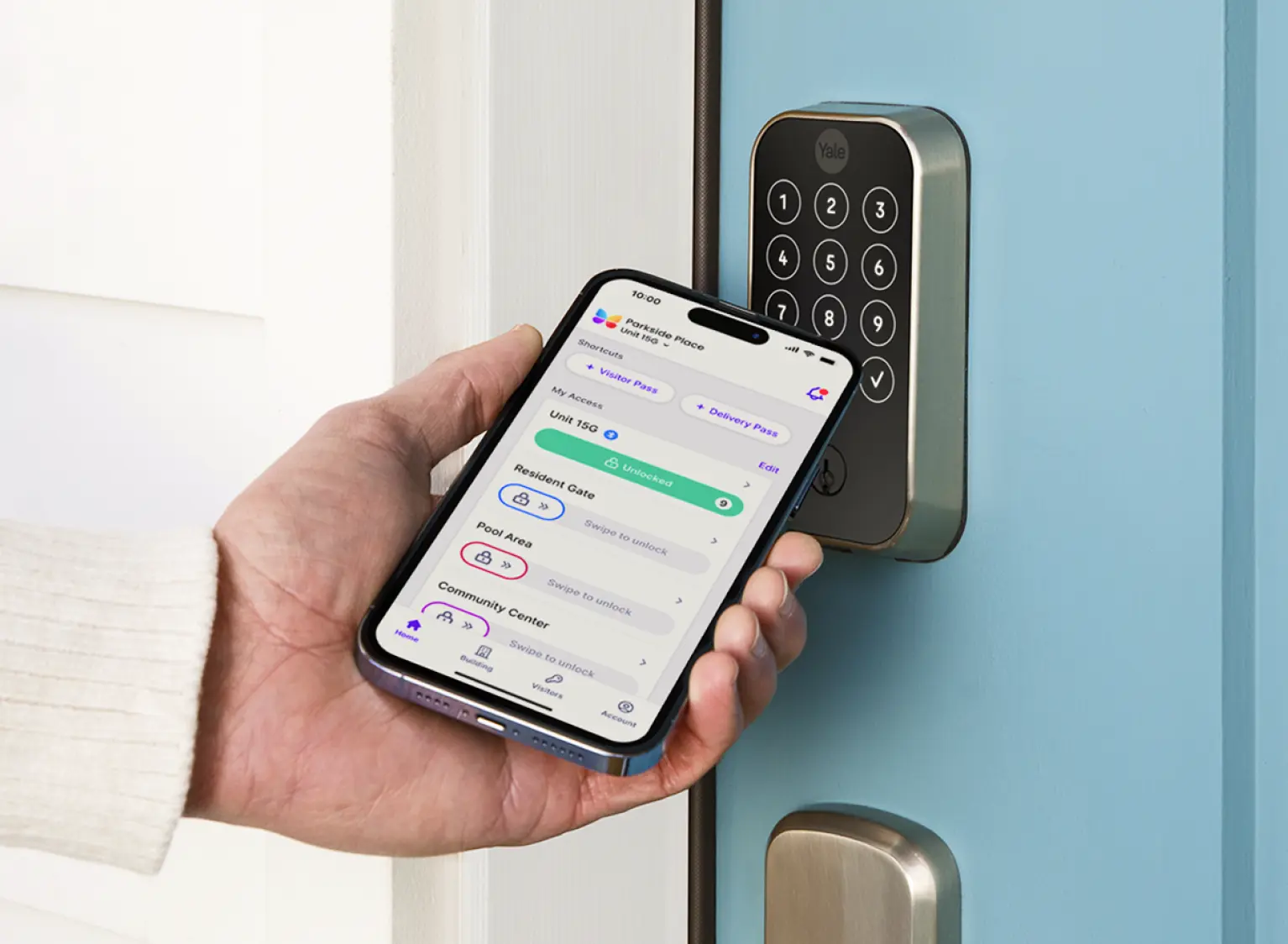
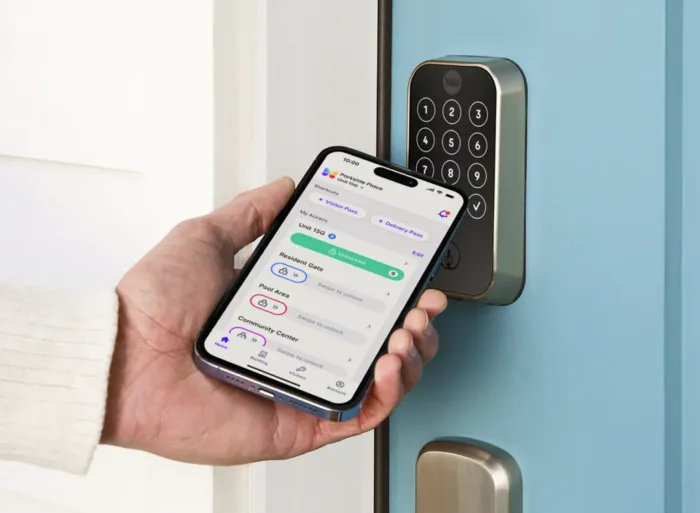
Smart locks for exterior apartment doors are not a single product category with one best answer. The right choice depends first on which door you mean: an apartment unit door that opens to an outdoor corridor, breezeway, or garden-style walkway, or a shared exterior entrance that serves many residents, visitors, and staff.
That distinction matters because the lock has to solve the right problem. An exposed unit door needs documented physical security, weather and temperature suitability, compatible installation, and a reliable backup entry plan. A shared entrance adds multiuser access, visitor entry, egress, and property-wide administration. A lock that is easy to install in an apartment is not automatically ready for rain, sun, heat, cold, or multifamily operations.
Use the door, the property layout, and the access plan as your starting point. Then compare smart locks by verified security performance, manufacturer documentation, installation impact, offline access, lease or owner approval, and local life-safety requirements.
This guide will answer:
- What counts as an exterior apartment door?
- Start with the door, not the smart lock
- Verify physical security with ANSI/BHMA certification
- Check weather, temperature, and warranty suitability
- Compare retrofit and full replacement smart locks
- Plan connectivity, credentials, and failure fallback
- Confirm lease, installation, fire, and egress requirements
- Build a managed access strategy for multifamily properties
- FAQs
Watch how ButterflyMX works:
What counts as an exterior apartment door?
An exterior apartment door can mean an individual unit entry exposed to outdoor conditions, such as a door that opens onto an open corridor, breezeway, or garden-style walkway. It can also mean a shared building entrance that residents, visitors, staff, and service providers use to enter the property.
In an open-breezeway community, the unit door may be the resident’s main controlled entry because there is no enclosed lobby or vestibule. ButterflyMX covers that property layout in its guide to smart locks for open breezeway apartment buildings.
A shared entrance is a different access problem. It usually involves more people, more traffic, visitor access, staff permissions, and egress considerations. Some properties need both layers: smart access at exterior-facing unit doors and a managed access system at shared entrances. Identifying the door first keeps you from comparing products against the wrong requirements.
Start with the door, not the smart lock
The best way to evaluate smart locks for exterior apartment doors is to work from the door outward. Before comparing apps, keypads, or credentials, answer these questions in order:
- Identify the door type, owner, traffic level, direct weather exposure, and role in the property’s access path.
- Verify the exact lock model or retained hardware for documented physical-security performance and applicable ANSI/BHMA certification.
- Read the manufacturer’s documentation for exposed components, operating-temperature range, sealing requirements, installation conditions, and warranty exclusions.
- Confirm the door’s thickness, preparation, alignment, installation impact, and whether a physical key or another authorized backup method remains available.
- Test the failure plan for dead batteries, lost phones, failed mobile credentials, internet loss, and emergency entry.
- Decide whether the door will be controlled by one resident or managed as part of a portfolio that must support turnover, staff access, visitor entry, auditability, and integrations.
No single ANSI/BHMA grade, installation style, or connection type is automatically correct for every exterior apartment door. A shaded unit door in a garden-style property, a shared exterior entrance, and a high-traffic staff door can all point to different decisions. The useful comparison is between the actual door conditions and the documented capabilities of the specific lock configuration.
Verify physical security with ANSI/BHMA certification
For exterior door security, start with documented mechanical performance rather than app features. ANSI/BHMA A156.2 establishes Grade 1, Grade 2, and Grade 3 performance tiers for bored and preassembled locks and latches. Grade 1 is the most rigorous tier, but that does not make it a universal requirement for every apartment door. The right certified performance depends on the door’s use, risk profile, property requirements, and local expectations.
The BHMA overview of A156.2-2022 explains that grading addresses testing related to cycling, strength, operation, and security. That matters because electronic convenience and physical resistance are separate issues. Mobile access, PINs, biometrics, and remote controls may change how people unlock the door, but they do not by themselves prove forced-entry resistance.
Exact models and variants also matter. Consumer Reports lab-tested smart-lock coverage notes meaningful physical-security differences among individual smart-lock models and variants. So, avoid judging a lock only by brand, product family, or feature list.
- Confirm the exact model number and which component carries the stated ANSI/BHMA certification.
- Check whether the product replaces the full lock assembly or works with an existing deadbolt and exterior cylinder.
- Evaluate mechanical security separately from credentials, connectivity, and mobile-app features.
- For retrofit locks, evaluate the retained exterior hardware because the retrofit device does not independently upgrade its grade or condition.
This is especially important for renters and owners considering interior-side retrofit devices. Preserving the existing exterior keyway can be convenient, but the existing deadbolt still needs its own security evaluation.
Check weather, temperature, and warranty suitability
Some smart locks may be suitable for exterior exposure, but apartment-friendly marketing is not the same as weather-rated hardware. A lock can be easy to install in an apartment and still be a poor fit for direct rain, strong sun, moisture, cold, heat, or a warranty-limited installation.
Review the current manufacturer documentation for the exact model before purchase. Pay close attention to which parts are exposed after installation. An exterior keypad, escutcheon, cylinder, and interior module may not all have the same exposure limits. If the manufacturer lists an IP rating, read what component and installation condition it applies to rather than treating it as blanket approval for the whole door.
Exposure checklist
- Is the lock sheltered by a hallway, overhang, or breezeway, or is it directly exposed to rain and sun?
- Which installed components face the exterior: keypad, escutcheon, cylinder, reader, interior module, or trim?
- What operating-temperature range does the manufacturer document for the exact model?
- Does the documentation mention moisture, sealing, direct rain, installation conditions, or warranty exclusions?
- How will the property handle low-battery alerts, battery changes, approved backup entry, and maintenance during temperature extremes?
- Will drilling, altered trim, or a replacement lockset affect door alignment or weather sealing?
Neither a retrofit lock nor a full replacement is automatically weather-suitable because of its installation category. Exterior suitability comes from model-specific documentation, correct installation, and the conditions at the actual door.
Compare retrofit and full replacement smart locks
A retrofit smart lock operates or replaces the interior mechanism of a compatible existing deadbolt while typically leaving the exterior cylinder and keyway in place. A full replacement changes the lock assembly. The difference affects key control, installation impact, renter approval, and how you evaluate the hardware.
For renters, the main appeal of a compatible retrofit is that it may keep the landlord or property key working because the exterior cylinder remains in place. August renter guidance describes this type of interior-side retrofit approach. However, keeping the keyway does not make the change permission-free. Renters still need to review the lease and obtain any required owner approval.
For landlords and property teams, a full replacement can make sense when the goal is to evaluate the complete lock assembly rather than add electronics to existing hardware. That said, full replacement can also change keys, door preparation, installation requirements, and maintenance procedures. Readers who want broader apartment smart-lock category guidance can also review ButterflyMX guidance on smart locks for apartment buildings.
The installation type answers only one question: what hardware changes. It does not, by itself, prove weather suitability, physical-security performance, offline reliability, lease compliance, or code acceptance.
Plan connectivity, credentials, and failure fallback
Connectivity should support the access plan, not distract from it. WiFi, Bluetooth, Z-Wave, Zigbee, and Matter over Thread can involve different combinations of local operation, hubs or bridges, remote administration, and ecosystem compatibility. More connected features do not automatically mean better resilience when the internet, a phone, or a cloud service is unavailable.
Before choosing credentials, decide what must still work when something fails. Can an authorized person unlock the door if the internet is down? What happens if the batteries are depleted? Who can enter if a resident loses a phone? Which unlocking methods remain local, and which require a hub, bridge, or cloud connection?
Questions to ask before you choose credentials
- Do residents, staff, visitors, or service providers need different credential types?
- Which methods are available: PINs, mobile credentials, fingerprints, key fobs, physical keys, or emergency-power procedures?
- Which credentials work locally, and which depend on internet access or a connected platform?
- Who can issue, revoke, or change access, especially after move-out or staff changes?
- What backup method is approved by the manufacturer and by the property owner?
Matter, Apple Home Key, and Aliro are useful compatibility considerations, but they do not prove mechanical grade, weather sealing, temperature tolerance, or warranty coverage. Support also changes by model and configuration, so verify current compatibility at the time of purchase.
Confirm lease, installation, fire, and egress requirements
Technical compatibility is not the same as permission. Renters should review the lease and get required approval before changing a lock, even when a retrofit leaves the exterior keyway unchanged. Owners and installers should also check door material, thickness, existing preparation, drilling needs, alignment, and sealing before installation.
Fire and egress requirements depend on the door and the jurisdiction. NFPA life-safety guidance on permissible egress-door locking arrangements describes general restrictions on egress-side locks that require a key, tool, or special knowledge, along with residential-occupancy provisions addressing additional locking motions. A means of egress is the path people use to leave a building in an emergency, so shared doors on that path deserve special review.
An individual apartment unit door and a shared exterior entrance should not be treated as the same code question. This article provides general educational information, not legal advice, engineering advice, or project approval. Local code adoption and interpretation can differ, so property teams should verify the proposed installation with the local authority having jurisdiction and any other applicable stakeholders.
Build a managed access strategy for multifamily properties
A resident-managed consumer lock solves a different problem from a multifamily access system. A single resident may care most about convenience, a physical-key backup, and reversible installation. A property team has to think about what happens across many doors, many users, and many access changes.
For multifamily properties, build the access strategy around practical operating questions:
- How are credentials issued at move-in and revoked at move-out?
- Who can grant or remove staff permissions?
- How are visitors, deliveries, maintenance teams, and authorized service providers handled?
- What audit information does the property need?
- How are emergency procedures, physical-key control, batteries, hubs, and maintenance managed?
- How do unit-level smart locks coordinate with shared entrances, video intercoms, mobile access, and remote access management?
Property layout should guide the architecture. An open-breezeway property may place more emphasis on exterior-facing unit doors because those doors are the main controlled entry points. An enclosed building often needs coordinated decisions for both the shared entrance and each residence. Either way, the system should match the path residents, visitors, staff, and service providers actually use.
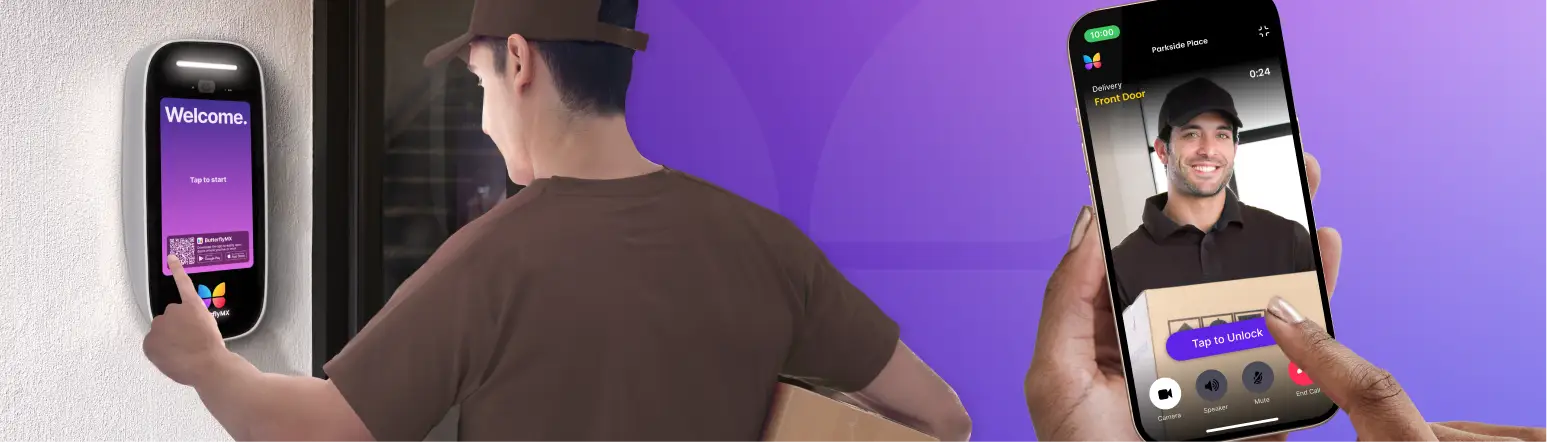
ButterflyMX is most relevant when a property team needs coordinated building access rather than a one-off consumer lock. ButterflyMX is not a smart-lock manufacturer, and it does not certify a lock’s weather resistance or mechanical grade. Instead, ButterflyMX can support compatible smart-lock integrations alongside access control, video intercoms, mobile access, visitor access, and remote administration. Residents can receive visitor calls and grant access from their smartphones, while property teams can remotely manage residents, visitors, credentials, and access.
That distinction keeps the decision clear. Choose the lock hardware based on the door’s security, exposure, installation, and fallback requirements. Then decide whether that lock needs to work as part of a managed property access system.
Frequently asked questions
Is a smart lock as secure as a traditional deadbolt?
A smart lock is not automatically more or less secure than a traditional deadbolt. Evaluate the exact model or variant, applicable ANSI/BHMA certification, retained hardware, and credible model-level testing rather than judging security by connectivity alone.
What happens if the battery dies during cold weather?
The answer depends on the lock model and installation. Before buying, confirm the documented operating-temperature range, low-battery warnings, approved backup entry, emergency-power procedure, and whether a physical key or another authorized method remains available.
Do smart locks work without WiFi?
Many smart locks can offer local unlocking methods without WiFi, but remote access and cloud-based administration may not work during an outage. Verify which credentials, unlocking methods, and management functions remain available offline for the exact lock and configuration.
How should property managers handle smart-lock access during resident turnover?
Property managers should revoke prior credentials, enroll the new resident, confirm staff permissions, maintain physical-key control, review audit needs, and verify that connected systems update as intended. The exact process depends on the selected lock, management platform, and integration.
The best smart-lock approach starts with the actual door. An exposed unit entry, an open-breezeway apartment, and a shared exterior entrance can all require different choices, even when the product descriptions sound similar.
Before selecting hardware, verify documented mechanical performance, exterior exposure limits, compatible installation, fallback access, lease or owner requirements, and local fire and egress considerations. For multifamily properties, also plan how the lock will fit into turnover, staff access, visitor entry, and building-wide access management.
Managing exterior unit doors and shared entrances? Talk with ButterflyMX about a coordinated property access strategy with compatible smart-lock integrations, access control, video intercom, mobile access, visitor access, and remote management.
Get your free quote!
Fill in the form below, and we'll email you right back.
Want a free quote?
Fill in the form below, and we'll email you right back.
You’ll be redirected shortly...