





Key takeaways:
- Plan alleys and basement stairwells as separate camera zones because light, weather, geometry, mounting risk, and connectivity are different in each place.
- For basement stairs, there is no single best mounting height: lower angles can improve facial detail, while higher angles can make the camera harder to reach.
- IR can help cameras see in the dark, but it does not replace required egress lighting or other security layers such as maintained doors, clear sightlines, and access control.
Apartment building security cameras for alley and basement stairs have to solve two different problems. An alley is exposed, often dark, and may border neighboring property. A basement stairwell is enclosed, narrow, and often part of the building’s egress path. Treating both spaces like standard common areas is how blind spots stay blind.
The best apartment security cameras plan starts with the actual conditions on site. For alleys, look for low-light performance, weather-appropriate hardware, and views of approaches and secondary doors. For basement stairs, look for IR-capable coverage across the travel path, mounting that balances face capture with tamper risk, and reliable power and network connectivity. Then support the cameras with working lighting, maintained doors, clear sightlines, access controls, and a written policy for footage use.
This guide will answer:
- Recommended camera plan for alleys and basement stairs
- Why these areas become blind spots
- Camera types by environment
- Placement and mounting height tradeoffs
- Lighting for usable video and safe egress
- Weatherproofing and connectivity by environment
- Privacy, retention, and liability boundaries
- Planning cameras with access control and video intercoms
- Blind spot audit checklist
- FAQs
Watch how ButterflyMX works:
Recommended camera plan for alleys and basement stairs
A useful camera plan separates the alley from the basement stairs before choosing equipment. The alley plan should focus on low-light video, exterior exposure, service-door activity, and neighboring privacy. The stairwell plan should focus on IR performance, narrow sightlines, tamper-aware mounting, and tested connectivity through basement construction.
- Decide what each camera must capture: faces, direction of travel, door activity, or general scene awareness.
- Test camera performance with the lighting that actually exists at night, including shadows, glare, vehicle headlights, and bright-to-dark transitions near doors.
- Evaluate wired Power over Ethernet, or PoE, before relying on WiFi in below-grade concrete or masonry areas.
- Use cameras as one layer alongside lighting, maintained secondary doors, sightlines, and access management.
There is no universal camera count, mounting height, or form factor for every property. The right layout depends on stair landings, turns, door locations, obstructions, property boundaries, moisture, available power, and the level of image detail the property team needs from recorded video.
Why these areas become blind spots
Alleys and basement stairwells become blind spots because they combine isolation, poor visibility, secondary access, and obstructed sightlines. An alley may serve deliveries, trash collection, parking, or a rear entrance. A basement stairwell may have tight turns, landings, and changing light. Both spaces can see little staff presence, but the conditions around each camera are very different.
- An alley is a semi-public exterior zone. Its camera plan must account for rain, dust, vehicle headlights, service activity, shared property lines, and views that might capture neighboring windows, yards, or private areas.
- A basement stairwell is an enclosed travel path and may be part of the building’s means of egress. Camera placement should not interfere with handrails, doors, sprinklers, exit signs, emergency equipment, or required lighting.
- A secondary door is a security control, not just something to record. Inspect the lock, closer, latch, credential process, and maintenance history instead of using a camera as a substitute for a working entrance.
This layered view is consistent with Crime Prevention Through Environmental Design, or CPTED. CPTED treats cameras as one part of a managed environment that also includes lighting, sightlines, landscaping, territorial cues, and access management. The U.S. Department of Justice guide to CPTED explains that physical design and property management work together rather than depending on one device.
Risk planning should stay practical and carefully qualified. Poor lighting, prior incidents, maintenance records, and foreseeability can become part of a negligent-security dispute, but they do not create an automatic legal conclusion. Treat this article as general information and get jurisdiction-specific guidance for legal duties, notice rules, and camera policies.
Camera types by environment
For both alleys and basement stairs, start with a fixed camera that can produce usable low-light or IR footage at the planned distance. Then choose the form factor around the environment. A fixed bullet or turret camera may make sense in an exposed alley. A tamper-aware dome or other fixed camera may fit an indoor stairwell better. For a broader overview of camera categories, review these types of apartment security cameras.
The table should guide the first conversation with an installer, not replace a site assessment. Bullet and turret directions can be useful outdoors because the camera body and aim are more visible, but the final choice still depends on mounting surface, exposure, field of view, and tamper risk. Dome cameras can be useful in indoor common areas where a lower-profile enclosure matters, but they still need the right lens, angle, and lighting.
Low-light performance describes how well a camera creates an image under limited visible light. IR illumination uses infrared light that the camera can detect in darkness. Neither term guarantees useful footage on its own. A camera’s listed IR range should be tested from the planned mount to the actual target area, because a stair landing, rear door, or alley approach may be farther away or more reflective than expected. Manufacturer guidance on apartment security camera planning also emphasizes placement and illumination for usable coverage.
Wide dynamic range can help where the scene has bright and dark areas at the same time, such as a lit exterior door opening into a dark stairwell or an alley with headlights. Corridor-format video rotates a supported camera image into a vertical view, which can reduce wasted horizontal space in a narrow stair run. It is worth testing when the geometry supports it, but it is not automatically better for every stairwell. For more form-factor context, see dome cameras for indoor common areas and bullet versus turret cameras for outdoor areas.
Placement and mounting height tradeoffs
Do not pick a stairwell camera height from a generic rule. Start by deciding what the view must prove later: who entered, which way someone traveled, whether a door opened, or what happened on a landing. That capture objective should shape the angle, not the other way around.
This is the core stairwell tradeoff: a lower camera may see faces better, but it can also be easier to block, hit, or tamper with. A higher camera may survive better, but the steeper angle can reduce identification detail. Practitioner guidance on stairwell placement describes the same tension, so the final decision should depend on stair geometry, camera lens, tamper exposure, and the desired view.
In many stairwells, aiming across a landing or travel path provides more useful context than aiming straight down from above. Watch people walk both up and down the stairs during testing. Review footage during the day, at night, with the door open, and during mixed-light conditions before accepting the installation. A broader guide to avoiding blind spots during camera installation can help structure that field test.
Placement also has to respect the building. Cameras, housings, cables, and mounts should not obstruct handrails, doors, sprinklers, exit signs, emergency equipment, or other life-safety features. Complex stairwells, tight landings, and unusual ceiling conditions are good reasons to bring in a qualified installer before deciding where equipment belongs.
Lighting for usable video and safe egress
Security lighting and emergency egress lighting are not the same thing. Security or supplemental lighting helps people see the space and can improve recorded video. Emergency egress lighting is a separate life-safety requirement governed by the applicable code. IR can help a camera form an image in darkness, but it does not give occupants the visible light they need to exit safely.
NFPA guidance on emergency lighting and exit marking describes emergency lighting for relevant egress paths as an initial average of 1 footcandle, with no point below 0.1 footcandle, for at least 90 minutes. Confirm the current code edition adopted in the property’s jurisdiction before using those figures for a project, because local adoption and project conditions control.
- Test the camera with existing ambient and security lighting before adding fixtures only for the camera.
- Look for shadows on landings, glare from wall-mounted lights, reflective painted surfaces, bright door lights, and vehicle headlights in alleys.
- Test IR performance after installation. A listed IR range does not prove that the camera will capture useful detail in a specific stairwell or alley.
- If the project needs exact security-lighting levels, use applicable primary IES guidance and local requirements rather than a generic number.
- Have a qualified electrician or local code authority address life-safety lighting and any changes to egress areas.
The practical point is simple: plan lighting for both people and cameras, but don’t confuse the two. Camera IR supports imaging. Code-governed egress lighting supports safe exit.
Weatherproofing and connectivity by environment
Alley exposure and IP ratings
An alley camera has to survive more than darkness. Rain, dust, condensation, temperature swings, cable entry points, mounting surfaces, corrosion conditions, and impact exposure can all affect the installation. That is why exterior hardware should be evaluated for the actual site rather than treated like an indoor camera moved outside.
An IP rating under IEC 60529 classifies how an enclosure resists solids and water. The first digit addresses solids such as dust, and the second digit addresses water. For exposed alley hardware, IP66 and IP67 are common ratings to evaluate. The IEC explanation of IP ratings identifies IP66 as protection against powerful water jets and IP67 as protection against temporary immersion, but the full installation context still matters.
An IP rating is not a full environmental or vandal-resistance rating. IP67 does not, by itself, prove that a camera can withstand impact, corrosion, poor cable sealing, or every site hazard. Basement stair cameras need their own moisture and condensation review instead of simply borrowing the alley rating decision.
PoE and wireless in basement construction
Basement connectivity deserves the same attention as camera choice. PoE carries network data and electrical power over Ethernet cabling for compatible devices. It is often the first option to evaluate for below-grade cameras because it avoids depending only on a wireless signal through concrete or masonry. Still, a wired route is not feasible in every existing building, so the property needs a site assessment before the design is final. Learn more about PoE camera reliability and planning considerations.
- Test WiFi signal at the final camera location, not just at the basement doorway or stairwell entrance.
- Confirm available bandwidth, recording destination, network segmentation, failover expectations, and who can access the system.
- If the property already uses a video management system, or VMS, define how the camera will record and whether interoperability requirements such as ONVIF support matter for the project.
- Confirm a power plan for every device and decide how outages will be noticed, reported, and fixed.
- Make sure technicians can safely reach cameras, cabling, and network equipment for cleaning, repair, and replacement.
Wireless cameras may be easier to place in some buildings, but the tradeoff is reliability. A camera that looks well-positioned on a plan is not useful if the signal drops, the power plan is unclear, or no one can reach the device for maintenance.
Privacy, retention, and liability boundaries
Keep camera views tied to legitimate common-area and security objectives. Avoid recording inside apartments, bathrooms, or any area where people reasonably expect privacy. In a shared alley, map property lines and review whether the field of view captures neighboring private space. Audio recording, signage, tenant notice, consent, footage access, and retention rules can vary by jurisdiction.
A written video policy should be part of the deployment, not an afterthought. The policy should state who may view or export footage, how incident requests are handled, how long recordings are retained, how access is logged, and who owns inspection and outage response. Retention should reflect operational needs, storage capacity, incident response, privacy concerns, and applicable law rather than a one-size-fits-all duration.
Maintenance records matter, too. Document inspections, camera outages, lighting failures, repairs, lens cleaning, and changes to fields of view. Inadequate or broken common-area lighting may be considered in a negligent-security analysis when a foreseeable crime occurs, as explained in this overview of negligent or inadequate security claims. That is general legal information, not a liability determination or a substitute for legal counsel.
Planning cameras with access control and video intercoms
Cameras are most useful when they are planned with the entry they are watching. A rear service door, basement entrance, or alley gate may need a view of the approach and the door area. Access control can manage who is allowed to use that entrance, while a camera provides visual context for activity around it. At an appropriate entrance, a video intercom may also support visitor communication and smartphone-based access.
Before choosing hardware, define the entry process. Who needs access? How are credentials issued and removed? Who can review footage? Where will recordings live? What happens when a door, camera, light, or network connection fails? These questions keep the camera from becoming an isolated recording device with no clear role in day-to-day operations.
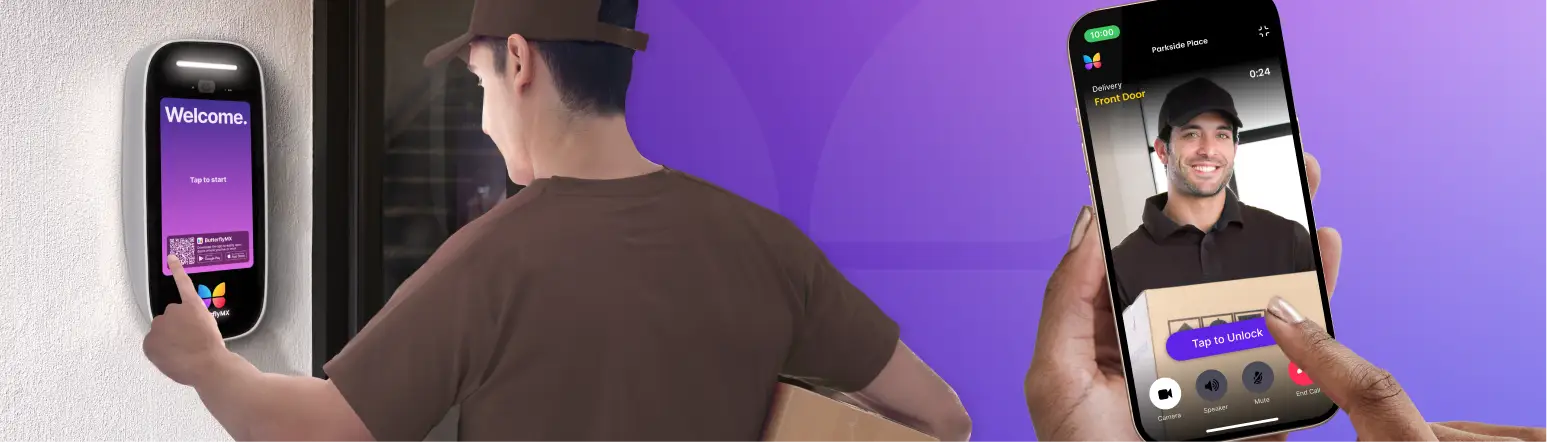
ButterflyMX fits naturally into that planning discussion when a property wants connected access and security tools. ButterflyMX Access Control and Video Intercom products support property access needs beyond the main entrance, residents can receive visitor calls and grant entry through their smartphones, and property teams can remotely manage residents, visitors, credentials, and access. ButterflyMX Security Cameras can be evaluated as part of a broader property access and security plan after the coverage, privacy, and operational requirements are defined.
Verify interoperability, permissions, recording behavior, and product-specific details before implementation. Do not assume that every camera, access controller, intercom, VMS, or credential system will work together exactly the way the property expects.
Blind spot audit checklist
Use this checklist during a walk-through with the installer, maintenance team, and property decision-makers. It is a planning tool, not a replacement for code, electrical, privacy, legal, or professional installation review.
- Map every approach, door, landing, turn, concealment area, property boundary, and desired identification point.
- Document day and night lighting, glare, shadowed areas, door-open conditions, IR distance, and the line between security lighting and emergency egress lighting.
- For each proposed view, compare camera form, lens and field of view, mounting angle, tamper exposure, IP rating needs, and moisture conditions.
- Test power, PoE routes, WiFi signal, bandwidth, recording, retention, and compatibility with the existing security and access environment.
- Assign ownership for inspections, lens cleaning, outage notifications, repair escalation, footage access, and policy updates.
Once the property has identified its blind spots and entry requirements, it can decide whether ButterflyMX is a fit for a connected approach to security cameras, access control, and video intercoms.
Frequently asked questions
How many cameras does a basement stairwell need?
A basement stairwell needs enough cameras to cover its landings, turns, doors, occlusions, and identification goals. There is no reliable camera-per-floor formula, so confirm the layout with an on-site walk-through and test footage.
Can wireless cameras work in concrete basement stairwells?
Wireless cameras can work only if the signal, bandwidth, power, recording, and maintenance plan are reliable at the final camera location. Because concrete and masonry can interfere with wireless performance, evaluate PoE first or require an onsite signal test before relying on WiFi.
How long should alley and stairwell footage be retained?
Footage retention should follow a written policy based on applicable law, incident response, storage capacity, privacy, and authorized-access needs. A single retention period does not fit every property or jurisdiction.
Can IR illumination replace emergency stairwell lighting?
No. IR illumination can help a camera capture images in darkness, but emergency egress lighting is a separate life-safety requirement that must be addressed under applicable code and local rules.
Effective alley and basement-stair coverage starts with a site-specific plan. Match the camera to the environment, test the view under real lighting conditions, confirm power and connectivity, and keep privacy, retention, maintenance, and access policies clear.
If the audit shows that a rear entrance, service door, or basement access point also needs better credentialing or visitor access, ButterflyMX can support a connected plan for security cameras, access control, and video intercoms.
Get your free quote!
Fill in the form below, and we'll email you right back.
Want a free quote?
Fill in the form below, and we'll email you right back.
You’ll be redirected shortly...