





Key takeaways:
- A laundry room access control system controls who can enter the room; it does not, by itself, manage washer payments, reservations, or machine operation.
- Shared PINs are simple, but individual cards, fobs, unique codes, or mobile credentials make revocation and access-event review easier.
- The best system depends on the door, power, wiring, egress role, accessibility, resident policy, and whether the laundry room should connect to property-wide access control.
A shared laundry room is usually a resident-only space, but many properties still rely on a mechanical key, an unlocked door, or a code that gets passed around. That creates a basic management problem: who should be able to enter, how should access change when someone moves out, and what should staff review when there is a complaint?
A laundry room access control system answers the entry part of that problem. It verifies a resident, staff, or vendor credential; tells compatible locking hardware when to unlock; and lets administrators manage permissions under property rules. It controls access to the room, not payment for washers, wash-cycle settings, or laundry booking software.
The right choice is not just a keypad versus a fob. Property teams also need to look at the door and frame, available power, cable routes, wireless options, emergency egress, accessible reader placement, and whether the laundry room should be managed with the same access system used at entrances and other amenity spaces.
This guide will answer:
- What is a laundry room access control system?
- Why shared laundry rooms need controlled entry
- Laundry room credential options
- How much does laundry room access control cost?
- Installation and integration considerations
- Fire, egress, and accessibility checks
- How to choose by property type
- Laundry room access control buyer checklist
- FAQs
Watch how ButterflyMX works:
What is a laundry room access control system?
A laundry room access control system is an electronic entry system for a shared laundry room. It checks whether a person is allowed to enter, signals compatible locking hardware, and may record the access event for administration or review.
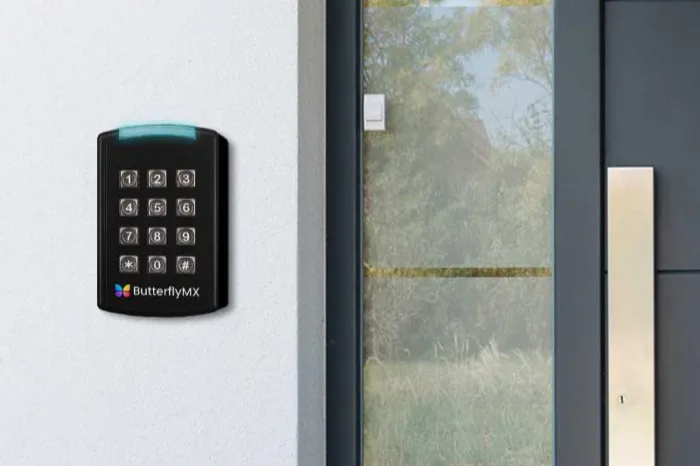
Most electronic access control systems use the same basic chain of parts: a credential, a reader, a controller, locking hardware, and management software. The credential may be a PIN on a keypad, an RFID card or fob, a mobile credential that uses a supported technology such as NFC or Bluetooth, or, in special cases, a biometric identifier. The reader receives the credential. The controller decides whether that credential has permission. Then the lock releases if access is approved.
That entry process is different from laundry management. Payment systems, machine monitoring, wash-cycle controls, and reservation tools can be useful in some buildings, but they do not automatically decide who can enter the room. For broader operating ideas beyond door access, see apartment laundry room management ideas.
The system can also be set up in different ways. A standalone device may manage one laundry room door. A property-wide access control platform may coordinate the same resident credentials across entrances, package rooms, fitness centers, and laundry rooms. That difference matters because it affects how credentials are issued, revoked, audited, and explained to residents.
Why shared laundry rooms need controlled entry
A laundry room is not just another interior door. It is a shared amenity with residents coming and going, staff entering for cleaning or repairs, and vendors needing approved service access. Controlled entry gives the property a way to limit routine use to authorized people instead of relying on an unlocked common-area door or a key that is hard to recover.
The clearest benefit is administrative control. When a resident moves out, management can remove that person’s credential. When a vendor only needs access during a service window, the property can define that policy if the system supports it. When residents report theft, tampering, or a dispute, an access event tied to an assigned credential may provide useful context. Those problems appear often in resident discussions, but they should be treated as reported concerns rather than proof of a measured industry-wide trend.
Access control is not a cure-all. It cannot stop every tailgater, every shared credential, or every disagreement over laundry. It works best when it is paired with a clear policy: access hours, who gets credentials, how lost fobs or shared codes are handled, how maintenance access is approved, and how residents will be notified when rules change.
Lighting and security cameras can support the same policy, but they do different jobs. A camera may add visual context under the property’s privacy and retention rules. Access control decides whether the door should unlock. A good laundry room plan treats those tools as related, not interchangeable.
Laundry room credential options
The best credential for a laundry room depends on how much accountability the property needs and how much administration the team can support. A shared PIN may be easy to roll out, but it can spread quickly. Individual credentials take more setup, yet they usually make it easier to remove one user without disrupting everyone else.
Keypad and PIN access
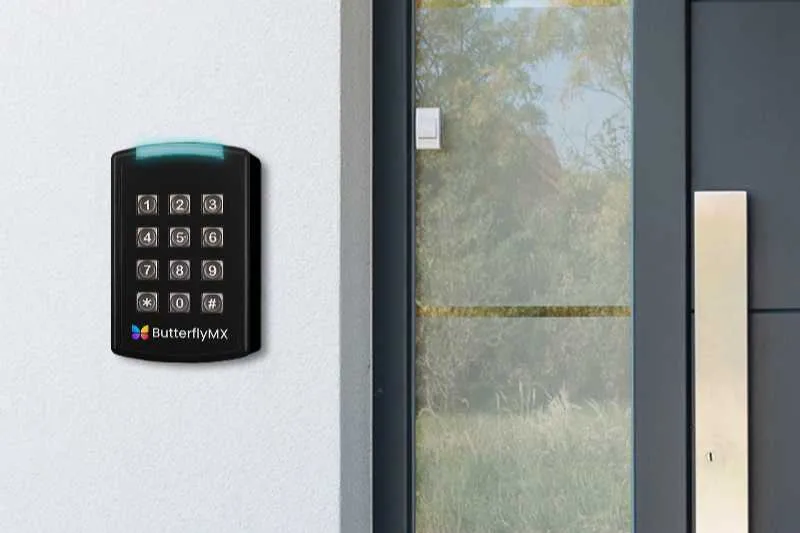
A keypad can be attractive because there is no physical credential to hand out. For a small property, a basic PIN policy may be enough to keep the laundry room from being open to the public. The tradeoff is attribution. If every resident uses the same code, management typically cannot tell which person used it, and changing the code means communicating a new number to every authorized resident.
Unique codes can improve that model when the system supports them. They allow a property to remove or change one user’s access instead of resetting the code for everyone. Even then, the property still needs rules for code sharing, move-outs, staff access, and after-hours use.
Cards and key fobs
Cards and fobs are familiar in multifamily and other managed properties. When each credential is assigned to one resident, staff member, or vendor, the property has a cleaner path to revoke that credential later. The downside is the physical inventory: cards and fobs must be issued, replaced when lost, and removed from the system when access should end.
Some vendor guidance raises cloning concerns about older 125 kHz fob technology. Treat that as an upgrade consideration, not as a universal statement about every credential. If your property is comparing card or fob hardware, this overview of card reader door locks can help explain the broader category.
Mobile credentials
Mobile credentials can reduce the need for a separate card or fob and can be useful when a property already wants centralized access management. They still depend on compatible readers, software, resident onboarding, and a backup plan for people who do not use a smartphone or cannot use one in a given moment.
This option often makes the most sense when the laundry room is part of a larger access program. If the same resident credential works at the entrance, package room, fitness center, and laundry room, the property has fewer separate rules to manage and explain.
Biometric readers
Biometric readers can tie access more closely to a person’s identity, but that strength comes with extra concerns. Privacy, consent, enrollment, legal requirements, and accessibility all need current review. For many shared laundry rooms, that complexity may be more than the access problem requires.
The credential is only one decision. The property also has to decide whether access is shared or individual, whether temporary vendor permissions are allowed, whether the room has access hours, and who can override the system for maintenance or emergencies. In high-demand buildings, booking or machine allocation may be added as a separate layer, but it is not the same thing as controlling the room door.
How much does laundry room access control cost?
There is no verified public price range that applies specifically to laundry room access control. A useful budget starts with the actual door, because two laundry rooms can look similar and still require very different hardware, labor, or code review.
Ask vendors and installers to break the quote into clear parts:
- Reader, keypad, controller, and compatible locking hardware
- Power supplies, electrical work, network equipment, and cable routes
- Door and frame work, including latches, closers, strikes, or fire-rated assemblies when applicable
- Installation labor, commissioning, and any integration with an existing access platform
- Cards, fobs, mobile-credential administration, software, maintenance, and support
The biggest cost drivers are usually site-specific. Door condition, fire rating, available power, wiring difficulty, network coverage, and integration scope can all change the quote. A 2026 commercial vendor guide listed general installed pricing of about $1,100 to $2,000 for two doors and software fees of roughly $35 to $90 per door per month. Those figures are vendor-reported, multi-door references. They are not a laundry-room estimate, a ButterflyMX price, or a market-wide benchmark.
A standalone device may cost less to plan at one opening, but it can create a separate credential process. A property-wide access control system may make more sense when the laundry room is one of several resident amenity doors. Learn more about the broader category of residential access control systems when comparing those approaches.
Installation and integration considerations
Do not choose the credential before checking the opening. The door, frame, latch, closer, fire label, power, wiring path, and network coverage all affect which access hardware is practical. Laundry rooms can also be harder than they look, especially in basements or interior corridors where electrical panels, network equipment, or cable routes are far from the door.
Wired versus wireless retrofit options
Wired access control can be a good fit when cable routes, centralized power, and planned electrical work are available. Wireless retrofit hardware may reduce new cable runs and is marketed for multifamily common doors, including laundry rooms. But wireless does not mean infrastructure-free. The project still needs compatible hardware, reliable connectivity, batteries or power, gateways where applicable, service planning, and a maintenance routine.
Door and environment checks
A site survey should look at more than the reader location. The installer should review the door and frame material, the current locking hardware, the closer, the fire label if present, the room’s traffic pattern, humidity, and exposure to damage. A damp basement laundry room with heavy use may create different maintenance concerns than a small, interior laundry closet near an office.
Administration after installation
Installation also creates an ongoing access process. Decide who enrolls residents, who can revoke credentials remotely, how temporary service access is approved, what staff should do during an outage, which access events are retained, and who is allowed to review them. These rules should be written before residents start using the system.
This is where ButterflyMX may fit for properties that want more than a single isolated door. ButterflyMX supports access needs beyond the main entrance, including remote management of residents, visitors, credentials, and access. For a laundry room, that can matter when the property wants amenity access to follow the same administrative approach as the rest of the building. The final hardware, lock behavior, and installation plan still need to be validated for the specific opening.
Fire, egress, and accessibility checks
A laundry room door may be a simple interior opening, a fire-rated opening, part of a required egress path, or a door subject to a permitted electronic locking arrangement. Those are different conditions. Before buying hardware or modifying the door, confirm the opening’s function, fire-door status, locally adopted code edition, and the requirements of the authority having jurisdiction, often called the AHJ.
NFPA guidance, including concepts addressed in NFPA 101, describes conditions for certain access-controlled egress-door arrangements. Those conditions can include release upon relevant fire-protection-system activation and loss of power. They apply only when the opening and local requirements support that arrangement. Do not treat access-controlled egress locking as the same thing as delayed-egress locking, and do not assume every laundry room door follows the same rule.
Fire-rated doors add another layer. Fire-door requirements, including NFPA 80 concepts where locally adopted and applicable, can affect what hardware may be changed and how the complete door assembly must perform. This is one reason the installer and AHJ should be involved before hardware is selected.
Fail-safe and fail-secure behavior
Fail-safe hardware unlocks when power is removed. Fail-secure hardware remains locked from the secured side when power is removed. Those terms describe one part of the system, not the entire code answer. Free egress, the door assembly, releasing hardware, fire-door status, and the locally approved emergency plan all matter.
Accessible reader and keypad placement
Keypads and readers are operable parts, so placement must be reviewed with the accessible route and door operation in mind. ADA Section 308 guidance from the US Access Board identifies an unobstructed forward reach range of 15 inches minimum to 48 inches maximum for operable parts. Obstructions, side reach, approach space, and local project conditions can affect the final placement, so mounting height alone is not a complete accessibility review.
- Confirm whether the laundry room door is fire-rated or part of required egress.
- Verify the approved locking and release behavior for that exact opening.
- Check compatibility before changing a latch, strike, maglock, closer, or door assembly.
- Review reader or keypad placement as part of the full accessible approach.
- Coordinate the design with a licensed installer and the AHJ before purchase or modification.
How to choose by property type
The same laundry room door can create different access-control priorities depending on who uses the property and how often residents turn over. Use these as starting points, not universal rules.
Multifamily properties
Multifamily teams often need a system that can keep up with move-ins, move-outs, lost credentials, and common-area access rules. Remote credential removal and a familiar access method may be more important than adding another standalone device that staff must manage separately.
HOA and condo communities
HOA and condo boards should focus on governance. Define whether owners, tenants, guests, cleaners, vendors, and property staff receive access. Also decide who approves exceptions and how the community will communicate code changes, credential rules, and after-hours policies.
Student housing
Student housing often has frequent turnover and more lost-credential events. Individual credentials, access schedules, clear replacement procedures, and event-level accountability may be more useful than a shared PIN that can move from one resident group to another.
Senior living
Senior living operators should prioritize simple use, accessible reader placement, staff override procedures, and emergency planning. A credential is not convenient if the reader location, door force, or approach makes the room difficult for residents to use.
High-demand properties may also need booking or allocation tools. One large Vienna deployment combined RFID laundry-room access with web booking and user-level energy allocation, which shows how scheduling can be layered onto entry control when demand justifies it. That does not make booking a standard requirement for every laundry room access control system.
Laundry room access control buyer checklist
Use this checklist before vendor conversations and the door survey. It is not a substitute for professional installation, legal review, or local code approval.
- Document the door, frame, latch, closer, fire label, traffic pattern, humidity, and exposure to damage.
- Determine whether the opening serves egress and verify the locally approved lock and release design.
- Check available power, cable routes, network coverage, battery-service needs, and wireless connectivity.
- Select the credential policy: shared PIN, unique code, card, fob, mobile credential, or a combination.
- Define move-in, move-out, lost-credential, guest, vendor, maintenance, staff override, and after-hours procedures.
- Ask what access events are recorded, who may review them, how long they are retained, and whether video context is appropriate under property policy.
- Request an itemized cost breakdown for hardware, door work, installation, software, credentials, integration, maintenance, and support.
- Evaluate whether the laundry room can use the same credential and administration process as entrances or other amenity doors.
- Prepare resident communications that explain access hours, credential rules, outages, and where to get help.
Once the site conditions and access policy are clear, request a free quote to explore access control for the laundry room and other amenity spaces.
Frequently asked questions
What happens to laundry room access when power fails?
Power-loss behavior depends on the lock type and the approved door design. Fail-safe hardware unlocks when power is removed, while fail-secure hardware stays locked from the secured side; free egress, fire-door rules, and local requirements still govern the final design.
Is a keypad or key fob better for a shared laundry room?
A keypad is often simpler, while an individually assigned fob usually gives clearer revocation and access-event accountability. The better choice depends on whether the property values low administration or stronger person-level control.
Can access control be added without rewiring the laundry room door?
Sometimes, wireless retrofit hardware may reduce new cable runs. The property still has to confirm door compatibility, power or battery service, connectivity, gateways where needed, integration needs, and maintenance requirements.
Can residents use the same credential for the laundry room and other amenity doors?
Yes, a compatible property-wide access platform may support one credential across multiple doors. Confirm system compatibility, permissions, event records, and resident administration during the site survey and integration review.
A good laundry room access control system starts with a simple question: what should happen at this exact door when a resident, staff member, or vendor needs access? The answer depends on the credential policy, the door hardware, the egress role, accessible placement, power, connectivity, and how the property wants to manage access over time.
For properties that want laundry room access to work with broader amenity and entrance management, ButterflyMX can help teams explore keypads, mobile access, and remote credential administration beyond the main entrance. Request a free quote to evaluate the right access control approach for your laundry room and property.
Get your free quote!
Fill in the form below, and we'll email you right back.
Want a free quote?
Fill in the form below, and we'll email you right back.
You’ll be redirected shortly...