
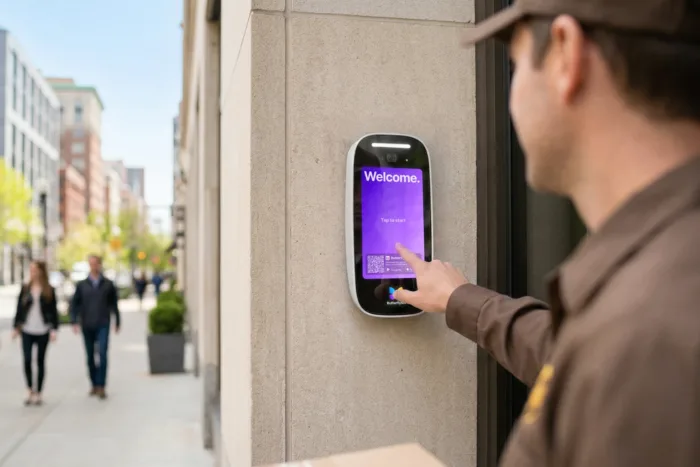





Key takeaways:
- A smart apartment door buzzer connects visitor calls and door release to a phone or app; many systems add video, but features vary by setup.
- Mobile number routing, approved single-unit add-ons, and professional video intercom replacements serve different users and building needs.
- Smart entry does not change safe-exit rules. Electrically locked common entrances still need project-specific life-safety and code review.
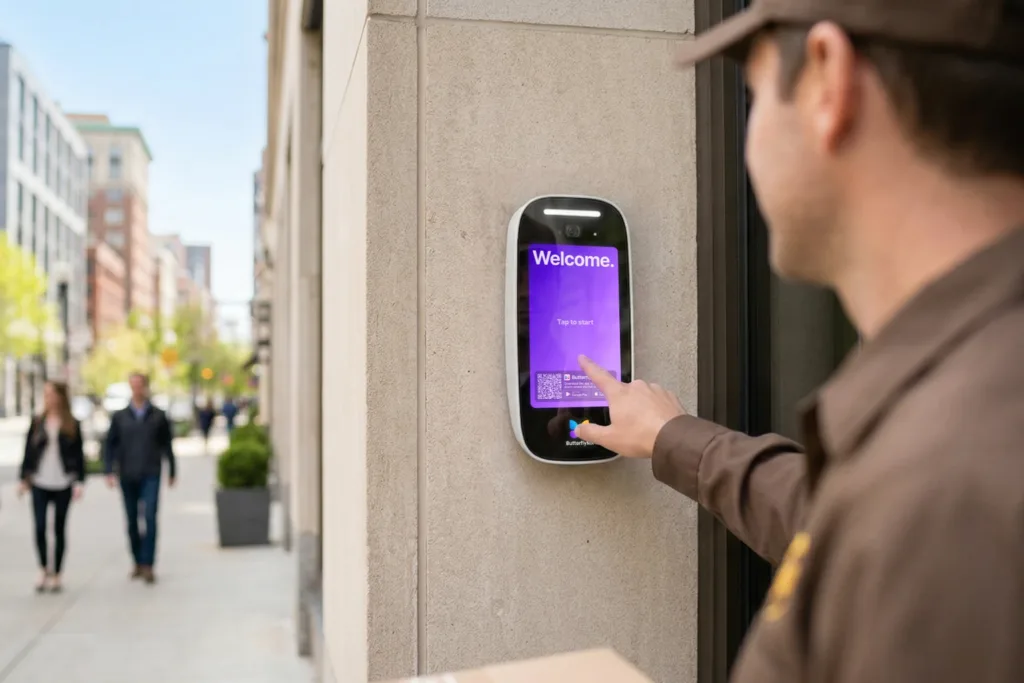
If you want to buzz someone into an apartment building from your phone, the first question is not which gadget to buy. It is what kind of buzzer system the building already has, who is allowed to change it, and whether the goal is one resident convenience or a managed access system for the whole property.
A smart apartment door buzzer is a connected entry system that lets a resident receive a visitor call on a smartphone and, depending on the system, talk to, see, or remotely admit that visitor. That can happen through mobile call routing, a limited add-on to a compatible legacy buzzer, or a professionally installed smart video intercom.
Those paths are not interchangeable. A renter trying to make an old in-unit buzzer more convenient has a different set of choices than a property manager replacing a shared entrance system. This guide explains how apartment buzzers work, where smartphone access fits, what limits DIY projects, and what property teams should review before upgrading an electrically locked entrance.
This guide will answer:
- What is a smart apartment door buzzer?
- How apartment buzzers work
- Three ways to make an apartment buzzer smart
- How smart buzzer options compare
- Fire and life-safety requirements for electrically locked doors
- Security and privacy considerations
- What does a smart apartment buzzer cost?
- How to choose the right smart buzzer path
- FAQs
Watch how ButterflyMX works:
What is a smart apartment door buzzer?
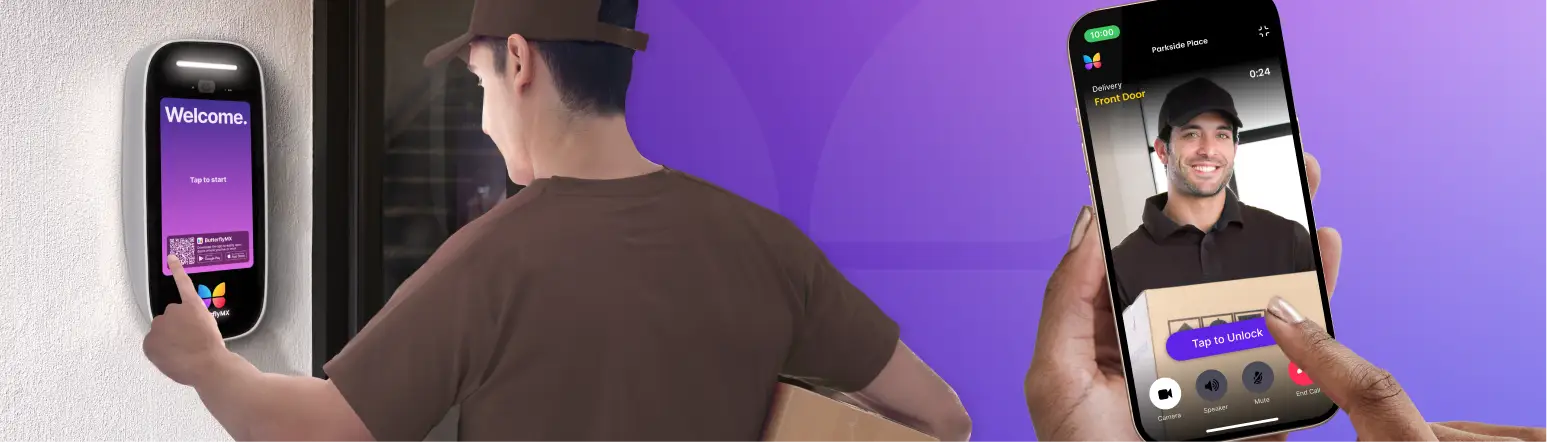
A smart apartment door buzzer is a connected visitor-entry system that can send a visitor call to a resident smartphone and allow remote door release. Many current systems also add two-way audio, video verification, and property-level access management, but not every smart buzzer includes the same hardware, app features, or cloud services.
That distinction matters because smart buzzer is an umbrella phrase, not one standard design. A traditional buzzer may connect an entry panel to an in-unit audio station. A telephone entry system may call a resident phone number. A smart video intercom may use an app, camera, controller, and physical door-release hardware together.
In plain terms, the visitor experience usually follows this sequence:
- A visitor chooses a resident or unit at the building entrance.
- The system routes the call to an in-unit station, telephone, or smartphone app.
- The resident decides whether to admit the visitor.
- The door-release hardware unlocks according to the installed system design.
The smarter the front end becomes, the more important the back end becomes too. Smartphone access still depends on the building’s wiring, controller, lock hardware, permissions, and support plan.
How apartment buzzers work
Most apartment buzzer systems have four functional parts: an entry panel, a resident endpoint, a controller or communications service, and lock-release hardware such as an electric strike. The entry panel starts the visitor call. The resident endpoint receives it. The controller or service routes the signal. The release hardware performs the physical unlock when access is granted.
Older buildings often use wired audio stations inside each apartment. Telephone entry systems route calls through phone service. Smart video intercoms can route visitor calls to a mobile app while still connecting to physical lock hardware at the entrance. So even when the resident experience feels simple, the system still has to bridge software, communications, and door hardware.
Legacy compatibility is where many DIY plans run into trouble. Apartment buzzer wiring can vary across buildings, and two panels that look similar may not be wired the same way. Some older stations use low-voltage multiwire arrangements with a separate release circuit, while other systems use different controls. The documented project about connecting one apartment buzzer to a smart-home hub is useful as an example of why assessment comes first, not as a universal wiring tutorial.
For managed properties, ButterflyMX is one modern alternative to legacy telephone-entry hardware. Its video intercoms let residents receive visitor calls and grant access from smartphones, while property teams manage access remotely. That makes it relevant when the goal is property-wide modernization, not a renter-installed workaround.
Three ways to make an apartment buzzer smart
There is no single upgrade path that works for every apartment buzzer. The practical choice depends on the installed system, who controls it, and how many people the upgrade needs to serve.
- Telephone-entry routing or reprogramming. If the building already uses a telephone entry system and the installed service supports it, the property may be able to route resident calls to a mobile number. This can give residents phone-based visitor access without replacing the entire system, but it depends on the existing equipment and service setup.
- An approved single-unit smart-home bridge. In some compatible legacy systems, a smart-home input-output bridge may detect a call or trigger a release action. This is the path many renters imagine when they want to make a dumb buzzer smart. But it is narrow, technical, and system-specific. Historic projects have used Z-Wave hardware and smart-home hubs, yet device availability and smart-home workflows change. Treat that kind of project as a dated example, not a current product recommendation.
- Professional smart video intercom replacement. A building-wide replacement can add app-based visitor calls, video, remote release, and centralized administration across units and entrances. This route is usually the better fit when a property needs consistent support, multiple entrances, broader credential management, or access integrations.
Before a renter adds anything
Renters should get written approval before modifying shared or building-owned intercom equipment. Check who owns the panel and wiring, whether the change touches a common entrance, whether the setup can be reversed, and who will fix the system if it fails. A single-unit bridge may solve one household’s convenience problem, but it does not create a supported building-wide access system or override property security rules.
How smart buzzer options compare
The table below compares the main paths by what they change for residents and property teams. The cost column uses profiles instead of price ranges because scope, wiring, labor, lock hardware, connectivity, and support can change the budget dramatically.
The biggest dividing line is authority. A renter deciding how to buzz people in is solving a personal convenience problem. A property team is managing resident turnover, visitors, staff access, multiple entrances, support, and long-term maintenance.
For managed properties that need video visitor calls and centralized access administration, ButterflyMX is one professionally installed smart video intercom option. It fits the property-wide path because it supports smartphone visitor access and remote access management across a building, rather than adapting one resident’s in-unit buzzer.
Fire and life-safety requirements for electrically locked doors
Smartphone entry does not decide how people must exit a building. Controlling who may enter is an ingress question. Making sure people can leave through a door in the means of egress is a life-safety question, and it may involve the International Building Code, NFPA 101, local amendments, and the authority having jurisdiction.
An electrically locked common entrance can fall under different code categories depending on the occupancy, lock type, release method, adopted code edition, and local rules. That is why property teams should avoid treating terms such as fail-safe, fail-secure, sensor release, and delayed egress as interchangeable labels. They describe different design concepts that qualified door, fire-alarm, and access-control professionals need to evaluate for the specific opening.
- A remote-unlock feature does not determine the required egress behavior.
- Some applicable arrangements may require a manual release method.
- Some arrangements may require unlocking tied to fire-alarm or sprinkler activation.
- Power-loss behavior, fire-alarm inputs, lock type, and door hardware must be reviewed together.
- Project-specific compliance is determined by qualified professionals and the authority having jurisdiction.
The International Code Council discussion of electrical locking systems in means of egress explains why there is no single rule for every access-controlled door. New York City offers one local example: its code addresses release requirements for certain electromagnetically locked egress doors. See the NYC Building Code provision on electromagnetically locked egress doors for that jurisdiction-specific context.
Before approving a smart buzzer, intercom, or lock controller, property teams should ask the installer which code path applies and how the proposed design behaves during an alarm, sprinkler activation, power loss, and internet disruption. This article is general education, not code, electrical, engineering, or legal advice.
Security and privacy considerations
A smart apartment door buzzer can give residents more information before they unlock a common entrance. That can be useful, but it does not remove human judgment from access decisions. Buzzer bombing, for example, is when someone buzzes multiple apartments hoping one resident will admit an unverified visitor.
Video verification and access records can support better decisions and later investigation. They should not be treated as a guarantee that every admitted person was authorized. A resident may still release the door without verifying the visitor, and an access log records system activity rather than proving intent.
Property teams should also review privacy and account controls before choosing a connected entry system. Ask how resident and administrator permissions are issued and removed, what access records are available, how long video is retained, and whether storage is local or cloud-based. Review vendor claims about encryption, updates, and account security in the context of the actual product and deployment.
Physical conditions matter too. Outdoor entry panels need to suit the building entrance, weather exposure, and expected use. And when residents move out, staff roles change, or contractors finish a job, the property should have a clear process for removing credentials and administrative access.
What does a smart apartment buzzer cost?
There is no useful universal price for a smart apartment door buzzer because the phrase can describe anything from a limited single-unit add-on to a multi-entrance smart video intercom project. A realistic budget looks at the whole system, not just the panel on the wall.
- Entry hardware, resident endpoints, controllers, and door-release hardware
- Lock work, compatible wiring, installation, testing, and commissioning
- The number of units, entrances, users, directories, and credentials
- Internet connectivity, software or subscription services, video storage, and support
- Approved integrations with other property access needs
- Future maintenance, updates, warranties, and local labor conditions
A small add-on and a supported property-wide system should not be compared as if they solve the same problem. One may be a resident convenience project, if approved and compatible. The other may be a building access project involving hardware, software, installation, support, and life-safety review.
A vendor buyer guide can help identify cost categories, but it should not be treated as a universal market-price benchmark. The 2025 apartment buzzer buyer guide also points to factors such as video, mobile access, installation, scalability, storage, durability, and integrations. Property teams should request a scope and quote based on their own entrances, units, wiring, lock hardware, and support needs.
How to choose the right smart buzzer path
Start with decision authority. If you are a renter, confirm written permission and identify whether the buzzer, wiring, and door-release hardware belong to the building. Then define the real need. Are you trying to receive visitor calls on a mobile phone? Remotely release a common entrance? Add video before admitting a visitor? If shared wiring or a release circuit is involved, get qualified help instead of experimenting with the building system.
If you manage the property, begin with the building rather than the product. Document entrances, units, existing wiring, lock hardware, user groups, credential needs, video needs, integrations, and resilience expectations. Then ask vendors who handles installation, support, updates, warranties, privacy controls, storage, and recurring costs.
The installer conversation is just as important as the product conversation. Ask how the intercom controller connects to the existing lock hardware, what happens during power loss or connectivity disruption, and how the design interacts with fire-alarm inputs and required egress behavior. Those answers help separate a convenient smart feature from a complete and maintainable entrance system.
A professional replacement is generally the better fit when the property needs centralized administration, multiple entrances, video visitor calls, property-scale credential management, or connected access needs beyond one apartment. ButterflyMX can help owners and managers explore a smart video intercom approach in which residents receive visitor calls on smartphones and property teams manage residents, visitors, credentials, and access remotely.
Frequently asked questions
Can a smart buzzer work without rewiring the whole building?
Sometimes. Telephone routing, compatible existing wiring, or a limited approved add-on may avoid a full rewire, but the entry panel, wiring, lock hardware, and building policies need to be assessed first.
What happens if internet access or power fails?
It depends on the system design and installed lock arrangement. Property teams should confirm local operation, backup power, connectivity resilience, and safe egress behavior with qualified professionals before installation.
Can a smart buzzer integrate with an apartment smart lock?
It may be possible, but compatibility depends on the intercom, lock, intended door, and property authorization. A unit-door smart lock and a common-entrance intercom are separate access-control use cases.
Does a renter need landlord approval for a DIY smart buzzer add-on?
Yes. Renters should obtain written property approval before modifying shared or building-owned equipment, especially when wiring or a common-entrance release circuit is involved.
A smart apartment door buzzer is useful only when the upgrade matches the building. Mobile call routing may be enough for some telephone-entry systems. An approved single-unit bridge may work in a narrow legacy setup. A professionally installed video intercom makes more sense when the property needs centralized management, video visitor access, multiple entrances, or long-term support.
For owners and managers planning a property-wide upgrade, ButterflyMX can help evaluate a video intercom approach that supports smartphone visitor access and remote property access management. Talk with ButterflyMX about modernizing access for your building.
Get your free quote!
Fill in the form below, and we'll email you right back.
Want a free quote?
Fill in the form below, and we'll email you right back.
You’ll be redirected shortly...