





Key takeaways:
- High-turnover properties need an intercom that makes resident changes fast, controlled, and easy to audit, not just a panel with a long feature list.
- Cloud-managed IP or video intercoms are often the strongest fit for frequent move-ins and move-outs, as long as the property verifies infrastructure, accessibility, outage behavior, support, and cost.
- Total cost should include hardware, installation, subscriptions, connectivity, maintenance, support, and the staff time required to onboard, update, and offboard residents.
At a high-turnover apartment property, the intercom is part of the leasing cycle. A new resident needs to appear in the directory, receive the right access method, and understand how visitors will reach them. A departing resident needs to be removed from the directory and have access revoked. If that process is slow or unclear, the front door becomes another source of staff tickets, resident frustration, and avoidable security gaps.
For most properties with frequent resident changes, the best starting point is a cloud-managed IP or video intercom. That type of system can make it easier for authorized staff to update resident records remotely, revoke credentials, and handle onboarding at scale. But it is not the right answer for every building. Infrastructure, resident needs, phone fallback, outage behavior, staffing, support, and total cost all matter.
This guide explains how to choose an apartment intercom for high turnover properties by looking at the work behind the device: directory administration, credential control, PMS synchronization, resident access, installation needs, and vendor fit.
This guide will answer:
- What high turnover means for intercom selection
- How resident onboarding and offboarding should work
- How intercom architectures handle resident turnover
- Six features that make an intercom turnover ready
- How requirements change by property type
- How to plan installation, accessibility, security, and outages
- How to calculate total cost for a high-turnover property
- How to evaluate vendors and make the final choice
- FAQs
Watch how ButterflyMX works:
What high turnover means for intercom selection
A high-turnover property is not defined by one universal percentage. In this context, it means resident changes happen often enough that onboarding, directory maintenance, credential issuance, and access removal become recurring staff work. Student housing is the clearest example because changes often cluster around the academic calendar, but a conventional multifamily property can face the same pressure through steady leasing activity.
A good apartment intercom for high turnover properties should let authorized staff update resident information quickly, remove former residents from access permissions, support bulk or repeatable administration, and give residents a usable option when they do not want to rely only on a smartphone app. The system should make the move-in and move-out process more controlled, not simply move the same manual work into a new screen.
That is why cloud-based apartment intercoms often become the leading category for administration-heavy properties. Remote directory administration can reduce dependence on local panel programming or routine site visits. Still, buyers should verify the exact product and deployment. Not every cloud system has the same bulk tools, permissions, integrations, fallback options, or outage behavior.
Start with the work, then evaluate the hardware. Who adds a new resident? Who approves a phone number change? Who issues or replaces a credential? Who confirms that access is removed at move-out? Clear answers to those questions reveal whether a system is ready for turnover or merely attractive in a product demo.
How resident onboarding and offboarding should work
Turnover readiness starts with two plain-language concepts. Directory administration is the process of creating, editing, publishing, and removing the resident information used for visitor calls and access. Credential revocation is the controlled removal of a fob, mobile credential, PIN, or permission when it should no longer unlock a door.
For a high-turnover property, those tasks should follow a repeatable sequence:
- Create or import the resident record and confirm the unit, contact information, and authorized occupants.
- Publish the directory entry according to the property’s naming and privacy rules.
- Issue the approved access method and explain visitor-call and fallback options.
- Handle changes such as a new phone number, replacement credential, roommate change, or unit transfer.
- At move-out, remove access, update the directory, and resolve exceptions such as early departures or overlapping leases.
The main question is how much of that sequence depends on manual work. Local panel programming can make resident changes site-dependent. Bulk CSV import can make large updates more manageable, but it still requires clean records and a process for errors. Supported property management software, API, or PMS synchronization may reduce duplicate entry by syncing relevant resident records, but buyers should confirm the supported platform, fields, timing, permissions, failed-record handling, and offboarding rules before treating an integration as automation.
Resident self-service can also help, but only when it has guardrails. Ask which fields residents can edit, whether staff approval is required, how duplicate or inaccurate records are handled, and whether changes are logged. For context on the administrative limits of older call paths, see this guide to residential telephone entry systems and their alternatives.
How intercom architectures handle resident turnover
Cloud-managed IP or video intercoms are generally the strongest fit for high-turnover properties because they can reduce dependence on local panel programming. But architecture labels can be confusing, so it helps to separate administration from connectivity.
Cloud versus on-premise describes where management happens. A cloud-managed system commonly lets authorized teams manage records remotely. An on-premise system may rely on local infrastructure, onsite software, or panel-level administration. Wired, wireless, cellular, SIP, and IP describe how the system connects or places calls. Those terms do not, by themselves, explain how easy it is to update a directory or revoke a credential.
The table below compares common intercom architectures at a category level. Individual products differ, so verify administration, fallback behavior, support responsibilities, and pricing with each vendor.
The last row is not an automatic winner. A small building with stable occupancy may value simplicity over a more advanced administrative model. A larger property with frequent move-ins and move-outs may find that lower upfront hardware costs are outweighed by recurring staff work, technician visits, or slow directory changes.
Security and visitor verification also matter. Audio-only buzzers give residents less context than video systems, and a visitor may try multiple units until someone grants access. That is one reason to evaluate the limitations of apartment buzzer systems alongside turnover administration. For a broader look at system categories, read the multi-tenant intercom system buyer guide; this article stays focused on how each category behaves when residents change often.
Six features that make an intercom turnover ready
A turnover-ready intercom is not defined by one feature. It is defined by how well the system supports the tasks that happen every time a resident moves in, changes information, or moves out.
- Fast remote directory updates. Authorized staff should be able to add, edit, and remove directory records through a documented process. If every change depends on an onsite panel visit, frequent turnover will remain labor-intensive.
- Clear credential revocation. The property should know who can deactivate access, how quickly the action should happen, and how the change is confirmed. Access removal should be a required offboarding step, not something staff remember later.
- Bulk import or supported synchronization. Ask whether the system supports CSV import, a property management integration, or an API workflow. Then test duplicate records, failed imports, timing delays, roommate changes, and offboarding exceptions. The label matters less than the actual process.
- Transparent licensing. Get written definitions of what is billed by unit, property, entrance, device, user, credential, or service. Include vacant units, resident replacements, growth, renewals, and implementation costs in the discussion.
- Non-app communication and access options. Residents without smartphones may need a telephone-call path, in-unit device, physical credential, or staff-assisted option. Verify what the proposed deployment supports rather than assuming every modern system includes every fallback method.
- Scalable support and controls. Review permissions, audit logs, staff training, installer coverage, and support escalation across entrances, buildings, and portfolios. A capability only helps if the team responsible for turnover can use it consistently.
Compare your current move-in and move-out process against these six criteria. That exercise often reveals gaps a generic product demo will miss, such as unclear ownership of resident updates, weak exception handling, or no documented fallback plan.
How requirements change by property type
Turnover does not create the same intercom requirements at every property. The right feature set depends on how concentrated resident changes are, how the staff is organized, and how residents prefer to receive calls or unlock doors.
Student housing
Student housing often has concentrated move-in and move-out periods around the academic calendar. Prioritize batch onboarding and offboarding, directory scalability, credential revocation, support capacity, and exception handling. Near-full-population turnover is an often-cited pattern for this property type, but it should not be treated as a universal annual rate.
Standard multifamily
Conventional multifamily properties usually need a balance. The system must handle resident turnover, but it also has to support daily visitor access, deliveries, resident adoption, and portfolio operations. A strong fit makes resident changes easier without making the front-door experience harder for households with different comfort levels around technology.
Condo and co-op communities
Condo and co-op communities often place less weight on directory churn than student housing does. Visitor convenience, package workflows, board preferences, and the preferred communication method may matter more than enterprise-scale import tools.
Senior and mixed-resident communities
Do not assume app-only operation will work for every resident. Telephone calling, in-unit devices, physical credentials, or staff-assisted alternatives can be important for accessibility and adoption. Confirm the available fallback methods for the exact system and deployment.
Very small properties should make the same practical comparison. Cloud tooling may offer useful remote administration, but its recurring cost and complexity should be weighed against the actual volume of resident changes.
How to plan installation, accessibility, security, and outages
An intercom that looks efficient in a demo still has to work at the site. Start with a survey of existing wiring, available power, network bandwidth, PoE availability, wireless design, cellular signal where relevant, door hardware, and every entrance that needs access control. PoE, or Power over Ethernet, carries power and network data over an Ethernet cable. SIP and VoIP refer to internet-based calling methods. Relay-controlled locks use an electrical relay to operate compatible door hardware.
Those terms matter because they affect feasibility, cost, and reliability. A retrofit may be simple at one building and complicated at another because of wiring, network conditions, power, or door hardware. Have an installer or qualified professional validate the final design instead of assuming a system category guarantees an easy installation.
Ask vendors and installers to document what happens during power loss, internet loss, cellular-service loss, cloud-service disruption, and individual device failure. The plan should cover visitor communication, resident entry, staff access, backup power, recovery, emergency procedures, and support escalation. Neither cloud connectivity nor a particular call path guarantees uptime.
Fail-safe and fail-secure describe how a locking device behaves when power is lost. The correct approach depends on the door, local requirements, life-safety considerations, and professional review. Do not treat either term as a universal recommendation.
Security and accessibility should be reviewed together. Evaluate visual visitor verification, permissions, auditability, phone or in-unit fallback, installer availability, training, and ongoing support as one operating plan. A commercial apartment intercom buying guide similarly emphasizes verifying management, access, and deployment requirements rather than treating a device category as a complete answer.
How to calculate total cost for a high-turnover property
Apartment intercom cost is more than the panel price. Before comparing proposals, separate hardware, installation, door or network upgrades, connectivity, subscriptions, maintenance, support, and the administrative labor involved in every onboarding, change, and offboarding event. Pricing ranges published by vendors are estimates, not neutral market benchmarks, and should be dated and verified before they influence a purchase decision.
A simple labor model can make the comparison more honest. List each recurring task, estimate how often it happens, note the staff time required, and include technician or support charges where applicable. Then compare that operating model with each proposal. This does not prove a guaranteed savings or ROI, but it shows whether a system may reduce manual touchpoints that matter at a high-turnover property.
Ask vendors to explain renewal terms, implementation charges, integration fees, support tiers, replacement assumptions, and responsibility for network or door-hardware work. Also test how billing changes as unit count, occupancy, resident records, credentials, entrances, and portfolio size change.
Commercial buyer guides such as this apartment intercom systems guide and this multifamily mobile-access overview can help identify cost categories, but vendor-specific figures should not be treated as market averages.
How to evaluate vendors and make the final choice
The most useful vendor demo is not a tour of features. It is a walk-through of your resident lifecycle. Ask each vendor to show a complete move-in, resident-record change, credential replacement, and move-out using the configuration they would actually sell for your property.
- Who owns directory updates, and can authorized staff perform them remotely?
- Which bulk tools, integrations, permissions, and audit logs are included in the proposed configuration?
- What happens to visitor communication and authorized entry during power, internet, cellular, cloud-service, or device failures?
- Which non-smartphone options are available to residents and visitors?
- How are licenses calculated as occupancy, units, entrances, credentials, and portfolio size change?
- Who installs, trains, supports, and services the system after deployment?
If you are considering a property management system such as Yardi, AppFolio, or RealPage, ask whether the specific integration you need is supported and how it handles fields, timing, exceptions, and offboarding. Do not infer compatibility from a platform name alone. The same discipline applies to category examples such as 2N, Aiphone, and DoorBird: compare current product capabilities against your workflow rather than relying on a ranking.
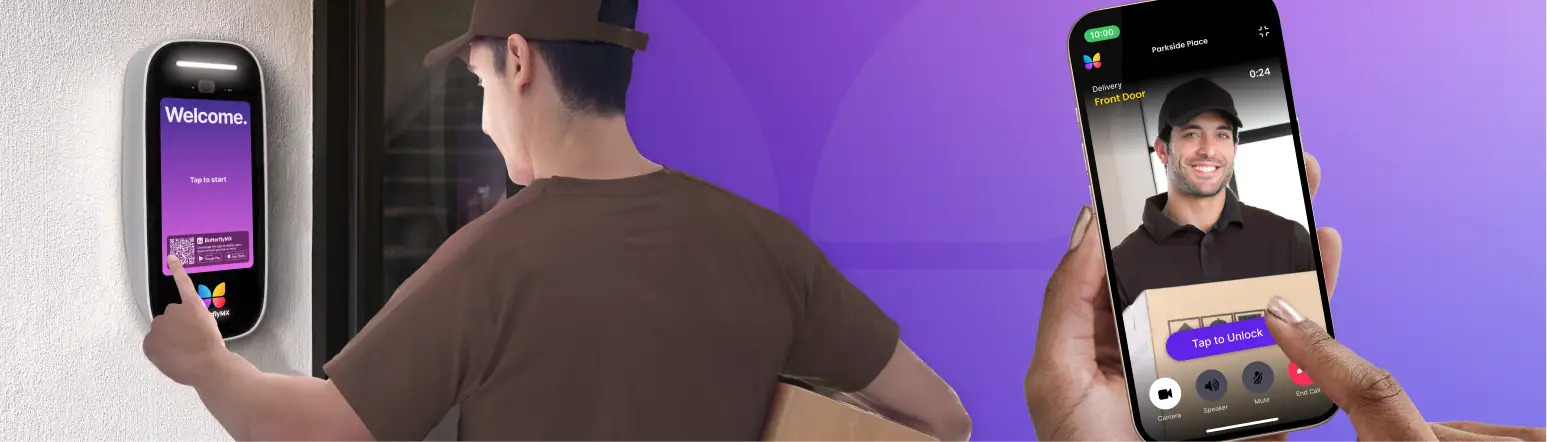
ButterflyMX is one modern option for properties evaluating cloud-managed access, smartphone visitor calls, remote management of residents, visitors, credentials, and access, and reduced dependence on legacy telephone-entry hardware. ButterflyMX video intercoms do not rely on traditional POTS telephone lines. As with any system, buyers should validate fit against the building infrastructure, resident needs, accessibility requirements, support model, and total cost.
Frequently asked questions
Which intercom type is best for a high-turnover apartment property?
A cloud-managed IP or video intercom is often the best starting point because it can support remote directory updates, credential revocation, and scalable administration. The final choice still depends on infrastructure, budget, resident needs, fallback options, outage behavior, and support.
Can residents without smartphones use a modern intercom?
Yes, if the selected system and deployment provide an appropriate alternative. Verify telephone calling, in-unit devices, physical credentials, or staff-assisted options instead of assuming every modern intercom includes every fallback method.
Does PMS integration eliminate manual directory work?
No. A supported PMS integration may reduce duplicate entry, but buyers still need to confirm the platforms, synchronized fields, timing, permissions, failed-record handling, and offboarding rules.
How should per-unit licensing be evaluated when occupancy changes?
Ask for written definitions of billable units, users, credentials, entrances, vacant units, resident replacements, portfolio minimums, renewals, and implementation or integration fees. Do not treat vendor subscription ranges as authoritative market averages.
The right apartment intercom for high turnover properties is the one that makes resident changes controlled, repeatable, and practical for both staff and residents. In many administration-heavy settings, that points toward a cloud-managed IP or video intercom with remote directory administration, dependable credential revocation, scalable onboarding, and verified non-app fallback.
The final decision should come from the real workflow, not the best demo screen. Watch each vendor handle move-ins, record changes, credential replacements, move-outs, exceptions, and outage scenarios. If cloud-managed access and smartphone visitor calling fit your property, discuss your turnover workflow, infrastructure, resident population, and access goals with ButterflyMX.
Get your free quote!
Fill in the form below, and we'll email you right back.
Want a free quote?
Fill in the form below, and we'll email you right back.
You’ll be redirected shortly...