






Key takeaways:
- Entrata combines a mature cloud PMS with OXP, Homebody RXP, and newer ELI+ agents for leasing, payments, maintenance, and renewal workflows.
- Entrata publishes no subscription rate; a third-party estimate puts costs at $4–$8 per unit monthly, plus implementation that can reach $30,000–$75,000 or more for complex rollouts.
- Entrata doesn’t replace access-control hardware: Access Connect links the PMS to partners, including ButterflyMX, for app-based keyless entry.
 Disclaimer: ButterflyMX provides these blog posts to help our customers and potential customers make the right business decisions. Our blog posts are based on the information available to us at the time of writing.
Entrata is a cloud property management platform for operators that want to manage leasing, accounting, payments, maintenance, and resident services in one place. Its current product direction also adds AI agents that can handle selected tasks with human oversight.
This Entrata review explains what the platform does, what it may cost, how implementation works, what customers say, and where access-control integrations fit. It also separates Entrata’s established PMS from its newer ELI+ AI layer, which has less independent customer feedback.
This guide will answer:
- What is Entrata?
- How does Entrata work?
- How much does Entrata cost?
- How does Entrata handle access control?
- Entrata implementation and integrations
- Entrata pros and cons
- What do Entrata customers say?
- Is Entrata a stable long-term vendor?
- Entrata alternatives to consider
- Entrata vs. ButterflyMX
- Frequently asked questions
- Is Entrata worth considering?
Watch how ButterflyMX works:
Entrata review: What is Entrata?
Entrata is a cloud property management system for leasing, accounting, payments, maintenance, renewals, and resident services. The current Entrata platform also includes a staff experience layer, a resident experience layer, and ELI+ AI agents.
That distinction matters because many older Entrata reviews focus on its traditional property management modules. Buyers should assess both the mature core PMS and the newer AI-driven functions.
How is Entrata’s platform organized?
The core PMS is Entrata’s system of record. OXP supports staff workflows, Homebody RXP serves residents, and Access Connect links resident information to compatible access systems.
Swipe to compare →
Who is Entrata designed for?
Entrata is aimed mainly at multi-property operators in multifamily, student, affordable, military, commercial, and manufactured housing. Its broad module set and enterprise sales process are more likely to suit large or complex portfolios than small landlords with basic needs.
For affordable housing teams, third-party product information describes HUD and LIHTC subsidy billing and audit reporting alongside market-rate operations. Operators should still confirm that a demo covers the exact workflows their portfolio requires.
How does Entrata work?
Entrata works as a centralized property record and workflow platform. Staff can move prospects through leasing, record financial activity, collect payments, manage work orders, and communicate with residents without switching systems for every task.
Core property management features
Entrata’s established modules cover the daily work expected from a full PMS:
- Leasing Center: Tracks inquiries, screening, applications, activity history, and electronic signatures.
- Accounting and reporting: Supports accounts payable and receivable, reconciliation, budgeting, job costing, and portfolio reporting.
- Facilities management: Lets teams create work orders, assign technicians, and coordinate vendors across properties.
- Resident services: Gives residents mobile access to payments, maintenance requests, and documents.
- Portfolio administration: Lets operators manage settings and workflows at the property or corporate level.
Door unlocking can appear in the resident app when a property has compatible Access Connect hardware. The connected access provider, not the core PMS, manages the physical entry workflow.
AI automation and configuration
ELI+ agents are designed to draft, decide, and complete selected leasing, payment, maintenance, and renewal tasks. Entrata describes human controls and an audit trail so staff can review agent actions.
Entrata also promotes more than 3,000 settings at the site or corporate level. That flexibility can help large operators standardize procedures, but it makes careful configuration, governance, and training more important.
Most independent customer ratings cover Entrata’s established PMS rather than its newest ELI+ functions. During an evaluation, buyers should assess the AI layer separately, including the tasks it can complete, available approvals, and how activity appears in staff workflows.
How much does Entrata cost?
Entrata uses custom quotes and doesn’t publish a standard subscription rate. A third-party pricing benchmark estimates $4–$8 per unit per month, but that range isn’t an official Entrata rate card.
A DoorLoop review of Entrata also identifies the lack of public pricing as a key buyer concern. In practice, buyers need a sales conversation before they can compare actual module, portfolio, and service costs.
Swipe to compare →
These figures are budgeting references, not a universal first-year total. An Entrata proposal may vary by portfolio size, selected modules, migration scope, services, and contract terms.
What affects Entrata’s total cost?
Unit count is only one factor. Buyers should also consider selected modules, data quality, migration complexity, reporting needs, configuration work, staff training, and connected third-party systems.
Entrata reportedly generated about $216 in annual revenue per billed unit in 2025. That figure blends subscription and embedded-payments revenue, so it shouldn’t be treated as a customer subscription quote.
A useful proposal separates recurring charges from implementation, migration, training, and optional services. It should also identify which tasks belong to Entrata, the buyer’s internal team, or an outside implementation partner.
How does Entrata handle access control?
Entrata handles access control through integrations, not native locks or intercom hardware. Its Access Connect product links Entrata with providers including Brivo, PDK, SALTO KS, ButterflyMX, and Igloo.
When compatible hardware is installed, resident records can support app-based keyless entry. Entrata coordinates property-management data and the resident experience, while the partner system controls the physical entrance.
Entrata alone doesn’t provide locks, video intercoms, or visitor-entry infrastructure. Properties should plan the PMS and physical access system as related but separate parts of their technology stack.
Entrata and ButterflyMX work together
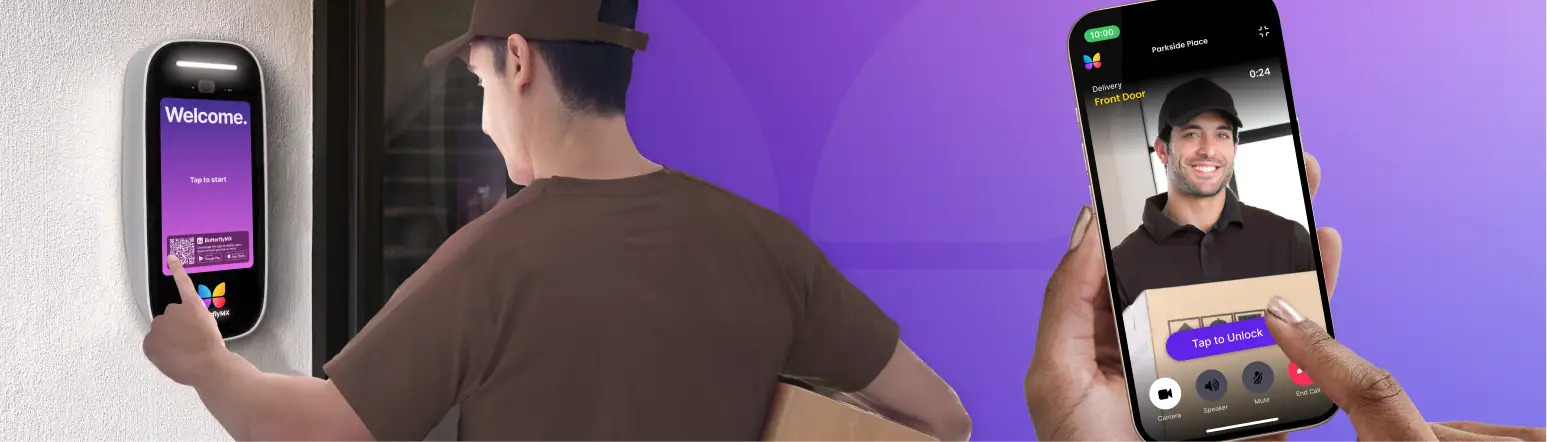
Entrata lists ButterflyMX as an Access Connect partner, making the platforms complementary rather than direct substitutes. Entrata manages property operations, while ButterflyMX can support video intercoms, access control, mobile access, visitor access, and smart lock integrations.
A resident may use Entrata for rent payments and maintenance requests while using access capabilities supplied through compatible ButterflyMX infrastructure. The exact access workflow depends on the products deployed at the property.
Entrata implementation and integrations
Entrata implementation is a professional software rollout that includes data migration, module configuration, testing, and staff training. The platform is cloud-based and requires internet access, but Entrata itself doesn’t require mounting or building wiring.
Implementation effort depends on portfolio size and the number of workflows being moved. A team replacing a long-used PMS may need to clean resident and accounting records, map reports, rebuild permissions, and train users before launch.
Entrata offers an API and integrations for access control, analytics, screening, marketing, and other property technologies. Its listed connections include Access Connect partners as well as analytics and business-intelligence tools.
Independent feedback suggests that migration and configuration deserve close planning. A property-management forum discussion, for example, describes a difficult migration from Yardi. One discussion can’t represent every deployment, but it shows why buyers should request a detailed conversion plan, testing schedule, training plan, and escalation process.
Scope access projects separately. Entrata deployment covers software and resident records, while a connected platform such as ButterflyMX supplies and manages the relevant physical access products.
Entrata pros and cons
Entrata’s main strengths are broad operational coverage, enterprise configuration, and a connected ecosystem. Its biggest tradeoffs are opaque pricing, implementation demands, and reported performance and reporting friction.
Entrata pros
- Centralized property workflows: Leasing, accounting, payments, maintenance, and resident services can live in one platform, reducing routine switching between disconnected systems.
- AI-assisted execution: ELI+ adds agents that can act on selected workflows rather than serving only as recordkeeping tools.
- Extensive configuration: More than 3,000 settings can help large operators apply procedures at the property or corporate level.
- Access-partner choice: Access Connect supports several providers instead of tying Entrata to one hardware brand.
- Enterprise scale: Entrata reported about 2.49 million billed units and 117% net revenue retention, useful context for long-term vendor assessment.
Entrata cons
- Opaque pricing: Buyers can’t compare an official public rate before entering the sales process.
- Potentially high rollout costs: Third-party estimates place complex implementations at $30,000–$75,000 or more before recurring subscription charges.
- Configuration and reporting learning curve: Broad controls can be useful, but teams may need training to create reports and manage bulk changes efficiently.
- Reported performance issues: Some reviewers describe lag, glitches, and occasional reloads, which can matter in high-volume workflows.
- Variable support experiences: Some customers praise support, while others report delays on complex issues.
- Separate access infrastructure required: Physical locks, intercoms, and visitor-entry functions depend on a compatible access provider.
What do Entrata customers say?
Entrata customer reviews are broadly positive, particularly on ease of use and consolidated workflows. Still, some reviewers report glitches, slow performance, reporting complexity, and support delays.
Capterra reports a 4.6 out of 5 rating from 444 reviews. Among reviewers who mentioned technical glitches, 71% described that topic negatively; among those who mentioned speed, 75% reported negative experiences. Those percentages apply only to people who raised each topic, not all Entrata customers.
G2 feedback also often praises Entrata’s all-in-one organization and help resources, while some reviewers mention mobile speed. By contrast, Entrata’s Trustpilot profile shows a lower 3.4 out of 5 score, but its small review volume makes it less representative than larger datasets.
The practical takeaway is that Entrata can earn strong overall satisfaction while still causing real friction for a subset of users. Buyers should test large reports, bulk changes, mobile workflows, and common support scenarios instead of relying on the headline score alone.
Is Entrata a stable long-term vendor?
Entrata’s reported scale, growth, retention, and profitability point to an established enterprise software business. Vendor stability should still be only one part of a broader procurement review.
An analysis of Entrata’s S-1 reports about $509 million in 2025 revenue, roughly 24% annual growth, 2.49 million billed units, and 117% net revenue retention. Entrata also reported a 16% GAAP operating margin for 2025.
Entrata filed a Form S-1 in 2026 seeking a New York Stock Exchange listing under the ticker ENT. The filing itself doesn’t establish the company’s current trading status.
Reuters reported on the filing and Entrata’s Silver Lake backing. Blackstone also invested at a reported $4.3 billion valuation in 2025.
For buyers entering a multi-year contract, these figures offer more useful continuity context than company age alone. Procurement teams should still assess contract protections, data portability, support commitments, product roadmap, and implementation capacity.
Entrata alternatives to consider
Entrata alternatives include AppFolio, Yardi, DoorLoop, Buildium, and RealPage. The right shortlist depends on portfolio scale, accounting needs, implementation capacity, and whether you prefer published or custom pricing.
- AppFolio Property Manager: A frequently cross-shopped PMS with a large unit footprint and a profile that may appeal to operators seeking a different balance of enterprise breadth and usability.
- Yardi Voyager or Yardi Breeze: An established property-management option that often appears in comparison and migration discussions. Voyager generally belongs in enterprise evaluations, while Breeze serves a different buying context.
- DoorLoop: A lower-cost-positioned alternative that emphasizes published pricing, making it relevant for buyers uncomfortable with Entrata’s custom quoting process.
- Buildium Property Management: A commonly listed alternative with published pricing that may help smaller operators compare a simpler purchasing model.
- RealPage: Another major enterprise property management suite for large multifamily operators.
Capterra lists several Entrata alternatives, while financial comparisons of Entrata, AppFolio, and other large vendors add scale context. Compare actual workflows and proposals rather than treating company size as proof of fit.
Entrata vs. ButterflyMX
Entrata and ButterflyMX aren’t direct substitutes. Entrata is a property management and operations platform, while ButterflyMX is a property access and security platform. Entrata’s Access Connect relationship allows the two systems to work in a connected deployment.
Swipe to compare →
The key question isn’t which platform replaces the other. It’s whether Entrata fits the operating model and whether ButterflyMX or another Access Connect provider fits the property’s physical access needs.
Frequently asked questions
How much does Entrata cost?
Entrata provides custom quotes and doesn’t publish standard subscription pricing. A third-party estimate puts the cost at $4–$8 per unit per month, with typical implementation estimated at $5,000–$30,000 and complex rollouts at $30,000–$75,000 or more.
What does Entrata software do?
Entrata manages leasing, accounting, payments, maintenance, renewals, reporting, and resident services. Its newer OXP and ELI+ layers also support AI-assisted execution of selected property workflows.
Is Entrata suitable for small landlords?
Entrata may be more platform than a small landlord needs. Its broad modules, custom sales model, and implementation requirements generally align more closely with larger multi-property operators.
What are the most common Entrata complaints?
Common complaints include occasional glitches, slow performance, reporting complexity, migration difficulty, and inconsistent support response times for complex issues. These concerns appear within otherwise strong overall customer ratings.
Does Entrata have a mobile app?
Yes. Entrata offers resident and staff mobile experiences, with resident functions including payments, maintenance requests, documents, and door unlocking when compatible Access Connect hardware is installed.
Does Entrata integrate with ButterflyMX?
Yes. Entrata lists ButterflyMX as an Access Connect partner for keyless entry tied to property-management records and compatible access infrastructure.
Does Entrata provide access-control hardware?
No. Entrata connects with third-party access providers, while compatible partner systems supply physical locks, intercoms, and related entry infrastructure.
What AI features does Entrata offer?
Entrata’s ELI+ agents support selected leasing, payment, maintenance, and renewal workflows. Entrata also describes human controls and an audit trail for agent actions.
Is Entrata publicly traded?
Entrata filed an S-1 in 2026 seeking a New York Stock Exchange listing under the ticker ENT. The filing alone doesn’t establish its current trading status.
Is Entrata worth considering?
Entrata is worth considering for larger operators that need leasing, accounting, maintenance, resident services, and portfolio workflows in one platform. Its scale, strong overall ratings, broad configuration, and emerging AI-agent layer make it a serious shortlist candidate.
The main tradeoff is complexity. Buyers should be ready for custom pricing, professional implementation, data migration, training, and a close review of reporting and performance needs. They should also assess the mature core PMS separately from the newer ELI+ layer.
Entrata doesn’t replace physical access infrastructure. If a property also needs video intercoms, access control, mobile and visitor access, vehicle access, or smart lock integrations, compare compatible access providers as a separate part of the project.
ButterflyMX works with Entrata through Access Connect and can support those property access and security workflows. Contact ButterflyMX to explore how a connected access platform could fit your property.
Get your free quote!
Fill in the form below, and we'll email you right back.
Want a free quote?
Fill in the form below, and we'll email you right back.
Redirecting you in 5 seconds.