





Key takeaways:
- MRI is a broad real estate operations suite with separate products for property accounting, lease administration, facilities, workplace management, presence management, and AI workflows.
- Core MRI products require custom quotes, while third-party PMX prices conflict at $5,000 and $10,000; OnLocation publishes annual prices from $634 to $3,180.
- MRI is not a native video-intercom or physical access system; it integrates with ButterflyMX and Brivo Access, while OnLocation focuses on visitor, employee, and contractor presence.

Disclaimer: ButterflyMX provides these blog posts to help our customers and potential customers make the right business decisions. Our blog posts are based on the information available to us at the time of writing.
MRI Software is a real estate and facilities software portfolio for organizations that need more than basic property management. It combines accounting, leasing, maintenance, workplace, reporting, visitor-management, and AI tools across separate products.
This MRI Software review explains what those products do, who they fit, what they cost, and what customers say about using them. It also covers implementation, MRI Agora, OnLocation, access integrations, and how MRI building management compares with a dedicated property access platform.
This guide will answer:
- What is MRI Software?
- How does MRI Software work?
- How much does MRI Software cost?
- Implementation, deployment, and training
- MRI Software review ratings and customer feedback
- MRI Software pros and cons
- Who should consider MRI Software?
- MRI Software alternatives
- MRI Software vs. ButterflyMX
- Frequently asked questions
- Final assessment of MRI Software
Watch how ButterflyMX works:
What is MRI Software?
MRI Software is a portfolio of real estate and facilities products. Its products cover property management, multi-entity accounting, lease administration, maintenance, workplace management, people-presence workflows, reporting, and AI-assisted operations.
MRI reports 45,000+ clients in more than 170 countries, with 16.5 million units and 5.5 million leases managed through its products. The company was founded in 1971 and is headquartered in Solon, Ohio, according to its company history.
MRI is privately owned by GI Partners, TA Associates, and Harvest Partners. Industry coverage has discussed a possible sale or public offering near a $10 billion valuation, but that reported exploration does not predict what the owners will do.
MRI Software products at a glance
MRI is a portfolio, not one uniform application. Before buying, map each workflow to a specific product and ask which products, services, and integrations are included in the proposal.
Swipe to compare →
Who is MRI Software designed for?
MRI Software serves property managers, owners, operators, investors, occupiers, facilities teams, and affordable or public housing organizations. Its product range supports commercial, multifamily, mixed-use, retail, industrial, office, and affordable-housing portfolios.
It is likely to fit organizations with complex entities, several property types, or a need to connect accounting, leasing, facilities, and portfolio reporting. A smaller team seeking one narrow workflow may find the product selection and implementation process heavier than necessary.
How does MRI Software work?
MRI Software works as a configurable operations and financial hub assembled from selected products. Teams can use PMX for core property management and accounting, then add ProLease, NETfacilities, ManhattanONE, OnLocation, or Agora as their workflows require.
Property management, accounting, and reporting
MRI Property Management X brings leasing, tenant or resident records, billing, multi-entity ledgers, portfolio reporting, and self-service portals into its core property-management environment. Configurable fields, screens, workflows, and reports let teams adapt the system to their processes.
That flexibility has a tradeoff. Capterra reviews and a detailed MRI Software review analysis praise the accounting depth but describe recurring difficulty with custom reports, exports, and configuration. Teams with advanced reporting needs may need formal training or paid specialist help.
MRI Agora AI capabilities
MRI Agora is the AI layer across the portfolio. It includes natural-language data queries through Ask Agora, workflow and risk monitoring through Agora Intelligence, and agentic automation with human review through Agora Orchestrator.
Agora also supports uses such as automated reconciliation and AI lease abstraction. The suite launched in phases from October 2025 through June 2026, and the cited launch coverage does not name a customer outcome metric or reference deployment. Buyers should ask for product-specific demonstrations, case studies, controls, and measurable results before placing major weight on AI features in a long-term decision.
MRI OnLocation visitor and workforce management
MRI OnLocation manages the presence of visitors, employees, contractors, and lone workers. It supports touchless QR sign-in, screening questions, identity and document capture, sign-in records, and mobile SOS functions.
The published OnLocation plans also set clear annual capacity limits. The Small plan includes up to 3,000 visitor or contractor sign-ins and 30,000 employee sign-ins. The Large plan raises those limits to 20,000 and 200,000, respectively.
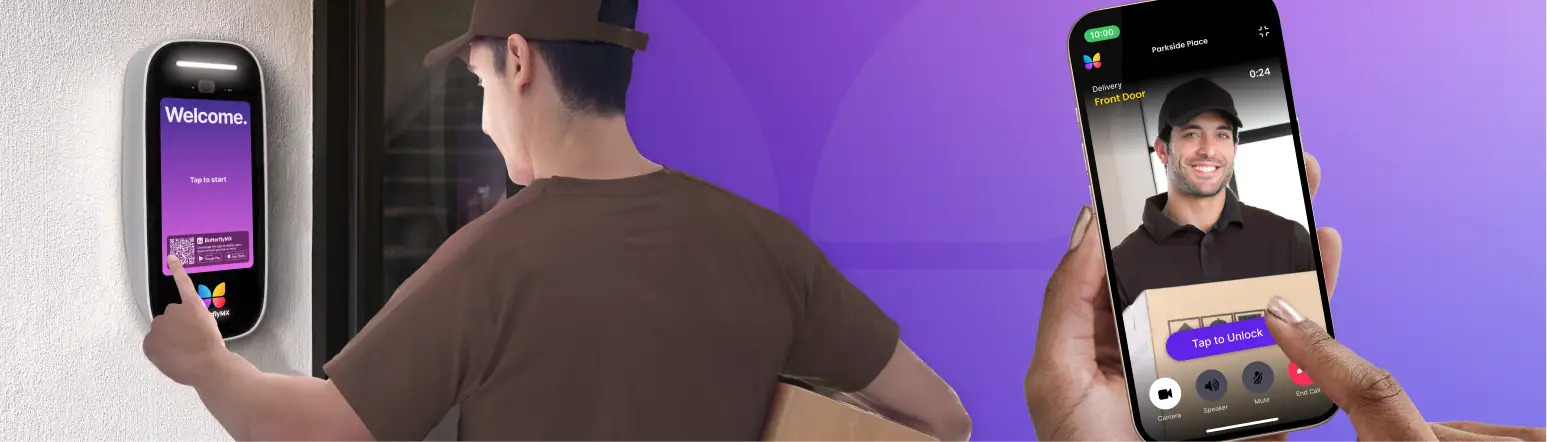
OnLocation is a people-presence product, not a native video intercom or physical door-control system. A property that needs residents to see visitors, speak with them, and grant entry remotely would use a specialist access platform such as ButterflyMX alongside its wider property-management stack.
Integrations and APIs
MRI reports more than 400 integration partners, while MRI Information Exchange is described as offering more than 1,000 unique APIs. The ecosystem can connect MRI with finance, business-intelligence, CRM, and property-access products.
MRI integration listings include ButterflyMX, Brivo Access, and AvidXchange. Power BI is also cited for analytics and reporting. For access-related workflows, MRI can serve as the operational or financial hub while an integrated platform such as ButterflyMX handles video intercom, mobile entry, visitor access, and physical access control.
How much does MRI Software cost?
Most core MRI Software products require a custom quote. Public third-party listings provide only directional starting points: Capterra lists $5,000 for MRI Property Management, while G2 lists $10,000 for its basic product. Because the figures conflict, buyers should not treat either as a complete or official enterprise price.
MRI OnLocation is the clearest exception because MRI publishes monthly and annual prices. ProLease also has a third-party starting figure, but a scope-specific quote is still needed for modules, users, implementation, migration, and services.
Swipe to compare →
OnLocation add-ons are priced separately. Published figures place the OnScan identity-scanning add-on at roughly $159 to $233 per user per year and Desk Booking at about $1,060 to $4,589 per location per year, depending on the selected tier.
Budgeting beyond the base license
Start with the workflows you need rather than one headline license figure. PMX, ProLease, NETfacilities, ManhattanONE, and OnLocation handle different jobs and may involve separate licensing, configuration, data migration, or implementation work.
Ask vendors to separate recurring licenses, one-time implementation, data migration, training, report development, integrations, add-ons, and ongoing professional services. That makes proposals easier to compare and reduces the risk of mistaking a third-party starting price for the likely total cost.
Implementation, deployment, and training
MRI implementation centers on software configuration, data migration, integrations, report setup, and staff training rather than physical hardware installation. Many reviewed deployments went live in under a month, but complex, multi-module projects can take three to 12 months or longer.
G2 implementation feedback shows wide variation. The main timeline drivers are the number of products, portfolio complexity, historical data, custom reports, integrations, and reliance on professional services.
Deployment also varies by product generation. Newer products such as ManhattanONE and Agora are cloud-native, while some legacy MRI products can use private-cloud or on-premises deployment. Confirm the hosting model, upgrade path, browser or client requirements, and support responsibilities for every proposed product.
Training and change-management considerations
Plan for formal training, especially around accounting configuration, report creation, and cross-module workflows. Customer feedback suggests that MRI becomes easier to use once configured, but new users may face a steep learning curve.
A practical rollout plan identifies internal product owners, data owners, report builders, and process leads before configuration starts. Buyers should also clarify which changes staff can make themselves and which require MRI or a consultant.
MRI Software review ratings and customer feedback
MRI Software ratings range from 4.1 to 4.7 out of 5 across major review platforms, but the scores reflect different review populations. G2 and Capterra focus more on product use, while Trustpilot feedback often centers on company support interactions.
Swipe to compare →
Recurring positive themes include responsive support staff, configurability, long-term reliability for property accounting, and deep general-ledger functions. Reviewers also describe the platform as easier to use after workflows are configured and users complete training.
Recurring concerns include difficulty creating or adapting reports, training needs, unclear billing experiences, slow forms, and reported accounts-payable or general-ledger reconciliation issues. These are customer-reported experiences, not universal product behavior, but they are useful topics for a demonstration and reference call.
MRI Software pros and cons
MRI Software offers substantial accounting and portfolio breadth. The tradeoff is quote-based pricing, implementation effort, training, and a product portfolio that may require several licenses.
MRI Software pros
- Deep multi-entity accounting: MRI can support complex entities, ledgers, historical records, tenant billing, and property-level financial workflows.
- Broad product portfolio: Related products cover property management, lease accounting, facilities, workplace operations, presence management, and AI-assisted workflows.
- Configurable processes: Fields, screens, workflows, and reports can be adapted to established business practices.
- Large integration ecosystem: MRI reports 400+ partners and more than 1,000 APIs for connecting specialist systems.
- Coverage across real estate sectors: The portfolio supports commercial, residential, mixed-use, and affordable or public housing use cases.
- Strong recurring support sentiment: Many Trustpilot reviews praise responsive and knowledgeable support representatives.
MRI Software cons
- Opaque enterprise pricing: Core product rates are not publicly listed, and third-party PMX starting prices conflict.
- Reporting friction: Advanced report creation and exports may require training, trial and error, or specialist help.
- Potential costs beyond licensing: Extra modules, configuration, custom reports, migration, and professional services can broaden the purchase.
- Variable implementation effort: Complex multi-module deployments may take three to 12 months or longer.
- Training dependency: New users may need formal instruction before they can work confidently in the system.
- No native video intercom or physical access hardware: MRI relies on integrated specialist platforms for doors, gates, video entry, and related access workflows.
The last limitation does not make MRI a poor property-management platform. It means buyers should treat operational software and physical access as separate layers. ButterflyMX can provide video intercoms, access control, mobile credentials, vehicle access, elevator controls, security cameras, package rooms, and smart lock integrations alongside MRI.
Who should consider MRI Software?
MRI Software may fit larger or more complex organizations that need multi-entity accounting and broad workflows across commercial, residential, mixed-use, or affordable-housing portfolios. It can also suit teams that value configurability and have the internal resources to manage training, reporting, implementation, and vendor coordination.
MRI deserves closer consideration when:
- Your portfolio needs deeper property and lease accounting.
- You want related products for property operations, facilities, workplace management, and reporting.
- Your team can support a structured implementation and change-management project.
- You need a large integration and API ecosystem.
- You are prepared to obtain and compare detailed, scope-specific quotes.
A narrower product may fit better if your main goal is simple property management, a quick rollout, or one specialized workflow. Organizations seeking only video entry, mobile door access, gate control, or resident visitor access should evaluate a dedicated access platform rather than treat MRI OnLocation as a substitute.
MRI Software alternatives
Compare MRI Software alternatives by use case because no single option fits every portfolio. Relevant choices include enterprise property-management platforms, multifamily-focused systems, and facilities-first tools.
- Yardi Voyager: A close enterprise comparison for organizations prioritizing property management and accounting across complex portfolios.
- AppFolio Property Manager: A multifamily-oriented alternative that may appeal to buyers prioritizing adoption and streamlined workflows.
- Entrata: A multifamily-focused platform with leasing and resident workflows.
- Facilio: An operations-first CAFM, CMMS, and EAM option for buyers who prioritize facilities and maintenance over property-accounting depth.
- RealPage OneSite: A multifamily option for buyers comparing property-management and revenue-management functions.
A comparison of MRI alternatives includes AppFolio, Entrata, and RealPage among common shortlist options. Use the same requirements, implementation assumptions, and total-cost categories for every demonstration.
MRI Software vs. ButterflyMX
MRI Software and ButterflyMX address different layers of property operations. MRI centers on property management, accounting, leases, facilities, workplace operations, and AI, while ButterflyMX is a property access and security platform. Because MRI lists ButterflyMX as an integration, the platforms may be complementary rather than direct substitutes.
Swipe to compare →
The practical choice is not always MRI Software versus ButterflyMX. A property may use MRI for financial and operational management while using ButterflyMX for visitor calls, credentials, doors, gates, elevators, and other entry workflows.
Frequently asked questions
What is MRI Software?
MRI Software is a portfolio of real estate and facilities products covering property management, accounting, lease administration, maintenance, workplace operations, people presence, reporting, and AI-assisted workflows.
How much does MRI Software cost?
Core MRI products require custom quotes. Third-party listings place MRI Property Management at starting prices of $5,000 and $10,000, while official OnLocation plans run from $634 to $3,180 per year.
Is MRI Software cloud-based?
Some MRI products are cloud-native, including newer products such as ManhattanONE and Agora, while certain legacy products can use private-cloud or on-premises deployment.
How long does MRI Software implementation take?
Many implementations finish within a month, but a complex rollout involving several modules, integrations, migrations, and custom reports can take three to 12 months or longer.
What AI features does MRI Agora offer?
MRI Agora offers natural-language data queries, workflow monitoring, automated reconciliation, AI lease abstraction, and agentic workflows with human review. The suite is relatively new, so buyers should request product-specific examples and outcome data.
Does MRI Software integrate with ButterflyMX?
Yes. ButterflyMX is listed as a property-access integration for MRI, allowing property operations software and a specialist access platform to serve different parts of the technology stack.
Does MRI Software provide video intercoms or access-control hardware?
No. MRI does not provide native video-intercom or physical access hardware. OnLocation focuses on sign-in and people-presence workflows, while physical entry relies on specialist integrations.
Who owns MRI Software?
MRI Software is owned by private equity firms GI Partners, TA Associates, and Harvest Partners. A possible sale or public offering was reported in 2025, but that does not establish what the owners will ultimately do.
Final assessment of MRI Software
MRI Software may be a strong fit for complex property organizations that need deep accounting, configurable workflows, and a broad portfolio of real estate and facilities products. Its central tradeoff is that this breadth can bring quote-based pricing, multiple product decisions, significant training, and a longer implementation.
Before signing a contract, map every required workflow to a specific MRI product, request an itemized proposal, test reporting with your own scenarios, and confirm implementation responsibilities. Compare MRI with Yardi, AppFolio, Entrata, Facilio, or RealPage based on your property type and operating priorities.
If your technology plan also requires video intercoms, mobile credentials, visitor entry, door or gate access, elevator controls, and related security workflows, evaluate a dedicated property access platform alongside MRI. Explore ButterflyMX to see how those access functions can fit into a broader property technology stack.
Get your free quote!
Fill in the form below, and we'll email you right back.
Want a free quote?
Fill in the form below, and we'll email you right back.
Redirecting you in 5 seconds.