





Key takeaways:
- OSDP is an access control communication standard that connects controllers with readers and other peripherals through two-way communication.
- OSDP can support stronger reader-to-controller security than Wiegand, but Secure Channel must be supported, enabled, and enforced.
- A retrofit can involve native OSDP readers or compatible converters, but credential formats, wiring, power, and remaining Wiegand links need testing.
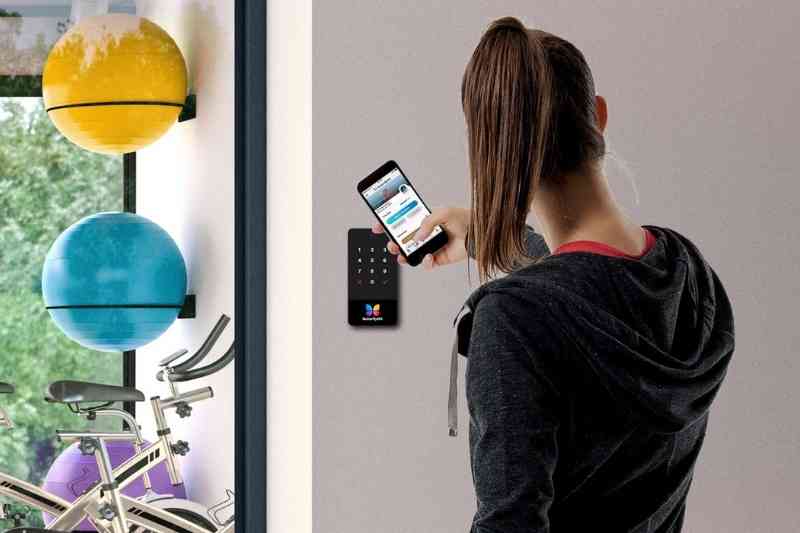
Access control readers are often judged by the credential they accept, such as a card, mobile credential, or PIN. But the connection between the reader and the controller matters just as much. That connection affects whether a system can supervise a reader, report a fault, and, when properly configured, protect communications.
OSDP, short for Open Supervised Device Protocol, is a standard for two-way communication between access control panels and peripherals such as readers. It commonly uses RS-485 and can support supervised operation and AES-128 Secure Channel, but OSDP support alone does not mean that encryption is active or enforced. For property teams planning a physical security upgrade, the practical questions are whether the equipment is compatible, how the wiring will work, and how security will be configured after installation.
This guide will answer:
- What is OSDP and who maintains it
- How OSDP works in access control
- OSDP vs Wiegand
- Is OSDP secure by default
- What OSDP Verified means
- OSDP wiring, topology, and distance
- How to migrate from Wiegand to OSDP
- OSDP for managed properties and ButterflyMX
- FAQs
Watch how ButterflyMX works:
What is OSDP and who maintains it
Open Supervised Device Protocol is an open access control protocol maintained by the Security Industry Association, or SIA. It defines how a controller communicates with readers and other peripherals. The protocol is standardized internationally as IEC 60839-11-5.
OSDP version 1 originated in 2008, and ownership moved to SIA in 2012. SIA released version 2.2.2 in October 2024. SIA listed that version when the research for this article was reviewed on October 29, 2026, but teams should confirm the current release before specifying equipment or publishing technical requirements.
OSDP is not a credential technology. A reader may accept proximity cards, smart cards, mobile credentials, or PINs while using OSDP to communicate with its controller. The same distinction applies to the Wiegand interface: a card format sometimes called Wiegand is not the same thing as the legacy reader-to-controller interface called Wiegand.
How OSDP works in access control
In a typical OSDP installation, an access control panel communicates with addressed readers and other peripherals over an RS-485 connection. RS-485 can use a multi-drop bus, meaning more than one peripheral may share a controller port when the panel, devices, topology, and installation design allow it.
The controller can poll a reader for status, and the reader can report conditions such as a tamper event, malfunction, or loss of communication. Depending on the products and features implemented, the controller may also control reader LEDs and buzzers, send text, or support configuration and firmware-related functions. Those capabilities are valuable because a property team can have more visibility into reader health than it would with a one-way credential-data connection.
A simple way to picture the installation is a controller connected to a shared data bus. The bus has a differential data pair, commonly labeled RS-485 A and B, while the reader also needs power and ground. Shielding and termination depend on the cable and manufacturer instructions. Devices on the bus are addressed individually, and termination is generally placed at the ends of the RS-485 run according to the equipment guidance.
Multiple devices on a shared bus are not a promise that every controller supports the same device count. References to 32 devices describe an RS-485 load concept, not a universal panel capacity. The controller documentation remains the deciding source for device limits and supported features.
OSDP vs Wiegand
The central difference is direction. Wiegand typically sends credential data one way from the reader to the controller. OSDP supports two-way communication, allowing supervision and device control in addition to credential exchange. OSDP can also use Secure Channel encryption, but that benefit depends on compatible equipment and secure configuration.
This comparison describes protocol capabilities, not automatic behavior in every installation. A controller and reader can both advertise OSDP support while differing in the features they implement. Before selecting hardware, confirm the supported OSDP profile, Secure Channel behavior, cable requirements, and commissioning process. For background on the category and the practical distinction from Wiegand, see Axis Communications guidance on choosing OSDP over Wiegand.
Changing the interface also does not automatically change the credential a property uses. A project may retain existing credentials if the selected readers and controller support them, or it may combine an interface upgrade with a broader credential change. Those are separate compatibility decisions.
Is OSDP secure by default
No. OSDP is not necessarily encrypted by default. Its Secure Channel feature uses AES-128, but a product that supports OSDP may not support Secure Channel, may not have it enabled, or may not enforce it. Secure Channel is meaningful only when compatible controllers and peripherals use it correctly and the controller rejects an unencrypted connection where that is required.
Security research presented in 2023 showed why configuration matters. The research described risks involving optional encryption, downgrade behavior, installation mode, weak or hard-coded keys, and replacement-reader key handling. The reported attacks required physical access to reader wiring and did not defeat separate encryption at the smart-card layer. Still, they show why an OSDP label alone is not a security assessment. The Bishop Fox research and SIA guidance following the 2023 findings both emphasize the importance of implementation choices.
A practical OSDP security checklist
- Confirm whether the exact controller and reader models support Secure Channel and whether the controller can enforce it.
- Prefer products on the SIA OSDP Verified Product List when protocol conformance is important.
- Use strong, managed keys and define who can provision or replace readers.
- Disable install mode after commissioning and follow the product process for securely adding replacement devices.
- Protect reader wiring from unauthorized physical access.
- Test tamper, offline, and communication alerts, then define who investigates them.
These practices do not make a deployment risk-free. They help ensure the system uses the protective functions that compatible equipment can provide. Do not assume a later OSDP release resolved the 2023 findings unless current product and security documentation specifically confirms it.
What OSDP Verified means
OSDP support, OSDP compliance, and OSDP Verified are related but different claims. A vendor can say its product supports or complies with OSDP. The OSDP Verified designation is reserved for products that have passed SIA third-party conformance testing. Buyers can review the SIA OSDP Verified program and product list rather than relying only on marketing language.
Verification is a useful procurement signal, but it does not prove that an entire installation is secure. It does not by itself confirm Secure Channel enforcement, key management, protected wiring, or proper commissioning. Ask the installer to identify the verified model, describe the supported OSDP functions, explain how keys are provisioned, confirm when install mode is disabled, and show how alerts will be handled.
OSDP wiring, topology, and distance
OSDP is sometimes described as a two-wire protocol because its RS-485 data link uses two data conductors. That shorthand can be misleading. A reader installation also requires power and ground, and shielding may be specified by the equipment and cable guidance. In practice, installers must plan the entire cable path, not just the data pair.
RS-485 generally works best with suitable twisted-pair cable and a bus topology designed for the controller and reader specifications. Termination of about 120 ohms is commonly used at the appropriate ends of an RS-485 bus, but the panel and reader documentation should control the final design. RS-485 bus termination is not the same as end-of-line supervision used for door contacts.
Distance is also conditional. Up to 4,000 feet is often cited as a best-case RS-485 reference at lower baud rates with suitable cable. It is not a universal OSDP run length. Baud rate, cable quality, topology, electrical noise, controller limits, reader limits, and the number of devices all affect the data connection. Technical cabling guidance for OSDP readers illustrates why cable and termination details matter.
Power can become the limiting factor before data communications do. Voltage drop across a long power run can prevent a reader from operating reliably even if the RS-485 data pair can communicate. A site review should separately calculate power needs and confirm the product-specific cable limit.
For example, the ButterflyMX Wiegand-to-OSDP Converter guide specifies four conductors to the controller and an 800-foot product limit for that converter installation. That is a product-specific requirement, not a general OSDP specification. Always use the current installation documentation for the exact controller, converter, and reader being deployed.
How to migrate from Wiegand to OSDP
A migration starts with an inventory, not a hardware order. Record the controllers, readers, credentials, credential formats, cable types, run lengths, power sources, door conditions, and operational constraints. That inventory reveals whether a site is better suited to reader replacement, conversion, or a phased approach.
- Determine what the controller supports. Confirm available ports, OSDP feature support, panel capacity, and any limits for mixed Wiegand and OSDP deployments.
- Choose a path. Replacing readers with compatible native OSDP equipment can provide the clearest route to a fully OSDP reader-to-controller link. A compatible Wiegand-to-OSDP converter can be useful where retaining existing readers is important.
- Test credentials and formats before rollout. Reader compatibility involves more than the connector. The controller, reader, converter, and credential format must work together. The ButterflyMX converter documentation, for instance, identifies a default 26-bit Wiegand format that requires compatibility testing.
- Validate the physical installation. Check the cable route, power budget, voltage drop, termination, controller limits, and environmental requirements. Do not treat an existing cable as suitable without confirming its condition and electrical requirements.
- Commission securely. Where Secure Channel is supported, confirm that it is enabled and enforced, provision keys safely, disable install mode after commissioning, test alerts, and document which segments remain Wiegand.
Conversion and replacement solve different problems. A converter can preserve an existing Wiegand reader while changing the connection on the controller side, but it may leave a Wiegand segment between the reader and converter. It should not be presented as providing every security benefit of a native OSDP reader. ButterflyMX documents one converter per reader, indoor dry-location use, and connection to its 2-Door Access Controller. Technical teams can review the Wiegand-to-OSDP converter compatibility and installation guide before considering that path.
OSDP for managed properties and ButterflyMX
For a managed property, the best path depends on the operational problem the upgrade is meant to solve. A team may value reader supervision because it wants earlier notice of offline equipment. Another may be focused on retaining credentials during a phased renovation. Others may need to work within existing cable routes, occupied-unit schedules, or a limited capital plan.
A useful vendor conversation should cover the required level of reader supervision, controller and reader compatibility, Verified status where applicable, Secure Channel enforcement, key handling, wiring and power limits, alert response, credential continuity, and the scope of any remaining Wiegand connections. Those questions make it easier to compare a native-reader replacement against a conversion plan without assuming that either is right for every property.
ButterflyMX offers documented OSDP-related product support and a product-specific migration option for compatible Wiegand door or vehicle readers connected to the 2-Door Access Controller. For current product context, see ButterflyMX OSDP support. Product support should not be treated as a claim about Secure Channel enforcement, encryption defaults, key-management behavior, or OSDP Verified status unless current product documentation confirms those details.
If you are evaluating a broader property access control upgrade, discuss the site inventory, reader strategy, and commissioning requirements with ButterflyMX. The goal is not simply to replace a legacy interface. It is to select a system design that matches the property operationally and can be installed, configured, and maintained responsibly.
Frequently asked questions
Can OSDP and Wiegand readers be used during the same upgrade?
They may be used in the same phased upgrade when the controller supports the required interfaces or compatible converters are used. Confirm panel capacity, reader compatibility, credential formats, wiring, and which parts of the system remain Wiegand because mixed-system behavior is product-specific.
Why does an OSDP reader go offline and come back?
An intermittent reader can result from cable quality, topology, termination, baud-rate compatibility, addressing, configuration, power, voltage drop, or equipment issues. Review controller and reader logs and inspect the installation before assigning a single cause.
Does an OSDP bus need termination resistors?
RS-485 installations commonly use termination of about 120 ohms according to manufacturer guidance. The correct placement depends on the bus topology and the equipment instructions, and it is different from door-contact end-of-line supervision.
How are multiple OSDP readers commissioned on one bus?
Each peripheral needs the appropriate address and product-specific commissioning process. Where supported, commissioning should also include secure key provisioning, communication testing, alert testing, and disabling install mode when setup is complete.
Is upgrading to OSDP worth it for an apartment building?
It can be worthwhile when a property needs stronger reader supervision, better device visibility, or a path to securely configured reader communications. The decision should weigh existing equipment and cable, Secure Channel enforcement, credential compatibility, cost, disruption, and whether a converter would retain a Wiegand segment.
OSDP gives access control systems a more capable reader-to-controller connection than traditional Wiegand, including two-way supervision and the potential for encrypted Secure Channel communications. But the protocol name is not a security guarantee. The strongest selection criteria are the exact controller and reader capabilities, Secure Channel enforcement, key and commissioning practices, cabling, power, and the realities of a phased migration.
For managed properties, that evaluation can reveal whether native OSDP readers, a carefully limited conversion project, or a staged replacement is the practical choice. Discuss your property access control upgrade with ButterflyMX after confirming the technical requirements that matter for your site.
Get your free quote!
Fill in the form below, and we'll email you right back.
Want a free quote?
Fill in the form below, and we'll email you right back.
Redirecting you in 5 seconds.