





Key takeaways:
- Start with diagnosis before buying equipment. A stuck button, audio problem, power failure, wiring issue, or door-release fault can call for a different fix.
- Repair makes sense for a localized, serviceable fault. Retrofit or replacement becomes more likely when failures repeat, parts are obsolete, wiring is unsuitable, or the building needs new access features.
- In a small apartment building, cost and disruption depend heavily on controlled entrances, door hardware, wiring condition, system type, and local requirements, not apartment count alone.
When the front-door buzzer stops working in a small apartment building, the pressure to fix it comes fast. Residents may miss visitors and deliveries. Managers may have to handle manual entry. Owners may also need to ask whether the building has a legal duty to keep the intercom working.
The answer is not always to replace the whole buzzer system. If the problem is isolated and parts are still available, apartment buzzer repair may be the right move. If the same system keeps failing, compatible parts are hard to find, wiring is damaged or incompatible, or the building needs video, mobile calls, or remote management, a retrofit or full replacement may be more practical.
This guide is written for 2-to-20-unit properties where budgets are tight, old wiring is common, and resident access has to be protected while work is underway. It explains how to document symptoms safely, compare repair vs. replace intercom options, understand cost drivers, ask about wiring, and plan the next step without guessing.
This guide will answer:
- Start with diagnosis, not equipment
- How an apartment buzzer and door release work
- Repair, retrofit, or replace the system
- What replacement costs in a small building
- Can existing intercom wiring be reused
- Choose the right system type for the property
- Legal requirements and repair responsibility
- Plan installation without disrupting resident access
- FAQs
Watch how ButterflyMX works:
Start with diagnosis, not equipment
Repair a broken apartment intercom when the fault appears localized, compatible parts are available, and the rest of the system still does what the building needs. Consider a retrofit or replacement when service calls keep coming back, parts are no longer supportable, inspected wiring cannot support the desired equipment, or the property needs functions the existing system cannot provide.
That decision starts with safe documentation, not live electrical work. A manager, landlord, board member, or superintendent can record what residents are experiencing before calling an intercom installer. Note whether the issue affects one apartment, one entrance, or the whole building. Write down whether the entry panel rings continuously, whether visitors and residents can hear each other, whether the door release works, and whether the failure is constant or intermittent.
Those notes help a professional separate a likely apartment-station or branch problem from a shared power, control, wiring, or door-hardware issue. They do not confirm the cause. Power supplies, concealed intercom riser wiring, relays, electric strikes, magnetic locks, and other electrified door hardware should be assessed by a qualified access-control or intercom professional.
- Confirm the scope: one unit, one entrance, several units, or the whole property.
- Ask whether the same failure has happened before and whether compatible parts are still available.
- Have a qualified professional inspect the entry panel, power supply, apartment stations, wiring, relay functions, and door hardware.
- List the building’s required functions, including visitor verification, mobile calls, remote administration, and every controlled door.
- Compare total scope, recurring service costs, resident disruption, and local requirements before choosing repair, retrofit, or replacement.
How an apartment buzzer and door release work
An apartment buzzer, also called an intercommunication system, connects a multi-tenant intercom panel at the entrance to apartment stations through power, audio, control equipment, and wiring. When a visitor selects a residence, the system sends a call to that apartment. When the resident grants entry, a control signal tells the door-release hardware to unlock or release the door. For broader background, see this complete guide to apartment buzzer systems.
The transformer or power supply provides low-voltage power. An amplifier or controller manages call and audio functions. Intercom riser wiring carries connections between the entry panel and apartment stations. A relay sends the release command to an electric door strike, magnetic lock, or related door-control component. Because these parts depend on one another, the symptom at the front door may not identify the failed part by itself.
- Continuous buzzing may indicate a stuck button or another entry-panel issue.
- No audio or one-way audio may point to an apartment station, audio path, connection, or shared-equipment fault.
- Static, humming, or intermittent calls may indicate wiring or interference problems.
- A door that does not release may involve a relay, power supply, electric strike, magnetic lock, or the door hardware itself.
- A building-wide outage may indicate a shared power or control problem.
These are useful diagnostic clues, not a do-it-yourself repair map. The number of affected apartments is often more important than the noise itself. One silent apartment may suggest a local station or branch issue, while several failed apartments or a dead entrance panel may point toward shared equipment. A technician still needs to confirm the cause, especially when the problem involves concealed wiring, a controlled entrance, or an egress route.
Repair, retrofit, or replace the system
The choice is easier when the three project scopes are separated. A repair corrects an isolated defect. A retrofit upgrades selected equipment while retaining infrastructure that has been inspected and found compatible. A full replacement changes the core system and any supporting components that cannot stay in service.
Use the table as a screening tool, not as a substitute for diagnosis or a site assessment.
Do not replace a system based on age alone. A reliable legacy audio intercom with one failed station may be worth repairing. On the other hand, repeated service calls, unavailable parts, unreliable resident communication, or a system that cannot support the building’s current access needs can make another repair feel like a short delay rather than a real fix.
For a small apartment building intercom, entrances and controlled doors often matter more than unit count. A 10-unit building with one simple front entrance may be a very different project from a 10-unit building with a main door, rear door, package area, and added lock hardware. Owners who are already leaning toward an upgrade should review common reasons to replace an apartment buzzer, but the technical assessment should still come first.
What replacement costs in a small building
There is no reliable universal price for replacing a small-building intercom. Published vendor-authored planning estimates vary: a ButterflyMX apartment intercom replacement guide cites roughly $1,500 to $2,500, while a 2026 Swiftlane pricing guide cites roughly $2,200 to $5,000 or more for a small single-entrance project. Those figures may be based on different assumptions, so treat them as planning references, not verified transaction data or a quote for your building.
A better budgeting question is what the installer has to touch. Apartment count is part of the picture, but controlled entrances, door hardware, wiring condition, and system type often drive the apartment intercom replacement cost more directly.
- Number of entry panels, controlled doors, and release points
- Audio-only, video, telephone-entry, cellular, or IP and cloud system type
- Condition, compatibility, and accessibility of existing wiring
- Electric strike or magnetic-lock work, door condition, and related hardware
- Labor, pathways, restoration work, network needs, permits, and testing
- Possible recurring software, cellular, network, or telephone-service charges
When you request an intercom installation quote, ask each bidder to price a comparable scope. Share the number of units and entrances, current equipment, known symptoms, wiring history, desired functions, lock hardware, network availability, permit questions, and any recurring fees. Without that detail, two estimates may look comparable while covering very different work.
Can existing intercom wiring be reused
Existing low-voltage intercom wiring can sometimes be reused when it is in suitable condition and compatible with the selected equipment. Reuse may reduce construction scope, apartment access, and wall repair. But it cannot be confirmed from a photo, the age of the building, or the look of a wall station.
Damaged, nonstandard, or incompatible cabling can require new wiring. So can added entrances, new controlled openings, or a replacement system with different infrastructure requirements. In older or converted buildings, undocumented alterations should be treated as something to inspect, not as proof that the wiring is either usable or failed.
During an intercom site assessment, ask the installer to document cable condition, conductor arrangement, continuity, available pathways, power, network availability, apartment endpoints, and every controlled opening. If the plan is to replace only apartment stations, confirm that the new stations work with the retained entry panel, power supply, control equipment, and wiring. A detailed guide to assessing a building before replacing a buzzer intercom can help owners frame those questions.
The wiring decision also affects resident disruption. Keeping compatible wiring may limit construction and scheduling. Rewiring can require more apartment access, pathway work, patching, restoration, and testing. That does not make rewiring wrong; it simply means it should be planned before the budget and timeline are treated as final.
Choose the right system type for the property
A small building does not need the same door entry system as every other property. Match the system type to the building’s budget, wiring, resident needs, administration style, and tolerance for recurring fees.
Audio, video, telephone entry, and IP systems
- Hardwired audio intercoms can be a practical choice when basic voice communication and door release are enough.
- Hardwired or retrofit video systems add visitor verification when the selected equipment and infrastructure support it.
- Telephone-entry or cellular systems use a phone or cellular calling model and should be evaluated with ongoing service costs in mind.
- IP or cloud video intercoms require suitable connectivity and may involve recurring fees, but they can support remote administration and smartphone-based visitor calls.
- Smartphone-overlay or add-on approaches may offer a lower-scope path in some buildings, but their fit depends on retained hardware, wiring, door hardware, connectivity, and desired functions.
Audio vs. video intercom decisions should be based on need, not novelty. If the building only needs dependable voice communication and door release, audio-only may be appropriate. If residents need to see visitors, managers need to update access remotely, or the property wants to move away from telephone-dependent entry equipment, video, mobile access, or an IP cloud video intercom may be worth evaluating.
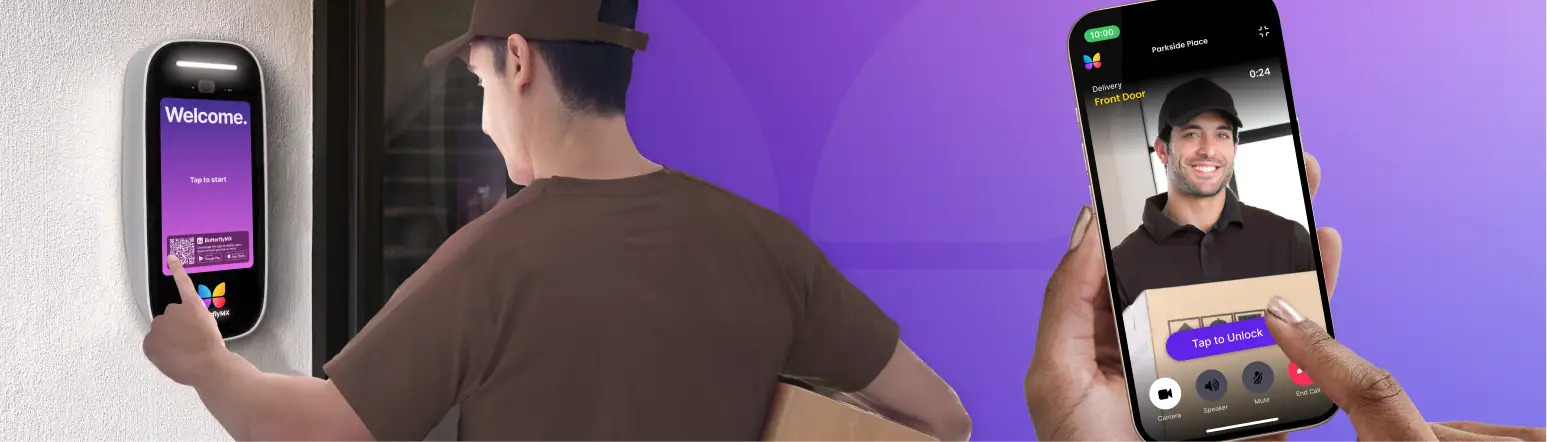
ButterflyMX is one modern video-intercom option for properties where smartphone visitor calls, remote management of residents and access credentials, and replacement of telephone-dependent entry equipment match the building assessment. It does not rely on a traditional POTS telephone line. That does not make it the automatic answer for every small property. A single repair, an audio retrofit, or another system may fit better after the site conditions are reviewed. For add-on options, see this discussion of smart apartment buzzer options.
Legal requirements and repair responsibility
Whether a working intercom is legally required depends on the jurisdiction, building classification, size, construction or conversion date, hardware configuration, and local housing, building, fire, accessibility, and permitting rules. This section is general information, not legal advice.
New York City offers a specific example with defined limits. Under New York State Multiple Dwelling Law Section 50-a, covered Class A multiple dwellings with eight or more units that were built or converted after January 1, 1968 must have two-way voice communication and remote door release at the main entrance. That rule should not be generalized to every NYC apartment building or to buildings outside New York City. Readers who need more local context can review this explanation of NYC intercom law requirements.
Legal coverage is also separate from repair responsibility. The party responsible for fixing a broken apartment intercom may depend on a lease, ownership documents, management agreement, warranty, maintenance rules, or local law. Residents should document the outage and notify the owner, manager, board, or appropriate local process. Owners and boards outside the confirmed NYC example should check with local housing, building, fire, accessibility, and permitting authorities or qualified counsel before assuming a requirement applies.
Plan installation without disrupting resident access
Replacement time and disruption depend on the real scope: entrances, controlled doors, wiring, apartment access, door hardware, commissioning, and resident coordination. A credible installer should inspect the site before promising a universal timeline.
- Document units, entrances, current symptoms, power, wiring, network availability, door and lock hardware, desired capabilities, and local approval questions.
- Ask for a written scope that states wiring assumptions, retained components, exclusions, permit responsibilities, warranty, training, support, recurring fees, and final testing.
- Communicate work dates, affected functions, and an approved temporary entry process before work begins.
- Phase work where practical, preserve required egress, and coordinate life-safety questions with qualified professionals and local authorities.
- Test every apartment call path, door-release function, directory entry, and managed opening before handoff.
Door hardware deserves careful review because it affects both access and egress. An electric strike normally works with a door latch and releases the keeper. A magnetic lock holds the door with electromagnetic force. In plain language, fail-safe behavior usually means the lock releases when power is lost, while fail-secure behavior usually means the door remains secured from the outside during power loss. The correct configuration, power-loss behavior, and permitted use depend on the full opening and local rules, so do not select, alter, or temporarily bypass electrified locking hardware without qualified access-control and code review.
After installation, assign responsibility for panel and directory updates, resident records, routine testing, power-supply checks, software administration where applicable, and support escalation. A simple maintenance plan can keep a minor issue from turning into another building-wide access problem. If video intercom and mobile access fit the assessed needs, request a building-specific assessment rather than relying on a generic price range.
Frequently asked questions
Can only the apartment stations be replaced?
Yes, station-only replacement may be possible, but only when the new stations are compatible with the retained entry panel, power supply, control equipment, and wiring. Similar-looking stations or connectors do not prove compatibility, so verify the model and wiring during a professional assessment.
Can an old buzzer be made smart without a full replacement?
Sometimes, an add-on or smartphone-overlay approach can make an older buzzer more convenient without replacing every component. Its suitability depends on the existing system, wiring, door hardware, connectivity, and the functions the property needs.
What is the difference between an electric strike and a magnetic lock?
An electric strike works with a door latch and releases the keeper, while a magnetic lock holds a door with electromagnetism. Their power-loss behavior, egress requirements, and permitted use depend on the opening and local rules, so a qualified installer and code professional should review the configuration.
What information should an owner gather before requesting a quote?
Gather the unit count, controlled entrances, current equipment, symptoms by unit, known wiring information, lock hardware, network availability, desired features, relevant photos, permit questions, and recurring-fee questions. This prepares an installer for an on-site assessment; it is not a remote diagnosis.
A broken buzzer does not automatically mean the whole system has to go. The best decision starts with diagnosis, then weighs the fault scope, parts availability, wiring condition, controlled entrances, resident needs, project cost, and local requirements. If that assessment points toward video visitor calls, mobile access, remote management, or a move away from telephone-dependent entry equipment, ButterflyMX may be worth evaluating alongside other suitable options. Discuss your building, entrances, wiring, and access goals with ButterflyMX to determine the right scope.
Get your free quote!
Fill in the form below, and we'll email you right back.
Want a free quote?
Fill in the form below, and we'll email you right back.
You’ll be redirected shortly...