






Key takeaways:
- A working video call does not prove the door can unlock. Your proposal needs to identify the lock, release interface and source of lock power.
- Existing locks, controllers and cabling may be worth retaining, but their suitability and the entrance’s exit requirements need professional confirmation.
- Compare installation quotes only after each identifies retained equipment, new hardware, labor, recurring charges and unresolved work.
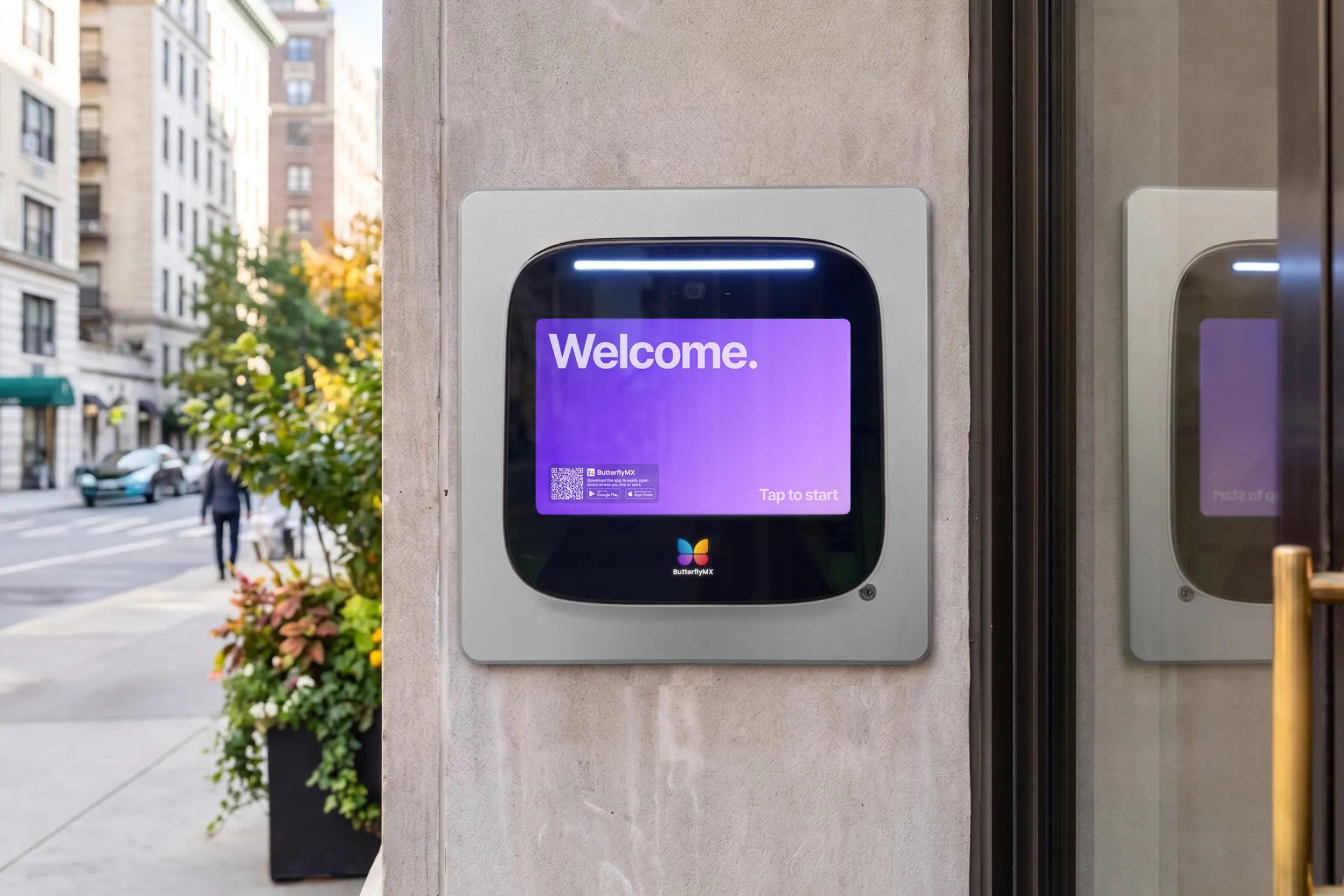
A video intercom with door release lets a resident or staff member see and speak with a visitor, then authorize the entrance lock to release. A relay or controller switches the lock circuit to carry out that request. The feature depends on a compatible lock, control interface and power arrangement, so a clear video call alone does not prove that the entrance will unlock.
If you’re approving an apartment intercom replacement, start with the entrance rather than the screen. Your installer needs to establish which locks, access-control equipment and cables can remain, how release power will be supplied, and which exit, fire-door and accessibility conditions affect the design. Then you can choose answering options, compare the full installation scope and agree on evidence that the finished entrance works. The assessment record below brings those decisions together before you approve an equipment order.
This guide will answer:
- How a video intercom with door release unlocks an entrance
- Confirm what switches the lock and what supplies its power
- Assess whether existing locks and access control can remain
- Resolve exit, fire-door and accessibility conditions before approval
- Choose cabling and answering options around the entrance
- Compare intercom proposals with one entrance assessment record
- Require documented operation before accepting the installation
- FAQs
Watch how ButterflyMX works:
How a video intercom with door release unlocks an entrance
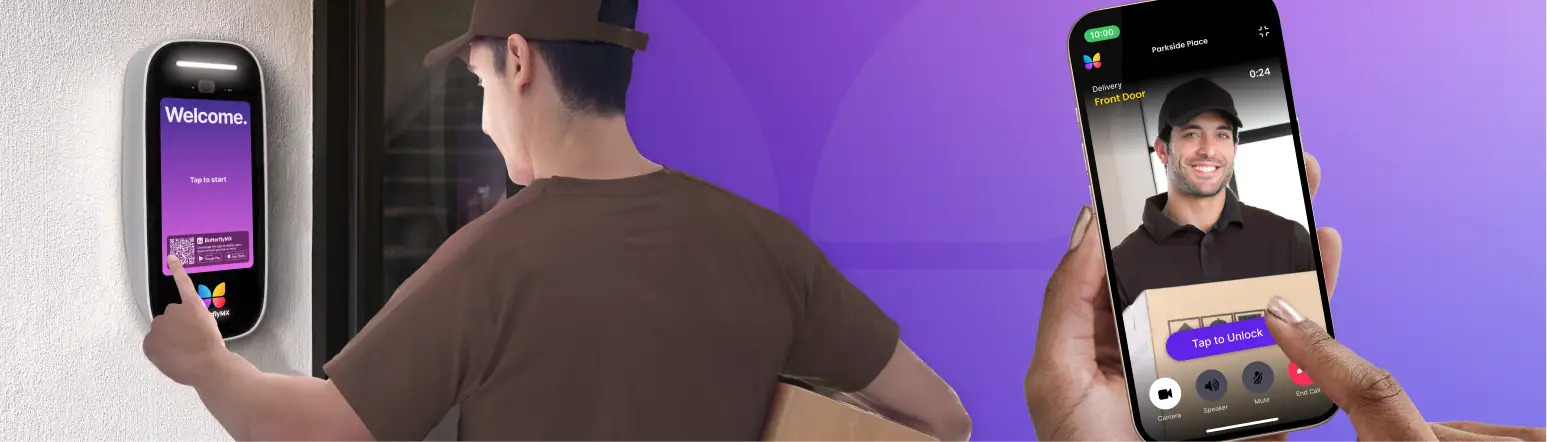
Door release connects a visitor conversation to a separate lock-control function. In Avigilon’s explanation of video intercom operation, the answering person verifies the visitor and authorizes access, while a relay or connected controller handles the release mechanism. Depending on the installation, that mechanism activates or interrupts power to the lock. The general sequence is:
- The visitor calls from the entrance station.
- The resident or staff answering device receives audio and video.
- The answering person verifies the visitor and authorizes a remote unlock.
- A relay or connected controller switches the lock circuit as the installation requires.
- The compatible locking mechanism releases.
These steps explain why communication and release need separate confirmation. A successful call shows that the visitor and resident can communicate, but it does not establish that the authorization reaches a suitable, powered lock. Nor does releasing the lock mean the door automatically swings open; a separate door operator would need its own documented capability. Treat labels such as video door entry system as category descriptions, not proof that a package includes every part of the release arrangement.
Confirm what switches the lock and what supplies its power
Switching a circuit is not the same as powering a lock
The release interface and the lock power supply answer two different questions. The interface determines how an unlock command switches the circuit; the supply provides the electrical energy the lock needs. A relay, including a dry-contact interface, acts as a switch rather than proof of a suitable powered lock output. Avigilon’s relay-based description explains the switching role, but your proposed equipment documentation must establish the actual power arrangement.
This distinction matters when a proposal simply says “door release included.” That wording may identify a control feature without explaining what powers your electric strike or other lock hardware. Likewise, PoE, an unlock button or a relay label should not be treated as evidence of lock-power capacity. Ask for the switching interface and power source to be identified separately so you can see whether the release path has been addressed.
Release power depends on the exact configuration
Whether an intercom supply can power the release depends on the equipment and configuration. The legacy, audio-only Aiphone TA-K instructions illustrate this distinction: the specified supply provides communication and release power, while a particular retrofit into an older system calls for a separate transformer. That example is not a wiring or supply recommendation for a modern video intercom. Its useful lesson is that the answer comes from the exact configuration, not the words “door release.”
Have your qualified installer document the lock model, required voltage, AC or DC power type, current requirements, switching-contact rating and proposed power source. The contact rating describes the electrical load the switching contacts can handle; it is a different check from whether the supply suits the lock. These are details for the installer to confirm against the selected equipment documentation, not measurements or calculations for you to perform. If the proposal leaves the lock’s power arrangement unspecified, its release capability at your entrance remains unconfirmed.
Assess whether existing locks and access control can remain
A replacement intercom does not automatically settle whether the entrance hardware should stay or go. Ask a qualified installer or door-hardware professional to assess the door, frame, latch, closer, existing electrified hardware and fire-door status together. If you already have an electrified lockset, request a model-specific suitability assessment rather than assuming it must be replaced. That gives you a basis for discussing retained equipment before new hardware is added to the quote.
Electric strikes and magnetic locks behave differently
An electric strike controls the latch at the door frame and can be available in either fail-safe or fail-secure form. Allegion’s codes manager defines fail-safe and fail-secure as unlocked and locked, respectively, when power is removed. Those terms describe the secure side, usually the outside of the entrance. They do not, by themselves, explain how someone leaves from inside.
With ordinary compatible lockset or panic hardware, the inside lever or push bar can allow exit independently of the strike’s fail mode. Allegion notes an exception for double-cylinder institutional locks, which is one reason the actual hardware combination matters. A fail-secure strike therefore should not be read as meaning that residents cannot leave during a power outage. Your installer still needs to confirm the inside exit operation of the complete opening.
A magnetic lock creates a different release-design question. In the same explanation, Allegion describes magnetic locks as fail-safe and as not providing free egress, or exit from inside, by themselves. Appropriate release devices and an assessed release arrangement therefore belong in the proposed scope. Neither a strike nor a maglock is universally preferable: the choice must account for both secure-side power-loss behavior and acceptable inside exit operation.
An existing access controller changes the integration question
If access control already operates the entrance, the proposal should explain how the intercom will work with it. Distinguish an intercom that releases the lock directly from one that requests release through the existing controller. Participants in a partly public 2017–2018 IPVM practitioner discussion raised event logging, forced-door alarms, schedules and lockdown behavior as integration concerns. Those observations provide useful questions for your integrator, not manufacturer-approved wiring instructions or promised results.
Have the proposal state whether an intercom release will be recorded, how door alarms will be handled, and how schedules or lockdown settings affect it. These details matter if you expect the replacement to preserve the way the entrance is managed today. Where suitable electrified hardware and controllers already exist, assess retention and integration; where compatibility is undocumented, resolve it before treating a kit as the answer. Retention is an option to evaluate, not a guarantee that every component can stay or that the project will cost less.
Resolve exit, fire-door and accessibility conditions before approval
Entry authorization does not settle exit operation
Working remote unlock from outside does not establish an acceptable way to leave from inside. A July 9, 2021 NFPA staff explanation of egress-door locking describes the general principle that exit operation cannot require a key, tool or special knowledge or effort. It also describes permitted arrangements that depend on occupancy and door location. Your entrance needs review under the rules that actually apply to it, not approval based on the unlock feature alone.
Your role is to obtain that review, rather than interpret the code yourself. The NFPA post expressly says it is not an official NFPA position, and its general explanation does not replace the controlling requirements. Ask the qualified door-hardware or life-safety professional to identify the applicable rules and any review needed from the authority having jurisdiction, such as the relevant local code authority. Keep an unresolved exit arrangement visible as an approval blocker.
Fire-rated openings need an appropriate hardware assessment
A fire-rated door adds a latching question that a release button cannot answer. Allegion’s codes manager explains that fire-rated openings using electric strikes require fail-secure strikes to preserve required positive latching and listings. This is attributed code commentary, and local applicability depends on adopted rules and the opening’s conditions. A fail-secure label alone is not sufficient approval of a particular strike or installation.
Have the proposed hardware and latching reviewed for the specific fire-rated opening. The proposal should identify who confirms that suitability and whether an authority review is needed. Until that confirmation is documented, neither keeping the existing hardware nor buying a replacement resolves the fire-door question.
Video alone does not establish accessible communication
Accessible entry communication involves more than providing a camera. The U.S. Access Board’s ADA guide says two-way communication systems provided for entry must include visual and audible signals within the applicable ADA scope. Its guidance includes systems at inaccessible entrances, while controls and other operable parts at accessible entrances have additional obligations. A video display alone therefore does not establish compliance.
Ask your accessibility reviewer to confirm the signaling and operating requirements that apply to your entrance. ADA guidance does not settle every multifamily housing obligation; separate housing, state or local requirements may also need review. Record the responsible reviewer and any unresolved conditions alongside the exit and fire-door findings. Your approval should rely on those professional confirmations, not on a general accessibility claim in a product description.
Choose cabling and answering options around the entrance
Existing cable must suit the selected equipment
Entrance cabling and resident answering describe different parts of the system. An IP intercom uses a data network, while PoE means power over Ethernet; supported 2-wire and 4-wire product families offer other wiring arrangements. Hikvision describes these families, positions its own 2-wire intercom products for legacy-wire retrofit, and describes IP equipment powered by a separate supply or PoE. Those manufacturer-level options do not confirm that your existing cable is reusable or that a selected model powers the lock.
Have your installer document cable suitability for the exact equipment, the entrance’s connection and power provision, and any new wiring required. Separately, specify whether residents need mobile answering, in-unit stations or a supported combination. App or cloud delivery is not a substitute for documenting the entrance infrastructure. Keeping these decisions separate lets you assess resident needs without assuming that an answering feature resolves the wiring work.
Wireless answering does not mean a wire-free release
“Wireless” can describe a communication link or the way residents answer, rather than the entire entrance. Avigilon distinguishes network and wireless arrangements, while Swiftlane describes hybrid systems with wired entrances and smartphone answering. An entrance may therefore still have wired networking, power and a wired lock circuit even when residents use their phones. Identify which connection is wireless before drawing conclusions about installation scope.
If wireless answering is important to your project, keep that requirement separate from the release-power and cable assessment. The proposal should identify the supported communication arrangement rather than rely on a broad wireless label. For more on that narrower choice, see our guide to a wireless video intercom with door release.
Compare intercom proposals with one entrance assessment record
Record what stays, what changes and what remains unresolved
Use one assessment record per entrance and have each quoting installer complete the same fields. A retained component should be one whose suitability is confirmed, while a proposed addition should be clearly identified as new work. Anything still awaiting a documentation check or professional decision belongs under unresolved, not assumed included. The record below is a procurement aid, not an engineered design, compliance certificate or technical test procedure.
Swipe to compare →
The earlier explanations establish why these fields matter, but they do not supply your entrance’s actual findings. Leave component values and approvals unfilled until the responsible professional provides them, and identify who must close each gap. Missing compatibility or approval information should pause purchase approval; missing scope information means proposal totals are not yet comparable. Ask your installer to complete an entrance assessment before you approve the equipment order.
A door-release kit is not a complete project scope
A kit title can describe a capability without identifying all the work your entrance needs. As a dated example, the BEC Integrated Solutions listing for the Aiphone GT-1C7-9 recorded on November 6, 2026 lists entrance modules, bus control units, nine tenant stations and an intercom supply. Its component list names no electric strike, maglock or dedicated lock supply, and the page lists no installation labor or recurring fee. Those omissions call for confirmation; they do not prove that every omitted item must be purchased, that installation is included or that ongoing service is free.
Apply that distinction when comparing your installation quotes. If one proposal identifies only intercom equipment while another also addresses retained locks, release power, wiring, labor and commissioning, they have not answered the same scope questions. Have each provider mark items as included, excluded, retained or unresolved, and explicitly state any recurring charges and what they cover. Only then can you judge whether a lower total is a lower price for equivalent work.
Require documented operation before accepting the installation
A working picture and answer button are not enough evidence that the replacement entrance has been delivered as specified. As the general call-to-release sequence shows, communication, authorization, switching and physical release are distinct links. A successful call neither proves the lock releases nor identifies the cause if it does not. Agree on installer-owned acceptance documentation while the proposal is still being discussed.
Request documentation of normal operation and outage behavior as separate deliverables. A lock’s fail mode describes its secure-side response to loss of power, not what every communication or control function does during an outage. The proposed configuration’s documentation should identify which functions remain available during internet loss and power loss, including any specified backup provisions. Ask the installer to provide:
- Documented call, answer, authorized release and subsequent door re-securing for the delivered opening.
- Separate descriptions of supported behavior during internet loss and power loss.
- Named responsibilities for verification, unresolved issues and the final handover.
These requests define evidence you want at acceptance, not a procedure for testing electrical or safety devices yourself. Leave fault-finding, measurements and safety-device tests to qualified personnel using the applicable equipment documentation. Your decision is whether the promised operation and remaining responsibilities have been documented clearly enough to accept the work.
Frequently asked questions
Does a door-release button automatically swing the door open?
No. Door release authorizes the locking mechanism to release; it does not establish that an automatic door operator is included. If your entrance needs powered opening as well as unlocking, have that separate capability documented in the proposed configuration.
Does fail-secure mean residents cannot leave during a power outage?
Not by itself. Fail-secure describes the secure side when power is removed, and ordinary compatible lockset or panic hardware can permit exit independently of an electric strike’s fail mode. Exceptional institutional hardware exists, so the complete opening still needs professional assessment.
Are communication signals needed at an inaccessible entrance too?
Within its applicable ADA scope, the U.S. Access Board guide includes inaccessible entrances equipped with two-way entry communication in its visual-and-audible-signal guidance. Accessible entrances also have obligations for controls and other operable parts. Have the applicable requirements confirmed rather than treating entrance accessibility as an exemption from signaling requirements.
Does a kit listing with no recurring fee mean there is no ongoing charge?
No. Silence in a listing does not establish a zero fee, as the dated Aiphone kit example illustrates. Obtain an explicit statement of ongoing service charges and inclusions for your proposed configuration; one listing does not establish whether other systems require or avoid recurring fees.
Approve a documented entrance solution, not just a video-and-unlock feature. Have your installer identify what can stay, what must be added and who will resolve each remaining compatibility or approval issue. Once that record is complete, you can compare equivalent installation scopes and make documented operation part of the agreement.
Get your free quote!
Fill in the form below, and we'll email you right back.
Want a free quote?
Fill in the form below, and we'll email you right back.
Redirecting you in 5 seconds.